New Cave Art Discovery Suggests “Bedrock” Was a Real Neolithic Community
— And Yes, Archaeologists Say Barney Rubble Was Definitely There
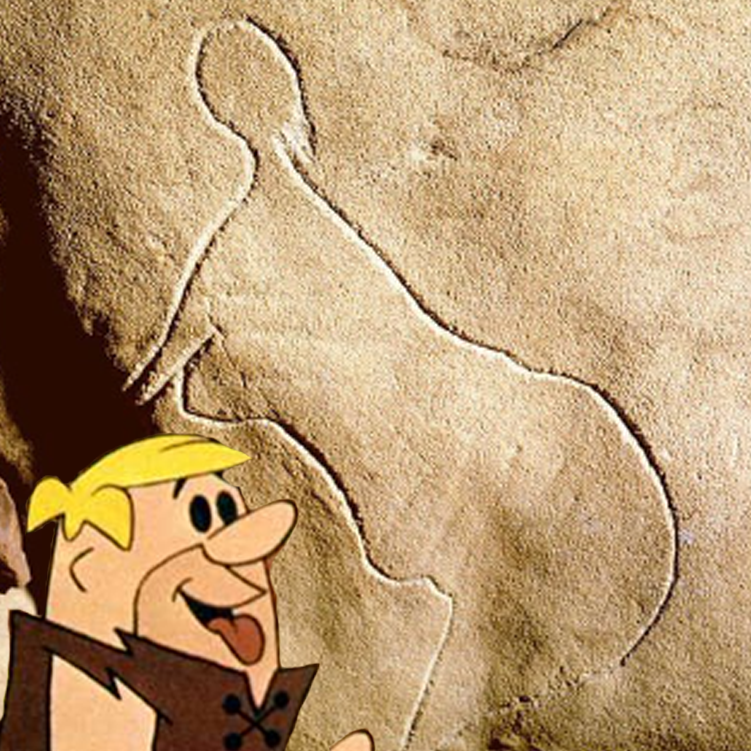
In what can only be described as the greatest day in the history of both archaeology and cartoon anthropology, researchers working in the Grotte de Cussac in Aquitaine, France, have announced a surprising new find:
a 25,000-year-old cave painting of a woman that appears, according to experts, to depict cultural traits strongly associated with the prehistoric community known as Bedrock.
Yes, that Bedrock.
The charcoal outlines, stylistic flourishes, and unmistakable posture of the subject match previously documented Bedrock-era depictions — particularly those from the Upper Yabba-Dabba period (approx. 30,000–20,000 BCE), when artistic expression flourished alongside early domesticated dinosaurs and experimental foot-powered household appliances.
But that’s not the headline.
The headline came during the site’s preliminary genetic analysis.
DNA Evidence on Site Confirms Presence of One “B. Rubble”
While studying surface residues near the painting’s sheltered alcove, researchers recovered what one lab assistant described as “a shockingly enthusiastic amount” of ancient DNA.
Cross-referencing the genomic markers with known prehistoric lineages revealed something remarkable:
A perfect match for an early human male widely hypothesized in popular culture —
Barney Rubble.
Lead geneticist Dr. Valérie Montaigne confirmed the result during a press briefing:
“We double-checked for contamination, handling errors, and hoaxes.
Unfortunately — or fortunately — the data is clear.
The profile aligns with a short-statured, highly social hominin exhibiting traits consistent with the man fans know as Barney Rubble.”
This suggests that Rubble, previously believed to be a fictional neighbor invented for television audiences, was in fact a real Paleolithic individual whose community interactions extended well beyond simple quarry work and bowling leagues.
The research team emphasized that the DNA was found near the painting, not on it, which rules out any inappropriate fanfiction interpretations and instead supports the theory that:
Barney was simply present, extremely excited about the art, and possibly saying something like, “Heh-heh-heh — will ya look at that, Fred?”
Implications for Prehistoric Anthropology (and Saturday Morning Television)
If verified by peer review, this discovery would mean:
- Bedrock was not merely an animated cultural construct but a genuine prehistoric society.
- Hanna-Barbera may have accidentally created one of the most accurate portrayals of Paleolithic suburbia ever broadcast.
- The Flintstone–Rubble friendship could represent the earliest known sitcom-adjacent social pairing in human history.
- Archaeologists must now consider the possibility that other characters — including but not limited to Fred Flintstone, Wilma Flintstone, Betty Rubble, and possibly a baby named Bamm-Bamm — also left physical traces in Upper Paleolithic Europe.
Dr. Montaigne declined to speculate but did say the team is “keeping an eye out for small hammer-shaped impressions in the sediment.”
What Comes Next
The Grotte de Cussac researchers plan to continue their excavations through the winter, hoping to uncover additional artifacts associated with known Bedrock material culture, such as:
- Foot-powered stone vehicles
- Animal-powered record players
- Inexplicably modern bowling balls
- A pterodactyl with a union complaint
For now, however, the biggest scientific news remains:
A cave painting of a woman.
25,000 years old.
And unmistakable genetic proof that Barney Rubble himself was standing nearby, in awe, nodding approvingly.
Science has never felt so Yabba-Dabba-Doo-lightful.
New Cave Art Discovery Suggests “Bedrock” Was a Real Neolithic Community
— And Yes, Archaeologists Say Barney Rubble Was Definitely There
In what can only be described as the greatest day in the history of both archaeology and cartoon anthropology, researchers working in the Grotte de Cussac in Aquitaine, France, have announced a surprising new find:
a 25,000-year-old cave painting of a woman that appears, according to experts, to depict cultural traits strongly associated with the prehistoric community known as Bedrock.
Yes, that Bedrock.
The charcoal outlines, stylistic flourishes, and unmistakable posture of the subject match previously documented Bedrock-era depictions — particularly those from the Upper Yabba-Dabba period (approx. 30,000–20,000 BCE), when artistic expression flourished alongside early domesticated dinosaurs and experimental foot-powered household appliances.
But that’s not the headline.
The headline came during the site’s preliminary genetic analysis.
DNA Evidence on Site Confirms Presence of One “B. Rubble”
While studying surface residues near the painting’s sheltered alcove, researchers recovered what one lab assistant described as “a shockingly enthusiastic amount” of ancient DNA.
Cross-referencing the genomic markers with known prehistoric lineages revealed something remarkable:
A perfect match for an early human male widely hypothesized in popular culture —
Barney Rubble.
Lead geneticist Dr. Valérie Montaigne confirmed the result during a press briefing:
“We double-checked for contamination, handling errors, and hoaxes.
Unfortunately — or fortunately — the data is clear.
The profile aligns with a short-statured, highly social hominin exhibiting traits consistent with the man fans know as Barney Rubble.”
This suggests that Rubble, previously believed to be a fictional neighbor invented for television audiences, was in fact a real Paleolithic individual whose community interactions extended well beyond simple quarry work and bowling leagues.
The research team emphasized that the DNA was found near the painting, not on it, which rules out any inappropriate fanfiction interpretations and instead supports the theory that:
Barney was simply present, extremely excited about the art, and possibly saying something like, “Heh-heh-heh — will ya look at that, Fred?”
Implications for Prehistoric Anthropology (and Saturday Morning Television)
If verified by peer review, this discovery would mean:
- Bedrock was not merely an animated cultural construct but a genuine prehistoric society.
- Hanna-Barbera may have accidentally created one of the most accurate portrayals of Paleolithic suburbia ever broadcast.
- The Flintstone–Rubble friendship could represent the earliest known sitcom-adjacent social pairing in human history.
- Archaeologists must now consider the possibility that other characters — including but not limited to Fred Flintstone, Wilma Flintstone, Betty Rubble, and possibly a baby named Bamm-Bamm — also left physical traces in Upper Paleolithic Europe.
Dr. Montaigne declined to speculate but did say the team is “keeping an eye out for small hammer-shaped impressions in the sediment.”
What Comes Next
The Grotte de Cussac researchers plan to continue their excavations through the winter, hoping to uncover additional artifacts associated with known Bedrock material culture, such as:
- Foot-powered stone vehicles
- Animal-powered record players
- Inexplicably modern bowling balls
- A pterodactyl with a union complaint
For now, however, the biggest scientific news remains:
A cave painting of a woman.
25,000 years old.
And unmistakable genetic proof that Barney Rubble himself was standing nearby, in awe, nodding approvingly.
Science has never felt so Yabba-Dabba-Doo-lightful.
New Cave Art Discovery Suggests “Bedrock” Was a Real Neolithic Community
— And Yes, Archaeologists Say Barney Rubble Was Definitely There
In what can only be described as the greatest day in the history of both archaeology and cartoon anthropology, researchers working in the Grotte de Cussac in Aquitaine, France, have announced a surprising new find:
a 25,000-year-old cave painting of a woman that appears, according to experts, to depict cultural traits strongly associated with the prehistoric community known as Bedrock.
Yes, that Bedrock.
The charcoal outlines, stylistic flourishes, and unmistakable posture of the subject match previously documented Bedrock-era depictions — particularly those from the Upper Yabba-Dabba period (approx. 30,000–20,000 BCE), when artistic expression flourished alongside early domesticated dinosaurs and experimental foot-powered household appliances.
But that’s not the headline.
The headline came during the site’s preliminary genetic analysis.
DNA Evidence on Site Confirms Presence of One “B. Rubble”
While studying surface residues near the painting’s sheltered alcove, researchers recovered what one lab assistant described as “a shockingly enthusiastic amount” of ancient DNA.
Cross-referencing the genomic markers with known prehistoric lineages revealed something remarkable:
A perfect match for an early human male widely hypothesized in popular culture —
Barney Rubble.
Lead geneticist Dr. Valérie Montaigne confirmed the result during a press briefing:
“We double-checked for contamination, handling errors, and hoaxes.
Unfortunately — or fortunately — the data is clear.
The profile aligns with a short-statured, highly social hominin exhibiting traits consistent with the man fans know as Barney Rubble.”
This suggests that Rubble, previously believed to be a fictional neighbor invented for television audiences, was in fact a real Paleolithic individual whose community interactions extended well beyond simple quarry work and bowling leagues.
The research team emphasized that the DNA was found near the painting, not on it, which rules out any inappropriate fanfiction interpretations and instead supports the theory that:
Barney was simply present, extremely excited about the art, and possibly saying something like, “Heh-heh-heh — will ya look at that, Fred?”
Implications for Prehistoric Anthropology (and Saturday Morning Television)
If verified by peer review, this discovery would mean:
- Bedrock was not merely an animated cultural construct but a genuine prehistoric society.
- Hanna-Barbera may have accidentally created one of the most accurate portrayals of Paleolithic suburbia ever broadcast.
- The Flintstone–Rubble friendship could represent the earliest known sitcom-adjacent social pairing in human history.
- Archaeologists must now consider the possibility that other characters — including but not limited to Fred Flintstone, Wilma Flintstone, Betty Rubble, and possibly a baby named Bamm-Bamm — also left physical traces in Upper Paleolithic Europe.
Dr. Montaigne declined to speculate but did say the team is “keeping an eye out for small hammer-shaped impressions in the sediment.”
What Comes Next
The Grotte de Cussac researchers plan to continue their excavations through the winter, hoping to uncover additional artifacts associated with known Bedrock material culture, such as:
- Foot-powered stone vehicles
- Animal-powered record players
- Inexplicably modern bowling balls
- A pterodactyl with a union complaint
For now, however, the biggest scientific news remains:
A cave painting of a woman.
25,000 years old.
And unmistakable genetic proof that Barney Rubble himself was standing nearby, in awe, nodding approvingly.
Science has never felt so Yabba-Dabba-Doo-lightful.