Name’s Phil Wright.
Mister Wright, if you’re on the clock.
I once had a young fella on a jobsite who worked like his life depended on it. Strong kid. Quick hands. Never late. Never stopped moving. You could tell he wanted it bad — respect, recognition, maybe a little room to breathe in a world that don’t hand much out.
But he had a chip on his shoulder.
Not the loud kind. The quiet kind. The kind that shows up when you don’t like seeing people defer to someone else. Especially someone who doesn’t look like they’re working as hard as you are.
And I’ll admit it — from the outside, it probably looked that way.
That week, I spent half my time talking. With foremen. With stewards. With the safety guy. With management. Sometimes with nobody at all — just standing, watching the flow of the work.
Meanwhile, that kid was hauling, lifting, hustling. Burning himself down by noon every day.
One afternoon he finally said it. Didn’t raise his voice. Didn’t curse. Just said:
“Mr. Wright, no disrespect, but I don’t get how you’re always getting thanked when you’re not doing half the work.”
I smiled. Not because he was wrong — but because he was ready to learn.
I told him, “You’re right. I’m not doing half the visible work. But you’re paying for it in your back.”
Next morning, I told him to stick with me all week.
Not to slow down.
Not to slack off.
Just to watch.
We walked the site before anyone started. I showed him how I read a job before touching a tool. Where the bottlenecks were. Where people crossed paths too often. Where effort was being wasted.
I showed him how I planned moves so I only lifted once what others lifted three times. How I talked to the right person before a problem became heavy labor. How a five-minute conversation could save an hour of sweat.
By Wednesday, he stopped rushing.
By Thursday, he stopped fighting the work.
By Friday, he looked… calm.
End of the week, he came up to me and said, real quiet:
“I’m getting more done. And I ain’t dead tired.”
I told him, “That’s what respect buys you. Not less work — better work.”
I didn’t see him much after that. Jobs change. People move on. That’s the way of it.
But just the other day, I heard from another steward that the same kid — not a kid anymore — had pulled someone aside on a jobsite. Someone young. Someone hot. Someone working hard and getting angry about it.
And he told him:
“Slow down. Watch how the old heads move. They’re not avoiding work. They’re avoiding waste. Respect is how you last.”
That’s how it’s supposed to work.
Labor ain’t just muscle.
It’s memory.
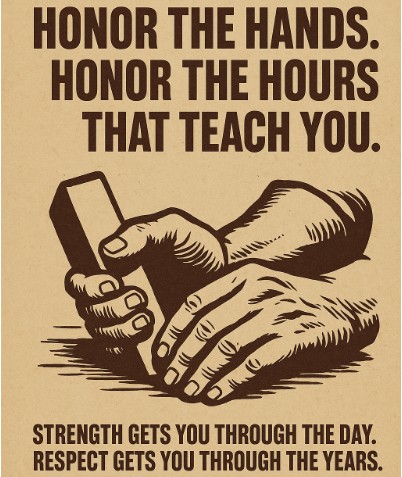
The hours that teach you matter just as much as the hands that do. And when you honor both, you don’t just get stronger — you get wiser.
That’s the difference between burning out and building a life.
Do it the Wright way.
Now you know, Jack.