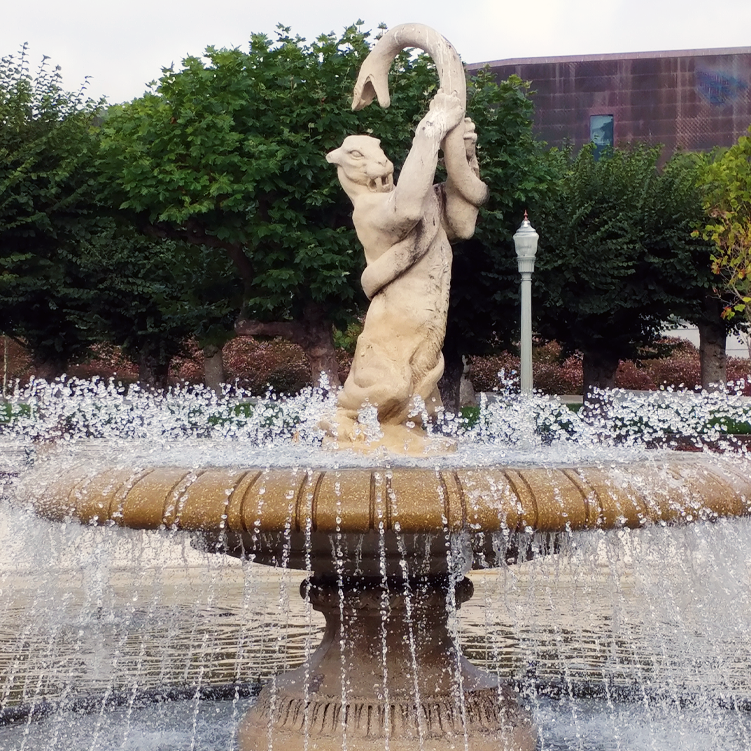
Set slightly off the main flow of Golden Gate Park’s Music Concourse, the Rideout Fountain is the kind of public artwork that doesn’t announce itself so much as confront you. At its center, a powerful big cat rears upward as a serpent coils and strikes, the two locked in a moment of violent equilibrium. Installed in 1924, the fountain was funded by a bequest from Corinne Rideout, part of a broader early-20th-century effort to civilize San Francisco’s grand new park with sculpture, water, and formal space. Sculpted by M. Earl Cummings, a longtime Park Commission artist, the work was conceived not as myth or fable, but as a raw study of animal force rendered at civic scale.
Unlike many fountains of its era, Rideout Fountain avoids allegory tied to gods, heroes, or moral instruction. There is no captioned lesson, no classical figure standing in for virtue or vice. Instead, the sculpture presents conflict itself as the subject: muscle against coil, teeth against scale. This choice reflects a period when American public art was increasingly fascinated by nature as spectacle—wildlife not as pastoral ornament, but as drama. Cast in stone rather than bronze due to budget constraints, the sculpture leans into mass and movement, its twisting forms amplified by falling water that heightens the sense of motion and tension.
As public art, the Rideout Fountain succeeds precisely because it resists easy interpretation. It doesn’t tell viewers what to think, only what to feel: unease, energy, and the recognition that parks are not just refuges from nature, but curated encounters with it. Over the decades—through neglect, partial damage, and eventual restoration—the fountain has endured much like its subject matter suggests. In a park defined by monumental institutions and manicured calm, this struggling cat and serpent remain a reminder that beneath the surface of civilization, conflict and vitality are always present, shaping both the natural world and the cities built within it.
Location
The Rideout Fountain sits in the Music Concourse area of Golden Gate Park — the formal, plaza-like space between the de Young Museum and the California Academy of Sciences. It’s one of the classic civic sculptures the city installed in the early 20th century. Richmond Review/Sunset Beacon
👤 Artist: M. Earl Cummings (1876–1936)
- Full name: Marshall Earl Cummings
- Cummings was a local San Francisco sculptor and longtime member of the Park Commission. He helped shape much of the park’s public art program in the early 1900s. Richmond Review/Sunset Beacon
- He studied under other prominent artists of the era and contributed numerous works throughout Golden Gate Park.
🛠️ Creation & Dedication (1924)
- Funded by a bequest from Corinna Rideout, widow of Norman Abbott Rideout, who left money specifically “to beautify Golden Gate Park.” Richmond Review/Sunset Beacon
- Dedicated in 1924 — the date appears on the basin’s rim inscription in Roman numerals: “Gift of Corinne Rideout, A.D. MCMXXIV.” Richmond Review/Sunset Beacon
- Architect Herbert A. Schmidt designed the basin and overall fountain setting, while M. Earl Cummings modeled the animal group. Richmond Review/Sunset Beacon
🐅 The Sculpture Itself
Subject & Composition
- The focal sculpture depicts a powerful big cat (often interpreted as a saber-tooth tiger) locked in a struggle with a serpent coiled around its body. Richmond Review/Sunset Beacon
- The dramatic, twisting forms of predator and snake create a dynamic tension — it’s literally a snapshot of life-and-death struggle.
Materials & Style
- The fountain and sculpture are crafted from cast stone (not bronze), a traditional medium for large civic works of that era. Richmond Review/Sunset Beacon
- Cummings originally wished it could be cast in bronze, but the project budget did not allow it. Beej Weir
🔧 Restoration & Later History
- By the early 2000s, the fountain had fallen into disuse due to vandalism and theft of parts. The snake’s head was missing for decades, leaving the dramatic struggle incomplete. Richmond Review/Sunset Beacon+1
- 2010 renovation: local artist Manuel Palos recreated the missing serpent head based on old photographs, and the fountain’s water system was rebuilt so it could run again. Beej Weir
- As part of a larger renovation of the Music Concourse fountains, Rideout Fountain was restored to working order and rededicated. Richmond Review/Sunset Beacon
🧠 Artistic Intent & Symbolism
Visual Narrative
Unlike mythic or allegorical statues meant to represent specific gods or heroes, Rideout Fountain’s centerpiece is a naturalistic, dramatic animal encounter — predator versus prey. Richmond Review/Sunset Beacon
The sculpture captures:
- Tension and struggle: the cat’s shadowed muscles and the snake’s deceptive coils suggest relentless conflict.
- The raw power of nature: the piece reflects artists’ and early-20th-century audiences’ fascination with wildlife and untamed environments.
Public Art Context
At the time, civic art frequently used:
- Animal motifs to symbolize broader themes like strength, resilience, and survival
- Monumental fountains as focal gathering points for city culture and pride
In this case, there’s no documented mythological narrative behind the cat and serpent — it’s essentially a dramatic, romanticized study of animal combat meant to evoke energy and draw visitors’ attention in the park’s formal core. Richmond Review/Sunset Beacon
🧾 Legacy
- Rideout Fountain remains one of Golden Gate Park’s most distinctive animal sculptures — a visually bold work that combines traditional civic ornamentation with dynamic natural imagery.
- It stands as a testament to early San Francisco patronage of the arts, driven by private citizens’ desire to enrich public spaces.