There’s never a wrong day to watch the internet rediscover political theory, but this morning’s show leaned Marxist. A cluster of very confident posters were explaining — with the zeal only memes can give a person — why incremental change is worthless and why ownership itself is the root of all inequality.
It’s an old argument, though it gets presented as a fresh revelation every few weeks. The problem is not that the diagnosis of power is wrong — it isn’t — but that the conclusion ignores the entire history of human society.
The Claim
The claim goes like this:
Because ownership creates inequalities, society should abolish ownership altogether.
And that is where the logic veers off the map.
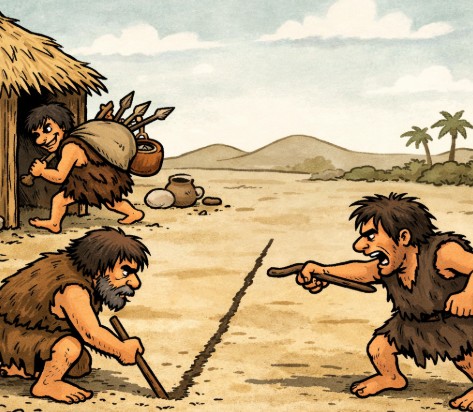
Even the most egalitarian cultures anthropologists have documented — small tribal bands, village societies, kinship groups — all maintained systems of personal items, shared resources, inherited responsibilities, and socially enforced boundaries. They didn’t have lords or landlords, but they absolutely had rules about who could take what, who was responsible for what, and what belonged to whom.
In other words:
They had ownership.
Just not the pathological, empire-corroding version.
The Real Problem
The problem isn’t owning things.
The problem is hoarding — the endless stacking of power and wealth until it distorts the entire society around it.
This distinction used to be understood instinctively by people actually entrusted with running a country. Not the revolutionaries or the purists, but the adults shaping real policy in the real world.
A Forgotten Model of Governance
Take the Eisenhower Republicans.
Not the social failings of the era — those can be acknowledged without nostalgia — but the governing philosophy that kept the Republic strong:
- Build a broad and stable middle class
- Contain extremes, left and right
- Tax accumulation before it becomes distortion
- Invest in public goods that lift the entire nation
- Understand that power, private or public, always wants to grow teeth
- Remember that capitalism is a tool to be managed, not a god to be worshipped
These were conservatives who saw government not as a burden but as the backbone of shared prosperity. They built highways, funded schools, strengthened unions, and taxed the top so the country could remain functional instead of feudal. They defended ownership while refusing to tolerate oligarchy.
What a Republic Actually Defends
They understood something today’s discourse seems to have misplaced:
A republic isn’t anti-ownership — it’s anti-privilege.
It isn’t anti-success — it’s anti-hoarding.
Freedom requires limits, or it collapses into theft.
And incremental change?
That isn’t betrayal.
That is the engine of any living republic.
Revolutions look good on posters.
Republics survive on maintenance.
Closing
So the next time someone announces online that ownership is the enemy or that incremental change is cowardice, take a breath. What you’re seeing is not a profound critique of the system — it’s an unwillingness to accept that self-government is a slow, deliberate, and permanently unfinished craft.
Purity belongs to ideology.
Patience belongs to adulthood.
A republic requires both — but depends on the latter.