A Monument to the Age When We Built to Last
If you want to understand Indiana—really understand it—don’t start with the highways or the cornfields. Start with the courthouses.
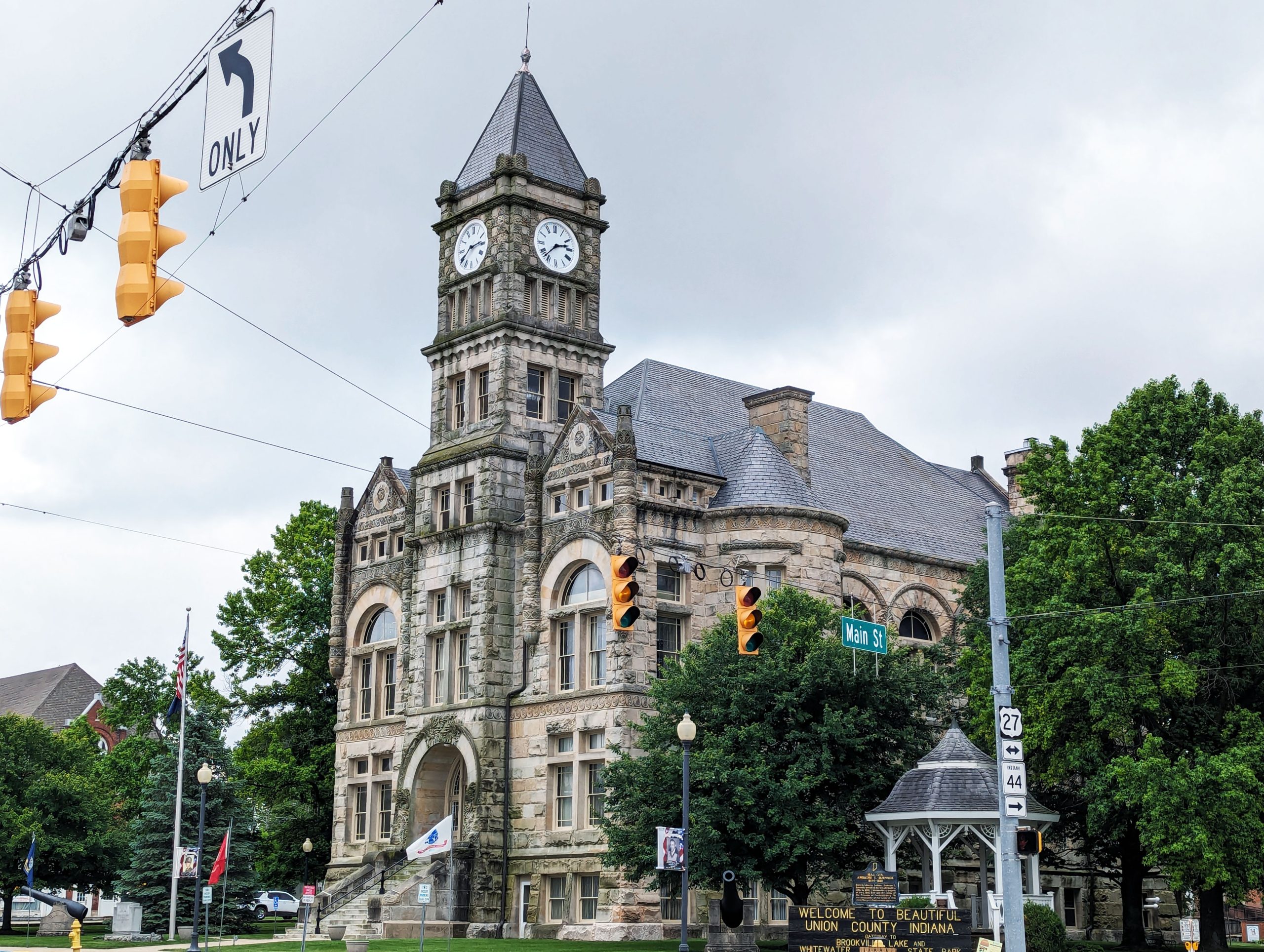
Indiana’s limestone courthouses are among the finest civic buildings ever constructed in the United States, and Union County’s courthouse in Liberty is a near-perfect example of why. These buildings were raised during a narrow window in the late 19th century when communities believed public architecture should inspire, not merely function.
This was the era of build it once, build it right, and build it beautifully.
Indiana Limestone: The Quiet Superpower
Indiana limestone is world-class. It’s durable, workable, and weathers into dignity rather than decay. Quarried primarily from south-central Indiana, it went on to shape some of the most famous buildings in the country—but its most honest expressions remain here at home, in county seats and small towns.
Union County’s courthouse wears its limestone the way a well-made tool wears use marks. The stone is not ornamental fluff; it is load-bearing, structural, and confident. The masons who cut and set it knew their work would outlast them, and they built accordingly.
Built in the Heyday of Civic Confidence
Completed in 1890, the Union County Courthouse was designed by architect William H. Duesing, a prolific courthouse architect whose work spans Indiana and Ohio. This was peak courthouse era: the moment when local governments invested heavily in architecture as a declaration of permanence and legitimacy.
There was no “value engineering” here.
No “good enough.”
No stripping things back to save a few dollars.
Instead, there was an understanding that public buildings shape public behavior.
Design That Means Something
The courthouse is Romanesque Revival in style—thick walls, rounded arches, deep window recesses, and a commanding central clock tower. Romanesque was not chosen accidentally. It communicates weight, stability, and authority without needing ornament for ornament’s sake.
The clock tower does more than tell time. It anchors the building visually and psychologically. It says: this place matters, and it keeps time for the community.
Arched entrances welcome without groveling. The symmetry reassures. The massing feels calm, not aggressive. It is assertive architecture—confident enough not to shout.
Craft as Civic Duty
What stands out most, if you slow down and actually look, is the craft density. Stone courses align cleanly. Carved details are restrained but deliberate. Every window opening was thought through. Every transition between surfaces was solved by a human hand.
This courthouse was not assembled.
It was made.
And that distinction matters.
Why You Should Tour Indiana Courthouses
Seriously—if you are ever in Indiana and have the time, make a point of touring the courthouses. Union County’s is excellent, but it’s far from alone. From Bedford stone to locally sourced limestone, from Classical to Romanesque to Beaux-Arts, Indiana’s courthouses form an informal statewide museum of American civic architecture.
They represent a time when:
- communities invested in shared spaces,
- builders were trusted to show skill,
- and beauty was considered a public good.
You don’t need to be an architect to feel it. Stand in front of one of these buildings and you understand immediately: someone cared.
A Quiet Lesson in Permanence
The Union County Courthouse is not flashy. It doesn’t beg for attention. But it has endured floods, wars, depressions, cultural shifts, and the slow erosion of craftsmanship elsewhere.
It’s still here.
Still solid.
Still doing its job.
In an age of disposable construction and temporary thinking, Indiana’s limestone courthouses remind us that durability is a choice—and that we once chose it on purpose.
If you want to see one of the better things Indiana ever did, start here.