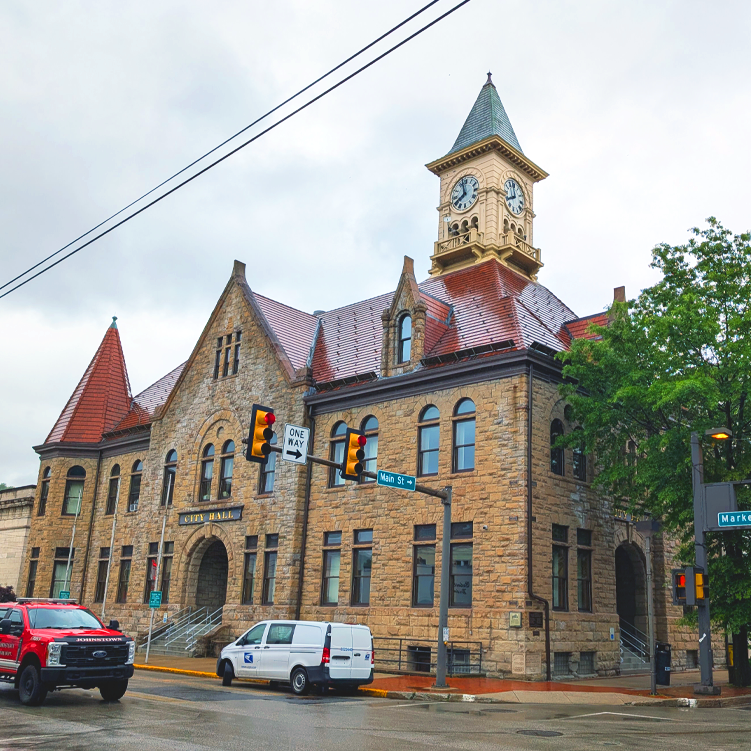
If you want to understand Johnstown in one stop—its grief, its grit, and its insistence on being a real city again—you walk to the northeast corner of Main and Market and look up.
Johnstown City Hall wasn’t thrown up as a quick replacement for a lost office. It was built as a civic statement: a deliberate, muscular, turn-of-the-century declaration that the city would not live forever in the shadow of May 31, 1889. The earlier municipal building on this site (erected in 1872) was destroyed in the Great Flood, and the replacement was conceived specifically to symbolize a “modern, progressive” Johnstown, rebuilt and forward-facing. Library of Congress Tile+1
City Hall is optimism in stone—set right where the town’s plan always implied public life should be. In the original 1800 layout by Joseph Johns, Market Square’s corners were reserved for “free and undisturbed” public use. City Hall occupies one of those corners, and it still reads like the anchor of the downtown grid. Library of Congress Tile
Built after the Flood, built to outlast it
The present City Hall went up during a period of civic confidence. The cornerstone was laid October 5, 1900, and the building was occupied October 30, 1902—fast work for a major public building, and a clear sign that Johnstown was back on its feet and thinking bigger than survival. Library of Congress Tile+1
It also marks something deeper than architecture: governance. The post-flood era pushed the valley’s boroughs toward consolidation—survivors of separate communities were welded into a shared civic project, and consolidation into the City of Johnstown was approved by voters on November 6, 1889. City Hall stands as a later, physical expression of that choice to rebuild together. Heritage Johnstown
The right style for a hard-earned civic confidence
Architecturally, Johnstown City Hall is a textbook choice with a very Johnstown purpose: Richardsonian Romanesque, the era’s favorite language for serious civic buildings—weight, permanence, authority. The building is attributed to Charles M. Robinson of Altoona, with Walter R. Myton as project architect; the HABS documentation notes Robinson as architect with Myton in charge of the branch office and local execution. Library of Congress Tile+2SAH ARCHIPEDIA+2
The style fits what the city needed to say in 1900:
- “We are stable.”
- “We are not temporary.”
- “We govern ourselves here, in the open, in the center.”
HABS describes City Hall as a strong example of Richardsonian Romanesque—an asymmetrical façade, towers, and rustication—kept in excellent condition. Library of Congress Tile
A civic machine disguised as a monument
This wasn’t just pretty frontage. It was designed as a working municipal engine.
After the flood, the city wanted a “new, bigger and better” City Hall that reflected national prominence. Unlike the pre-flood building, the new City Hall no longer included the market house function; it was built to contain offices (mayor, police chief, fire department), council chambers, committee rooms, and even prisoner cells. Library of Congress Tile+1
That’s an important shift: it’s the moment Johnstown’s municipal identity separates from the older “market town” model and steps into a more modern civic form.
Exterior: buff stone, red tile, and a clock tower that owns the corner
The building’s overall form is basically rectangular with an attached tower—two stories over a full basement, measuring 54′ x 114′. Its public faces address Market Street (west) and Main Street (south)—exactly the right move for a building meant to be a downtown anchor. Library of Congress Tile+1
Structurally and materially, it’s quietly modern under the historic skin:
- Reinforced concrete foundation Library of Congress Tile
- Steel framing Library of Congress Tile
- Walls of buff-colored stone from local quarries, laid as “broken-range ashlar” Library of Congress Tile
- A hipped roof with a cross gable and dormers, covered in red terra cotta tile Library of Congress Tile+1
The entrances are treated like civic thresholds should be: two main doorways, centered on both public facades, each framed by a heavy arch with voussoirs and a keystone. The original doors were oak; a contemporary newspaper noted the “Colonial style” glass—smooth on one side and wavy on the other—exactly the sort of small material detail that signals pride and craft rather than mere function. Library of Congress Tile+1
And then there’s the skyline: a square wooden cupola rising from the western roof end, carrying miniature versions of the building’s own Romanesque motifs and clock faces on all four sides. Library of Congress Tile+1
This is not a timid building—it wants to be seen, and it earns it.
Interior: built for use, finished like a proper public building
The floor plan is rational and legible: two wide corridors from each entrance intersect at the center of the first floor. Originally:
- First floor: clerk, treasurer, controller, mayor, police, fire marshal, and jail cells
- Second floor: council chambers, committee rooms, engineer, solicitor, street commissioners, health officer, marketmaster Library of Congress Tile
The building has been modernized over time, but the HABS report notes the first-floor plan remains basically intact (with the police department having moved), and the changes upstairs are modest. Library of Congress Tile+1
Then you get the “why we still love old buildings” list:
- Stairway at the corridor intersection: ornamented wrought iron with marble runners Library of Congress Tile
- Flooring: mosaic terrazzo Library of Congress Tile
- Original trim: natural-finish quartered white oak Library of Congress Tile
- Doors echo the exterior detail, using the same “Colonial glass” in the upper panels Library of Congress Tile
- Early lighting was both gas and electricity, and heating was steam—a snapshot of a city equipping itself for the modern era. Library of Congress Tile
This is the part people miss: City Hall isn’t only a historic object; it was engineered as an up-to-date, durable public workplace.
The flood marks on the wall: memory built into masonry
City Hall also functions as a public memory device. Markers on the wall record high-water lines from Johnstown’s major floods, including the city’s “three worst” as highlighted on the Heritage Johnstown walking tour materials, tying the building to the longer flood history that shaped federal flood-control work after 1936 and the trauma of 1977. Heritage Johnstown+1
That’s an unusually honest civic choice: not hiding the past, not making a shrine of it either—just letting the evidence sit in public view.
Why this building matters
Johnstown City Hall is a rare thing: a public building that still communicates its original purpose without explanation.
It says, in a language anyone can read:
- the center matters,
- government is supposed to be present in the life of the town,
- and a city that has been hit hard should rebuild beautifully anyway.
Romanesque civic architecture can be overbearing in places that never had to prove themselves. Here, it feels earned. Built after catastrophe, designed to anchor the resurrected city, and still doing its job a century later—City Hall is one of Johnstown’s best “we’re still here” statements. Library of Congress Tile+1