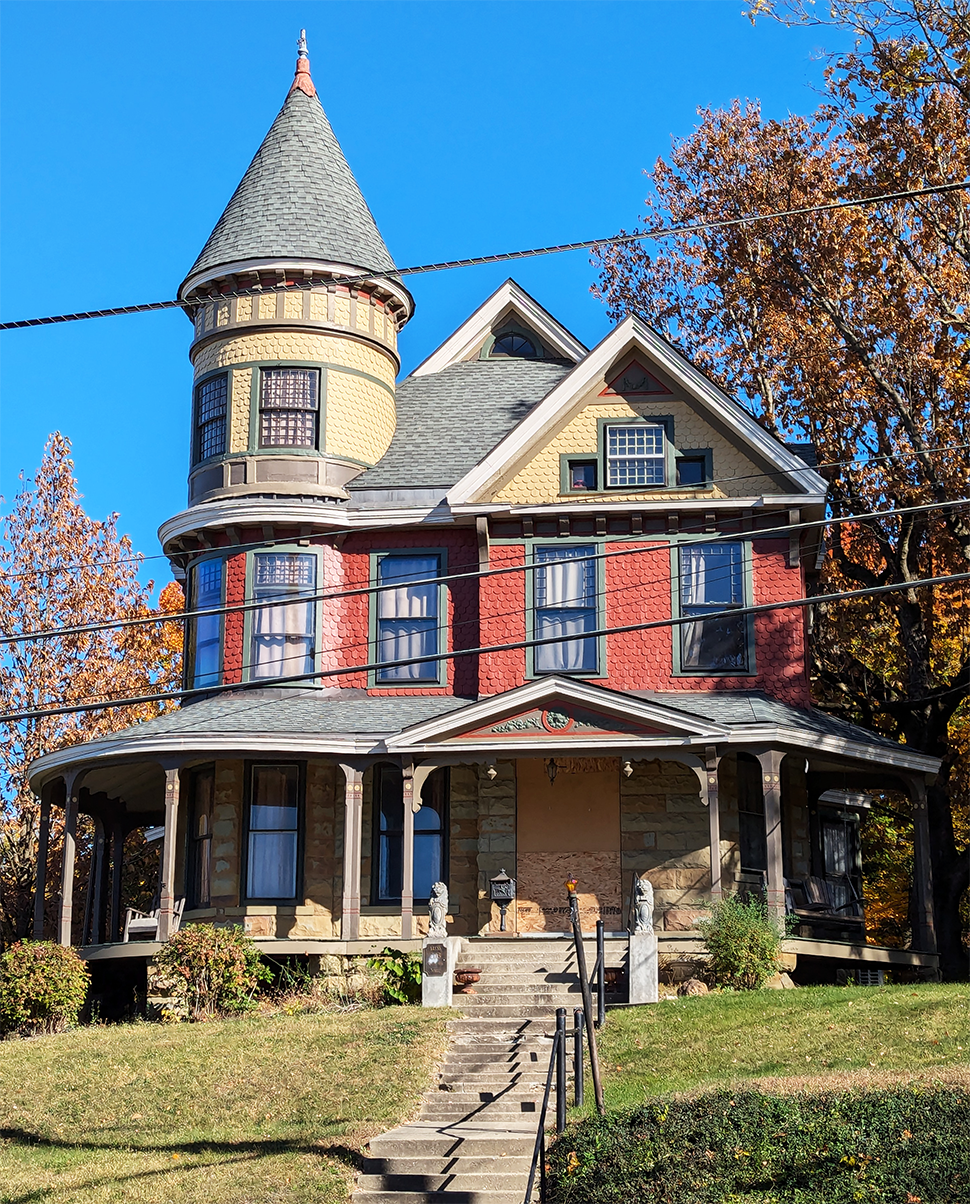
A Queen Anne Landmark on Ninth Street Hill
Seen from the street, the Kress Home presents itself as a study in confidence, complexity, and deliberate display. It sits elevated above the sidewalk on Ninth Street Hill, using the slope not as an obstacle but as a compositional device. The house does not meet the street—it rises from it.
The first and unavoidable focal point is the tower. Cylindrical, vertically dominant, and capped with a conical roof, it anchors the composition while breaking any expectation of symmetry. This is a classic Queen Anne move: the tower exists less for utility than for presence. It interrupts the roofline, commands the skyline, and ensures the house can be identified instantly from a distance.
Below and around the tower, the façade unfolds in layers rather than planes. Wall surfaces advance and retreat through projecting bays and recessed sections, creating depth and shadow that change with the light. The eye is never allowed to settle on a single flat surface. Instead, it moves upward and outward, following the rhythm of windows, trim, and rooflines.
The roof geometry reinforces this sense of motion. Multiple gables intersect at different heights and angles, each one treated as an opportunity for ornament rather than a purely structural necessity. The gables frame windows of varying shapes and sizes, emphasizing individuality over repetition. This is a house designed to be read as a sequence of moments, not a single static elevation.
Color and texture play an equally important role. The exterior combines contrasting tones that visually separate floors and architectural elements. Shingled surfaces sit above more solid masonry, reinforcing the sense of weight at the base and lightness above. This vertical progression—from stone foundation to patterned upper stories—grounds the structure while allowing it to feel tall rather than heavy.
The wraparound porch provides the visual and functional transition between house and ground. Its columns and railings establish a human scale at street level, tempering the vertical drama above. The porch does not compete with the tower or gables; it stabilizes them, offering a horizontal counterpoint that makes the composition feel intentional rather than chaotic.
The front approach is formal and centered, with a straight stair rising from the sidewalk to the porch. This axial gesture contrasts with the asymmetry above, reinforcing the idea that while the house celebrates complexity, it still understands ceremony. Entry is meant to feel purposeful.
Taken as a whole, the Kress Home embodies the Queen Anne ideal of architectural personality. Nothing here is minimized. Every element—tower, gable, bay, porch—participates in the larger visual argument that this house was meant to be noticed, remembered, and distinguished from its neighbors.
From the street, it does not read as a relic or a curiosity. It reads as a declaration:
that architecture can be expressive, layered, and unapologetically individual.
It stands not just as a house, but as a marker of a time when domestic buildings were expected to contribute character to the public realm—one bold façade at a time.