How Roads Were Shaped Before Roads Were Guaranteed
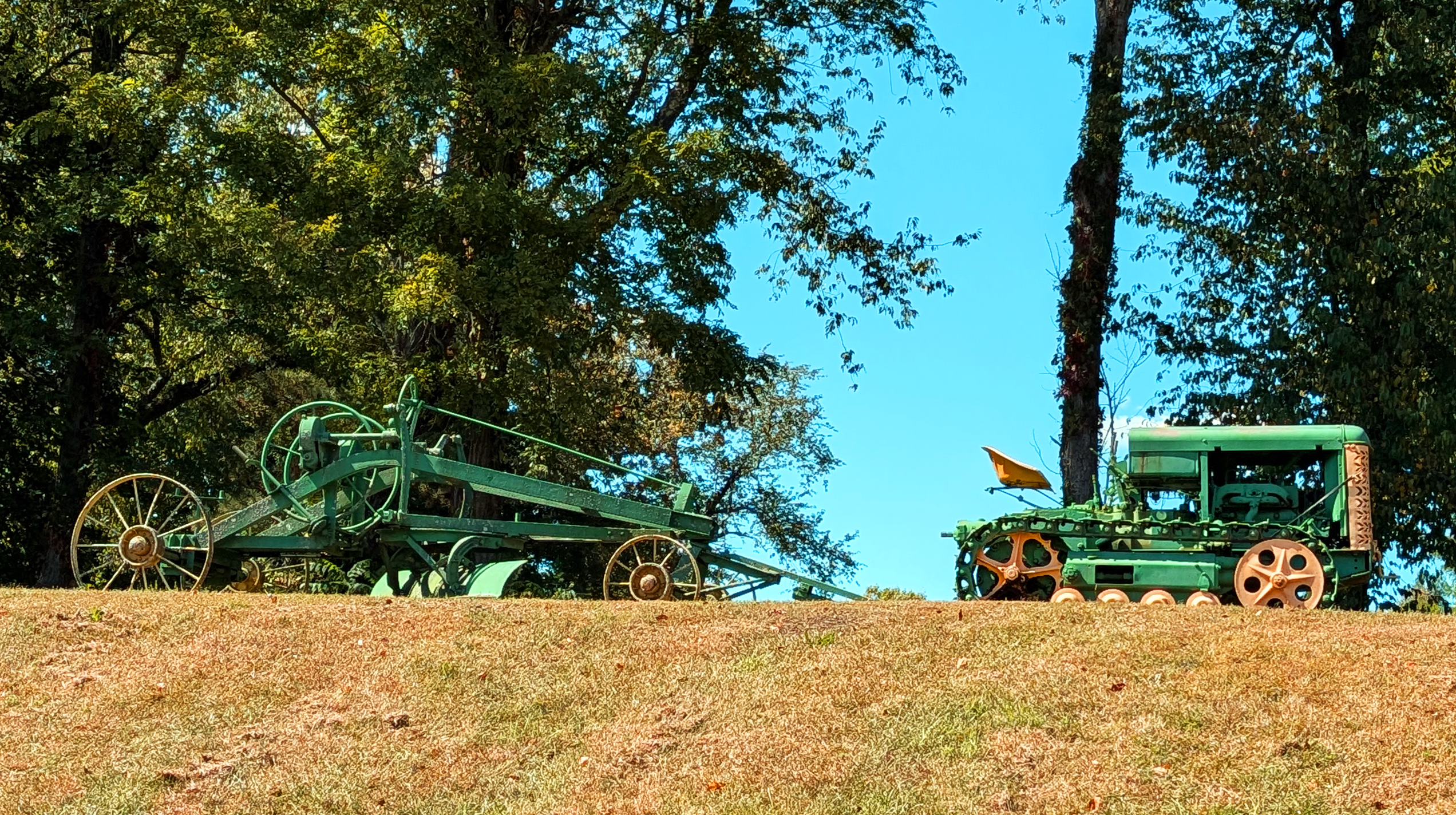
On a grassy rise, two machines sit in quiet alignment: an Oliver Cletrac HG crawler tractor and a horse-drawn road grader, likely a J.D. Adams model. They are separated by decades of industrial evolution, yet united by purpose. Together, they tell a simple truth about infrastructure—most of what we consider “modern” road building is refinement, not reinvention.
The Oliver Cletrac HG: Traction Over Power
The Oliver Cletrac HG crawler tractor emerged after the Oliver Corporation acquired the Cleveland Tractor Company in 1944. Compact, tracked, and deliberately underpowered by modern standards, the HG was not built for speed or spectacle. It was built for traction.
Tracks mattered more than horsepower. On soft ground, uneven grades, or freshly worked soil, the crawler’s ability to distribute weight evenly allowed it to pull, push, and stabilize equipment that wheeled tractors could not. In dozer configuration, it could shape embankments, maintain slopes, and assist graders by keeping material where it was needed.
This was not brute force engineering. It was controlled persistence—slow passes, repeated adjustments, and an operator who understood terrain by feel rather than sensors.
The Horse-Drawn Grader: Geometry Before Engines
Beside it sits a much older solution: a horse-drawn road grader, likely produced by J.D. Adams, a company that fundamentally changed road maintenance in the late 19th century.
J.D. Adams is credited with inventing the first “leaning wheel” pull grader in 1885. That innovation was deceptively simple. By allowing the wheels and blade to angle, the grader could shape a road surface rather than merely scrape it flat.
The goal was crown, not smoothness.
A properly graded dirt road rises slightly at the center and falls toward the edges. This geometry allows rainwater to shed off the surface instead of pooling, which would quickly destroy an unpaved road. The angled blade cut material from the sides and redistributed it toward the center, pass after pass, until the desired profile emerged.
No engines. No hydraulics. Just leverage, weight, geometry, and repetition.
The Early Mechanical Process of Road Grading
The process itself was methodical:
- Initial Passes
The grader’s blade was set at a shallow angle to loosen compacted soil and remove ruts. - Material Redistribution
Subsequent passes shifted material inward, building the crown gradually rather than all at once. - Edge Control
Ditches and shoulders were cleaned to ensure water had somewhere to go. - Compaction by Use
Traffic—wagons, carts, later automobiles—provided the final compaction. Roads were finished by being used.
When engines entered the picture, little changed conceptually. Tractors like the Cletrac replaced horses. Steel replaced wood. Control improved. Speed increased. But the logic stayed intact.
What Has (and Hasn’t) Changed
Modern graders are marvels of engineering: articulated frames, GPS guidance, laser leveling, computerized blade control. They can shape a road to millimeter precision at speeds that would have seemed impossible a century ago.
Yet the underlying task remains the same:
- Move material
- Shape a crown
- Control water
- Repeat until stable
The difference is not philosophy—it’s overhead.
Today’s equipment costs more, requires specialized maintenance, trained technicians, fuel logistics, software updates, and financing structures that would dwarf the value of entire early road departments. The machines are more capable, but also more fragile in systemic terms.
The old machines were slower, but resilient. They required understanding rather than abstraction.
Two Machines, One Continuum
Seen together, the Oliver Cletrac HG and the J.D. Adams grader are not relics. They are chapters in an unbroken process of human problem-solving: how to make the ground reliably passable.
Roads have always been negotiated with gravity, water, and soil. We have never conquered those forces—only learned to cooperate with them more efficiently.
The machines may rest now, but the work they represent is ongoing. Every modern road still owes its shape to the same angled blade and the same quiet insight: water decides whether infrastructure survives.
Everything else is just tooling.