St. John Gualbert Cathedral and the Architecture of Flood City
One of the great, underappreciated truths about Johnstown is that it is a city told through its churches.
Not metaphorically—physically.
While much of the American landscape flattened its sacred architecture into vinyl-sided boxes and interchangeable brick shells, Johnstown kept building churches as if style still mattered. As if permanence was a moral obligation. As if the skyline itself was a form of testimony.
The result is a city unusually rich in ecclesiastical architecture, spanning multiple revival movements and construction philosophies. Gothic, Romanesque, Italianate, Classical—often rising just blocks apart. These buildings were erected not during prosperity alone, but repeatedly in moments of recovery. Floods, fires, economic collapse—each era seems to have been followed not by retreat, but by another round of ambitious, expressive construction.
Today, many of these buildings sit underutilized, oversized for modern congregations, quietly waiting for either revival or reinvention. They are some of the most visually powerful structures in the city, and they speak to a time when even working-class communities demanded beauty, craft, and architectural seriousness from their public buildings.
Among them, one stands apart—not just for its scale or appearance, but for how it was built.
St. John Gualbert Cathedral is not merely a historic church. It is a structural turning point.
A Church Built After Everything Else Was Gone
The parish of St. John Gualbert traces its origins to 1835, making it the oldest Catholic parish in Johnstown. Like much of the city, its early structures were repeatedly tested by disaster. The catastrophic flood of 1889 reshaped Johnstown physically and psychologically, and in the chaos that followed, the earlier church was lost—reported to have burned during or shortly after the flood.
What followed was not a modest replacement.
Construction of the present building began in August of 1895, during the city’s intense post-flood rebuilding period. The cornerstone was laid that October. By 1896, a new church stood downtown—larger, more ambitious, and more technologically daring than anything the parish had previously known.
This was not simply an act of faith. It was an act of confidence.
Johnstown, still rebuilding its homes and industries, chose to erect a church that embraced the most advanced construction methods of its time.
Old World Form, Industrial Skeleton
At first glance, St. John Gualbert Cathedral reads as comfortably traditional.
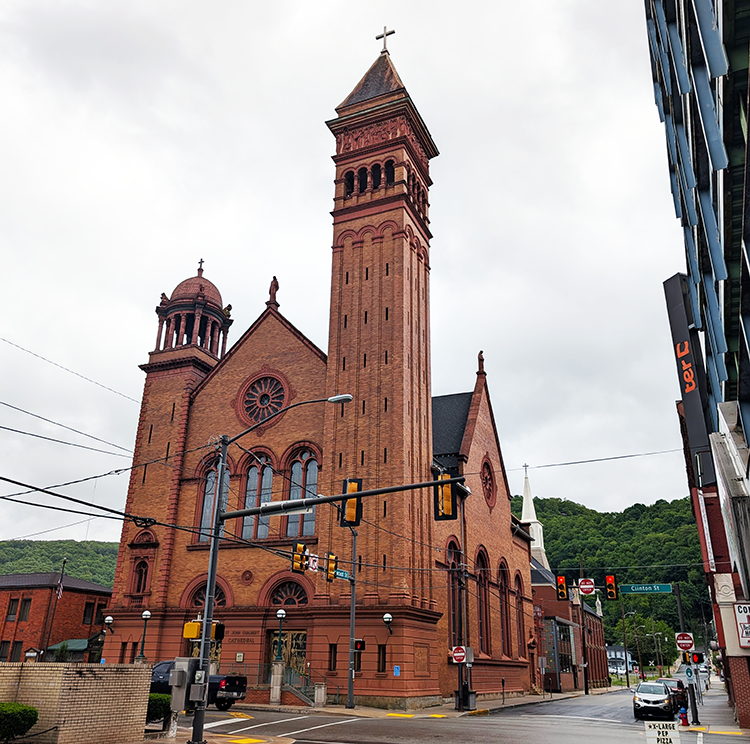
Its exterior blends Italianate and Romanesque Revival influences: rounded arches, layered masonry, restrained ornamentation, and a commanding square campanile rising from the corner of the structure. The bell tower, inspired by the Campanile of St. Mark’s in Venice, anchors the building visually and situates it firmly within a European architectural lineage.
The materials reinforce this impression. Pressed brick, brownstone, and rough-faced terra cotta give the building texture and gravity. A circular wheel window dominates the façade, and stained glass punctuates the walls with color and rhythm. From the street, the building appears every bit the product of 19th-century masonry tradition.
But that appearance is deceptive.
Behind the brick and stone is a steel skeleton—an internal framework that fundamentally changes how the building works.
An Early Ecclesiastical Steel Superstructure
St. John Gualbert Cathedral is recognized as an early example of a steel-framed ecclesiastical building—an unusual and forward-thinking choice in the mid-1890s, when most churches still relied on thick load-bearing masonry walls.
Hundreds of thousands of pounds of steel were incorporated into the structure. The steel frame supports the roof and interior loads, allowing the walls to be lighter and more decorative than traditional stone construction would permit. Terra cotta elements, in particular, benefited from this approach, serving aesthetic rather than structural roles.
Contemporary accounts describe construction sequences that would have seemed startling at the time: the steel framework rising rapidly, the roof completed before the foundation walls were fully finished, and the cross placed atop the tower before the cornerstone ceremony. This was not symbolic flourish—it was the practical reality of steel-frame logic asserting itself over centuries-old building customs.
In effect, the cathedral wears the costume of an Old World church while operating like a modern industrial building.
This makes it architecturally significant not because it abandons tradition, but because it bridges tradition and innovation. It demonstrates how sacred architecture adapted—quietly, cautiously, but decisively—to the structural revolutions reshaping American cities.
Scale, Proportion, and Presence
The building’s dimensions reinforce its civic role. Over 120 feet long and roughly 66 feet wide, the main body of the cathedral creates a broad, unified interior space. The tower, rising well over 160 feet depending on measurement, asserts itself across downtown sightlines, visible from multiple approaches.
Inside, the steel framework enables a wide-span interior with fewer structural interruptions. The ceiling is coved and coffered, the walls articulated with pilasters and classical detailing. Corinthian capitals crown the interior elements, lending a sense of refinement and continuity with European ecclesiastical design.
Light enters through stained glass and arched openings, animating the interior without overwhelming it. The space is dignified rather than theatrical—a deliberate balance between grandeur and restraint.
As a co-cathedral of the Diocese of Altoona–Johnstown since 1957, the building also contains the bishop’s cathedra, marking it as a seat of ecclesiastical authority rather than merely a parish church.
Change Without Collapse
Like many historic churches, St. John Gualbert has not remained frozen in time. Post–Vatican II renovations altered the interior, removing or relocating elements of the original high altar and reconfiguring the liturgical layout. These changes reflect broader shifts in Catholic worship rather than local neglect.
What is notable is how well the underlying structure has absorbed those changes.
The steel superstructure that once marked a daring experiment has proven durable, adaptable, and forgiving—qualities that many purely masonry churches lack. The building remains sound, imposing, and active, continuing its original function well into the 21st century.
A Cathedral That Explains the City
St. John Gualbert Cathedral is, in many ways, a key to understanding Johnstown itself.
It is a building born of catastrophe, constructed during recovery, designed with ambition, and executed with technical confidence. It looks backward in style while leaning forward in method. It is rooted in faith, but shaped by industry.
Most of all, it reflects a city that repeatedly chose to build seriously—even when circumstances suggested retreat.
In a place now filled with beautiful, underutilized structures, St. John Gualbert stands as a reminder that architecture was once considered a public good worth investing in, even under pressure. It was never just about shelter or function. It was about permanence, identity, and the belief that a city could rise again—stronger, smarter, and still beautiful.
That belief is still visible in steel, brick, and stone on Clinton Street.