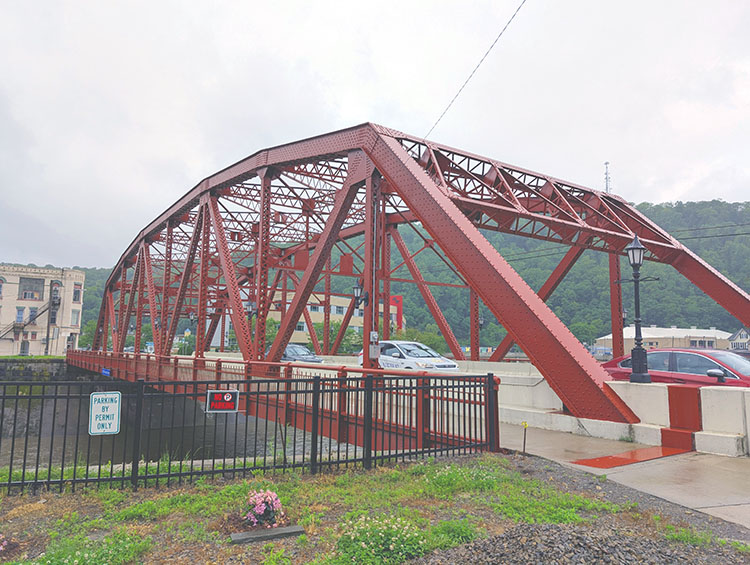
Franklin Street, Johnstown, Pennsylvania
It’s tempting—especially if you’ve spent any time around modern infrastructure manuals—to describe the Franklin Street Bridge as a basic bridge. A steel truss. One main span. No swooping cables, no sculptural concrete pylons, no algorithmically optimized curves meant to look good in drone footage.
A very basic design for a modern bridge.
And that, frankly, is a laughable statement.
Because there is no such thing as a “basic” bridge.
Bridges are among the most consequential technologies humanity has ever developed. They are the literal defeat of geography. They turn rivers from barriers into connectors, valleys into corridors, cities into systems. Every bridge—no matter how “simple”—is a negotiated truce between gravity, material science, weather, money, politics, and time. They fail spectacularly when misunderstood, and they quietly hold civilizations together when they work.
The Franklin Street Bridge does not try to impress you. It does something far more difficult.
It endures.
A bridge born of catastrophe
The bridge that now carries Franklin Street across the Stonycreek River was built in 1937, in the long shadow of disaster. One year earlier, the St. Patrick’s Day Flood of 1936 tore through Johnstown yet again, destroying bridges, severing neighborhoods, and reinforcing a lesson the city had already learned too many times: if you live at the confluence of rivers, your infrastructure must be rebuilt as often as your memory.
An earlier bridge at this crossing was swept away. What replaced it was not ornamental optimism, but industrial clarity.
The Pennsylvania State Highway Department oversaw the project, with Bethlehem Steel Company—then one of the industrial giants of the nation—supplying and fabricating the structure. This was the heart of the American steel era, and Johnstown was no stranger to that reality. Steel was not an abstract material here; it was a language people spoke fluently.
Architecture without pretense
Structurally, the bridge is a single-span steel truss, approximately 230 feet long, carrying Franklin Street (State Route 3055) cleanly across the river without intermediate piers in the waterway. The overall structure stretches roughly 236 feet, with a roadway width of about 38 feet—generous for its era and still serviceable today.
The truss itself follows a polygonal Warren configuration, a variation that subtly adjusts the depth of the structure along its length. This isn’t decoration. It’s efficiency. The geometry places steel where forces demand it and removes it where they don’t.
This is bridge design at its most honest:
- Loads are carried through triangles, not tricks.
- Strength comes from compression and tension, not bulk.
- The structure is fully visible, because it has nothing to hide.
You don’t need to be an engineer to feel why this works. You can see the forces resolving themselves as you cross. The bridge explains itself.
An industrial landmark in a city of bridges
Johnstown is unusual in how many historic metal truss bridges it has retained. Where other cities replaced theirs wholesale in the mid-to-late 20th century, Johnstown kept building, repairing, repainting, and reusing. The result is something close to an accidental open-air museum of American bridge engineering.
The Franklin Street Bridge is part of that lineage. It is not the largest, nor the most ornate, but it is deeply representative of the period when bridges were built to be maintained, not discarded. The steel lattice frames views of the Stonycreek, the downtown river corridor, and the layered history of a city shaped by water and work.
Rehabilitation, not replacement
True to its original philosophy, the bridge has been rehabilitated rather than erased. A significant rehab occurred in 2006, addressing structural and safety needs while preserving the original form. More recent work in 2021 included repairs and a highly visible repainting that transformed the bridge into a striking downtown landmark.
The color choice—International Orange, famously associated with the Golden Gate Bridge—was not accidental. It makes the structure unmistakable. It declares presence. It ensures that this is no longer an invisible piece of infrastructure passed over without thought.
From working bridge to living memorial
In 2021, the Commonwealth of Pennsylvania formally designated the structure as the City of Johnstown Firefighters Memorial Bridge. Legally, it is Bridge Key 8680. Humanly, it is something else entirely.
The memorial honors seven Johnstown firefighters who died in the line of duty:
- Jacob Graff (1926)
- Joseph Costanzo (1951)
- Thomas Potter (1952)
- John Brindle (1954)
- Robert Urbasik (1958)
- Richard Roberts (1989)
- John Slezak (1989)
This is not a monument tucked into a corner or elevated onto a pedestal. It is a memorial you cross every day. Commuters, pedestrians, emergency vehicles, and visitors all pass through the same space where remembrance has been welded directly into function.
It is difficult to imagine a more fitting tribute to firefighters than a structure that exists to connect, support, and hold fast under pressure.
Why this bridge matters
Calling the Franklin Street Bridge “basic” misses the point entirely.
This bridge represents:
- Post-disaster rebuilding rooted in experience, not theory
- Industrial-era engineering that valued durability and clarity
- A city that chose rehabilitation over erasure
- A memorial that lives inside daily civic life rather than apart from it
Bridges are promises. They promise that the other side is reachable. That effort was made. That someone thought far enough ahead to imagine traffic, floods, weight, wind, and time itself.
The City of Johnstown Firefighters Memorial Bridge keeps that promise quietly, every day—steel truss by steel truss—while reminding anyone paying attention that there are no ordinary bridges, only familiar miracles.