The Greenhouse and All the Rest
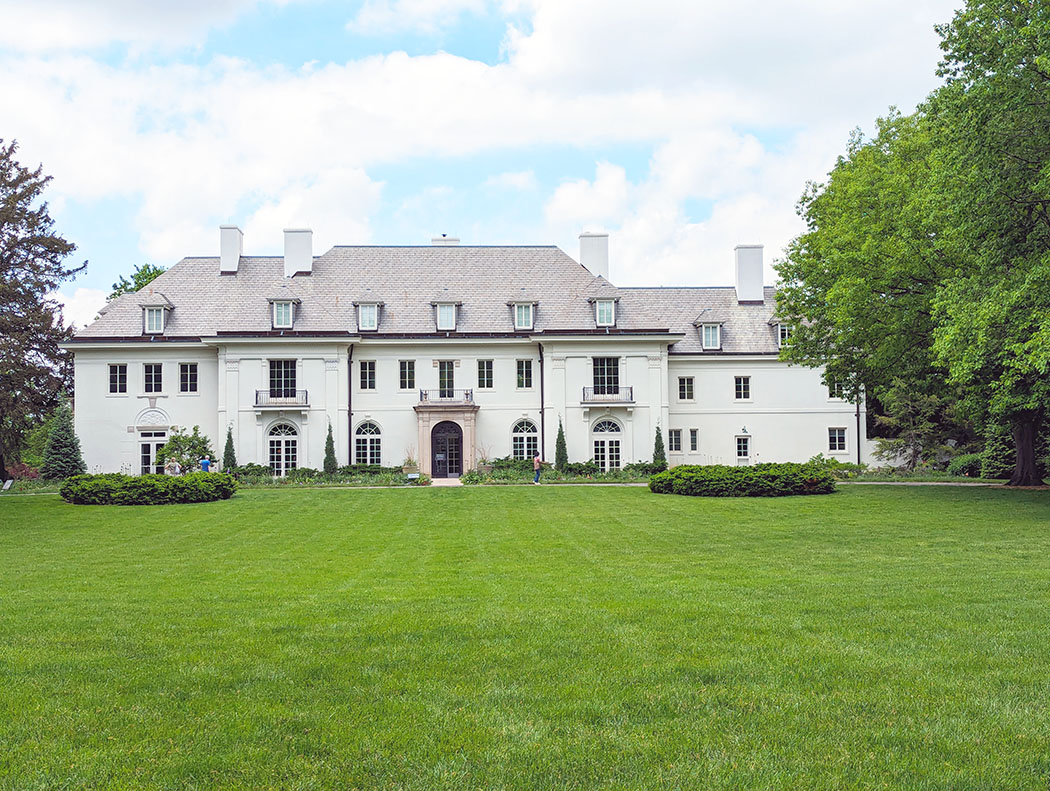
Oldfields is usually introduced as a house.
Sometimes it is framed as an estate. Sometimes as an art museum adjunct. Occasionally it is reduced to a stop on a campus map, an architectural artifact preserved inside a larger institutional organism. All of these descriptions are technically correct—and all of them miss the point.
If you want to understand Oldfields, you don’t start with the façade.
You start with the greenhouse.
A House Built Around Cultivation
Oldfields, commonly known as the Lilly House, was conceived not merely as a residence but as a total environment—a carefully composed relationship between architecture, landscape, light, and living systems. The house sits with confidence, but never arrogance, on its grounds. It is elegant without being theatrical, restrained without being austere.
Yet for all the attention paid to the main structure, the most revealing expression of the estate’s philosophy lies just off the expected path: the orchid greenhouse.
This was not a novelty. It was not decorative excess. It was an act of intention.
Orchids are not easy plants. They demand patience, consistency, and humility. They do not reward neglect, and they cannot be forced. To maintain an orchid greenhouse—especially in the Midwest—requires a quiet commitment to care, to systems, and to long timelines.
That tells you almost everything you need to know about the people who built and maintained Oldfields.
The Orchid Greenhouse as Cultural Artifact
The greenhouse at Oldfields was a working space, not a display box. It was designed for propagation, experimentation, and sustained stewardship, not for spectacle. Temperature, humidity, light, and airflow were carefully managed long before such concerns were fashionable.
This matters because it reframes the estate entirely.
Oldfields was not simply about collecting objects or signaling status. It was about cultivation—of plants, of taste, of environments that encouraged attentiveness rather than consumption. The greenhouse embodies a worldview that valued living systems as much as static beauty.
In many ways, it is more radical than the art on the walls.
Art can be acquired.
An orchid must be earned.
Architecture in Service of Attention
The house itself reflects this same ethic. Rooms are scaled to human presence, not intimidation. Sightlines are deliberate. Windows frame gardens rather than dominate them. The estate asks you to look outward, to notice seasons, textures, and growth.
This is architecture that assumes its occupants will be awake.
The greenhouse reinforces that assumption. It is a place where time slows down, where success is measured not in immediacy but in survival and bloom. It is the counterpoint to the acquisitive impulse—the reminder that value is not always portable or monetizable.
The Grounds as a Living Extension
Beyond the house and the greenhouse, the extensive gardens and grounds of Oldfields complete the estate’s logic. In the warm months, they are not merely pleasant—they are instructive. These are proper gardens: layered, seasonal, and attentive to both ornamental and ecological considerations. Paths unfold deliberately, plantings reward slow observation, and species selection reflects a long view rather than a decorative one. Walking the grounds is less like touring a manicured attraction and more like moving through a living catalog of horticultural intent. Many of the species encountered there appear throughout the Cernunnos Foundation archives precisely because they were experienced in situ—observed as part of a designed system rather than isolated specimens. The gardens do not compete with the house or the art; they contextualize them, reminding the visitor that cultivation, whether of plants or culture, is an ongoing practice rather than a finished product.
From Oldfields to Newfields
Oldfields now exists within a larger institutional structure known as Newfields, a name that replaced what was once more plainly and appropriately called the Indianapolis Museum of Art.
That earlier name mattered. It placed art—not branding, not experience design—at the center of the institution’s purpose.
Newfields has done important work in preservation and access, and it would be unfair to dismiss the entirety of the current campus. But it is also impossible to ignore the shift in emphasis. Where the old framing prioritized artistic and cultural stewardship, the new model leans more heavily toward revenue generation, event hosting, and market positioning.
This is not unique to Indianapolis. It is the prevailing logic of contemporary cultural institutions.
Oldfields survives within this context almost as a rebuke to it.
The greenhouse, in particular, stands as a quiet contradiction to the idea that value must justify itself quarterly. It produces nothing that can be scaled, branded, or rapidly monetized. Its worth lies entirely in continuity.
The Sutphin Mall: A Closing Gesture
Which brings us, inevitably, to the Sutphin Mall.
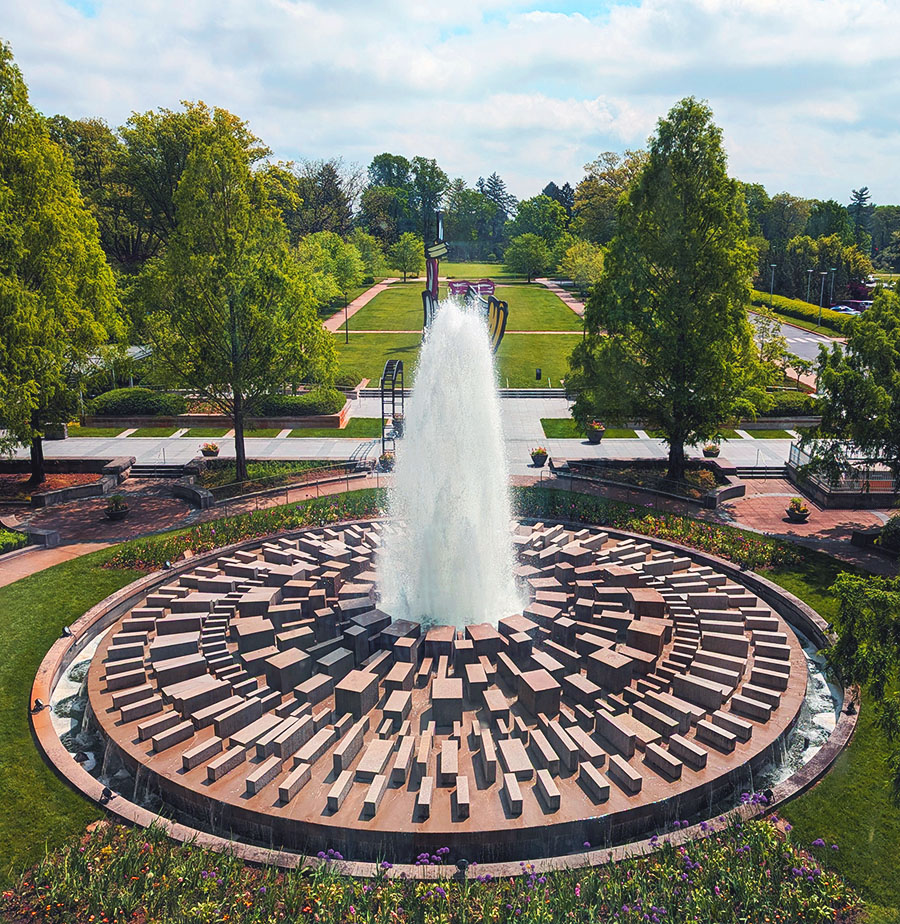
The formal mall, culminating in its fountain, remains one of the most composed and humane landscape features on the grounds. When the fountain is in full operation—water rising, falling, cycling with patient inevitability—it completes the argument Oldfields has been making all along.
This is not spectacle for spectacle’s sake.
It is movement in service of calm.
Energy disciplined into form.
The fountain does what the greenhouse does, and what the house does: it reminds you that systems can be beautiful when they are designed to endure rather than impress.
Why the Greenhouse Matters Most
You can admire Oldfields for its architecture.
You can appreciate the art museum for its collections.
You can enjoy the grounds for their tranquility.
But if you want the clearest insight into what made this place worth building in the first place, you look to the orchid greenhouse.
It represents a belief that culture is something you tend, not something you consume. That beauty requires maintenance. That patience is a virtue worth designing for.
In a time when institutions struggle to justify themselves through metrics and margins, Oldfields quietly offers another answer.
Plant something delicate.
Care for it over decades.
Let it bloom when it’s ready.
That is the kind of wealth that doesn’t disappear when markets shift—and the kind of wisdom that architecture, at its best, is meant to preserve.