Making the World Better, One Simple System at a Time
At the heart of the Cernunnos Foundation and our e-zine, The Blue Ribbon Team, is a simple, unfashionable idea:
the world can be made better, and it does not require permission from institutions to begin.
Much of our recent work has focused on the River Refugium Project (RRP)—an open-source ecological system for restoring polluted waterways while producing food, materials, and local economic value. The technical documentation is extensive, because it has to be. Rivers are complex. Watersheds are complex. Scaling solutions responsibly demands rigor.
But beneath all of that documentation is something far more basic.
Nature already knows how to clean water.
It just needs us to line the pieces up.
The Refugium is not a machine in the conventional sense. It is a pattern—remove excess nutrients, grow biomass, stabilize those nutrients, and return cleaner water. Whether this happens in a multi-acre greenhouse campus or a shallow pond behind a school, the logic remains the same.
And that realization leads to an uncomfortable but necessary conclusion:
the poorest communities, with access to the dirtiest rivers, are not locked out of this solution.
They are, in many cases, the most capable of deploying it first.
The Public Edition: Opening the Doors on Purpose
The River Refugium Project – Public Edition exists for one reason:
to remove intimidation and restore agency.
It distills the full Refugium architecture into a form that communities, farmers, NGOs, and municipalities can understand, adapt, and build without licensing, fees, or permission. The system is modular by design—small victories scale, and distributed solutions outperform centralized fixes over time.
But even this public edition assumes a future with capital, land access, or institutional backing.
That future is not evenly distributed.
So we also need a starting point that works now.
Tier-0: The Simplest River-Cleaning Food System
Before greenhouses.
Before bioreactors.
Before grants, sensors, and policy frameworks.
There is a version of the River Refugium that looks almost embarrassingly simple:
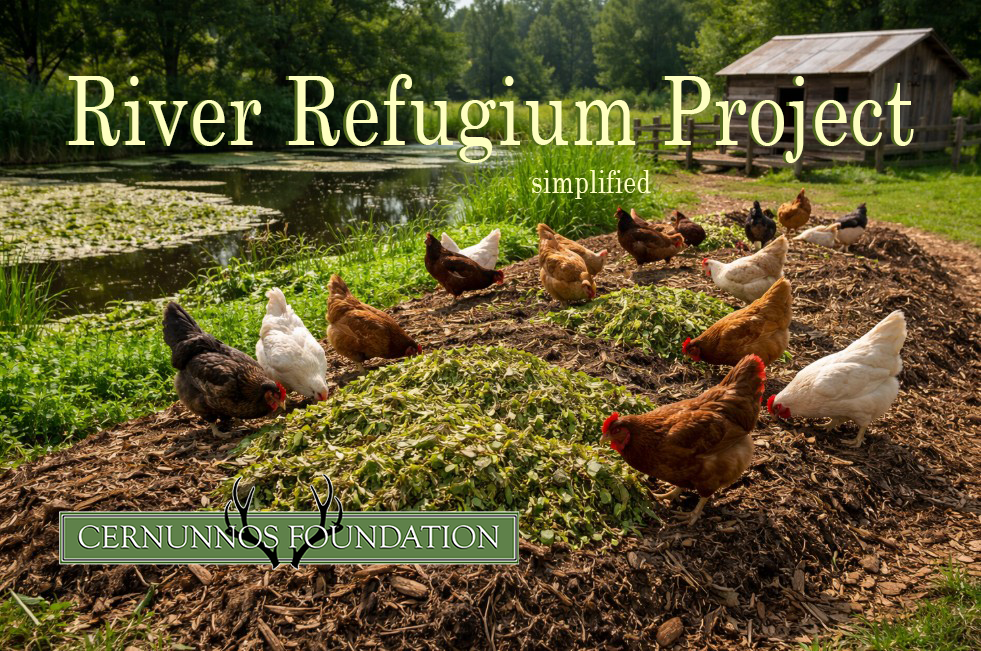
duckweed → compost → chickens → soil → food
No automation.
No proprietary technology.
No advanced infrastructure.
Just biology doing what biology has always done—when we allow it to.
A shallow pond pulls nutrient-loaded water from a creek or river. Duckweed and simple algae spread rapidly, feeding on nitrogen and phosphorus—the very pollutants degrading the watershed. Each harvest physically removes nutrients from the water.
That biomass is layered into compost pads with carbon materials—wood chips, leaves, straw—where it is stabilized, not washed back downstream. Chickens work the piles, converting insect blooms into protein while aerating and enriching the compost.
Nothing from the river goes directly to the table.
Everything passes through living buffers.
What emerges on the other side is not just food, but fertility.
Outputs That Matter to Real Communities
This small, low-tech system produces tangible, valuable outcomes almost immediately.
Cleaner Water
Every harvest of duckweed or algae is a measurable removal of nutrients from the river. Scale comes not from complexity, but repetition.
Food and Protein
Insects feed on plants. Chickens feed on insects. Eggs feed people.
Multiple biological steps ensure safety and resilience.
High-Quality Compost (The Hidden Keystone)
The most important output of this system is often overlooked: exceptional compost.
This compost is:
- Nutrient-dense without being chemically aggressive
- Biologically active, rich in microbes and fungi
- Structurally stable, holding water and nutrients instead of shedding them
- Capable of rebuilding depleted soils, urban lots, gardens, and orchards
It locks river pollution into humus instead of runoff.
It prevents the next generation of nutrient leakage before it happens.
In practical terms, this compost:
- Improves food yields without synthetic inputs
- Restores damaged land
- Reduces future river pollution at the source
It turns a watershed liability into a neighborhood asset.
Education and Ownership
Children understand it. Volunteers can manage it. Communities can own it.
No degrees required.
Just observation, participation, and care.
Why This Matters Now
In the current climate—economic, political, and environmental—complex solutions are often delayed by cost, permission, and institutional friction.
This system bypasses all three.
It is democratic by default.
It is understandable without expertise.
It can be deployed ahead of money.
A neighborhood with basic tools and a small flock can begin cleaning water immediately. Church lots, reservations, abandoned industrial parcels, stormwater easements, and community gardens can host Tier-0 Refugium nodes today.
No one has to wait to begin repairing their relationship with the river.
And when funding does arrive, these systems do not become obsolete.
They become the biological foundation beneath more advanced Refugium infrastructure.
This is not a compromise.
It is proper sequencing.
One Project, Many Doors
The River Refugium Project is not abandoning technical rigor.
It is widening the on-ramp.
There will always be a place for engineered greenhouses, advanced processing, and regional remediation campuses. But there must also be a place for people who are tired of waiting—people who want to clean water, grow food, and rebuild soil with what they already have.
Both approaches matter.
Both are valid.
Both point in the same direction.
A better world does not begin in a lab.
It begins where people decide to act.
Sometimes, all that’s required is a pond, a pile, and the patience to let living systems do their work.
As always for more information about the River Refugium Project you can see our articles here, or go to the