There are buildings that announce themselves, and there are buildings that hold a city.
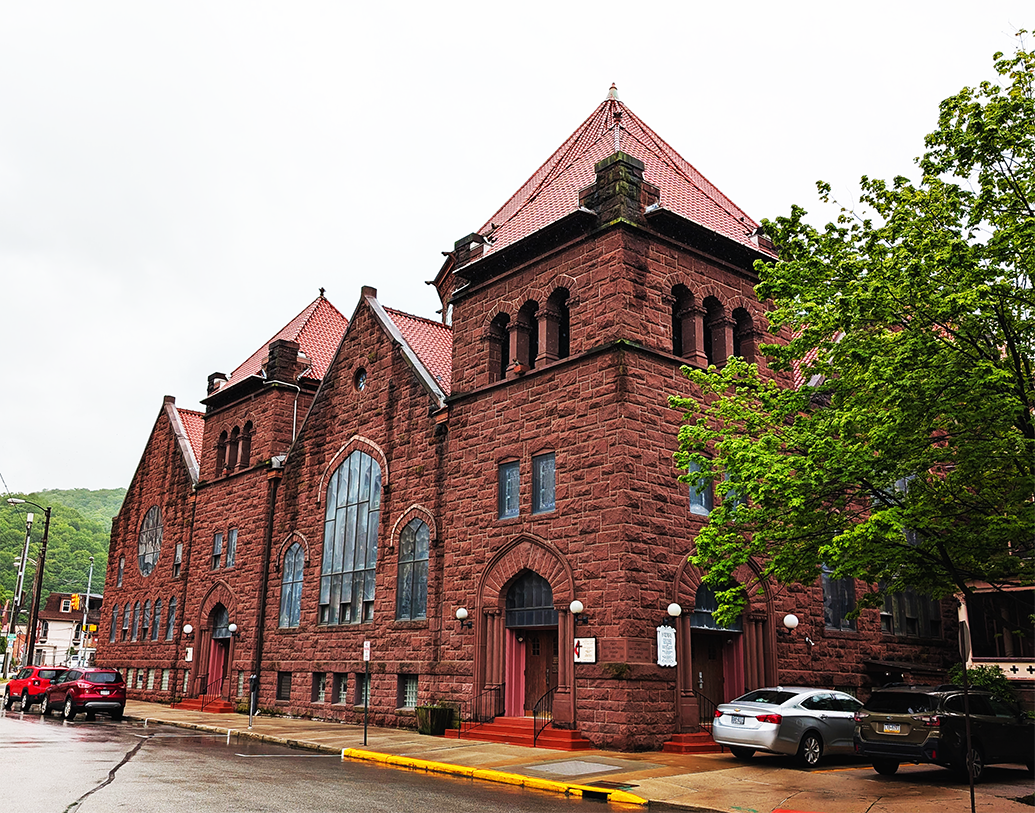
The First United Methodist Church of Johnstown belongs firmly to the second category.
Rising in red-brown stone at the edge of downtown, it does not shout for attention. It anchors. Its weight, proportion, and materiality give it the quiet authority of something that has watched generations pass and expects to watch many more.
A Stone Expression of Permanence
Architecturally, the church speaks in the language of Romanesque Revival, a style chosen not for delicacy but for endurance. The heavy stone walls, deep-set arched openings, and squared towers convey a sense of groundedness — an insistence that this structure was built to remain.
The masonry is doing real work here. The stone is not veneer or gesture; it is mass. Each block contributes to the building’s physical and symbolic gravity, tying it to the industrial and geological reality of Johnstown itself — a city shaped as much by rock and river as by steel and labor.
The steep red-tiled rooflines rise above the stone like a protective crown, softening the severity of the walls below. They add warmth and color without diminishing the building’s seriousness, an architectural balance that mirrors the role churches have traditionally played in working cities: sheltering without retreating, dignified without excess.
Towers, Arches, and Civic Presence
The paired towers are not merely ornamental. They serve as visual markers, orienting the eye and establishing the church as a civic landmark rather than a private enclave. Their arched openings echo medieval precedents, but here they function in a very American way — signaling community, accessibility, and shared space.
The large central window, framed by stone arches, pulls light deep into the sanctuary, bridging interior and exterior. Even from the street, one senses that this is not a sealed monument but a permeable one — a building that breathes with the city around it.
Set directly along the street rather than behind lawns or gates, the church engages Johnstown on equal terms. It belongs to the daily rhythm of traffic, pedestrians, weather, and seasons. It is a place one passes by and passes through, even when one does not enter.
A Witness to Johnstown’s Story
Historically, First United Methodist Church has stood through the full arc of Johnstown’s modern life: prosperity, catastrophe, rebuilding, reinvention. Churches like this were never only places of worship; they were gathering points, relief centers, meeting halls, and emotional ballast during times of crisis.
In a city marked by floods and fires — literal and economic — such buildings became repositories of continuity. Stone churches did not promise escape from hardship; they promised presence within it. Their very durability was part of their ministry.
That legacy remains legible in the building today. Even as the city around it has changed — towers rising and falling, storefronts shifting, traffic patterns rerouting — the church retains its role as a visual and moral fixed point.
Beauty Without Fragility
What makes the First United Methodist Church especially compelling is that its beauty is not fragile. It does not depend on pristine finishes or ornamental excess. Its aesthetic strength comes from proportion, material honesty, and restraint — qualities that age well.
Weather deepens the stone rather than diminishing it. Time adds texture rather than erasing intention. The building improves as it accumulates history.
This is architecture that understands its audience: a city of workers, families, immigrants, and survivors. It does not condescend. It stands with them.
A Quiet Cathedral for a Small City
Johnstown does not need grandiosity to justify itself, and neither does this church. In scale, material, and siting, it feels exactly right for its place — substantial without being domineering, beautiful without being precious.
It is, in many ways, a quiet cathedral: not defined by spires piercing the sky, but by walls that hold memory, shelter, and shared time.
Buildings like the First United Methodist Church remind us that civic beauty is not only found in monuments or museums. Sometimes it is found in the steady presence of a structure that shows up every day, in all weather, asking nothing more than to remain useful and open.
And in a city like Johnstown, that may be the highest architectural calling of all.