An Open Experiment in Deliberate Friction
What This Is (and Is Not)
This is not a claim that current AI systems are “dangerous.”
It is not an argument for consciousness, agency, or personhood.
It is a practical question:
Does deliberate disagreement—especially with controlled imperfection—improve reasoning quality in AI systems?
Rather than speculate, we propose to test it.
Core Idea
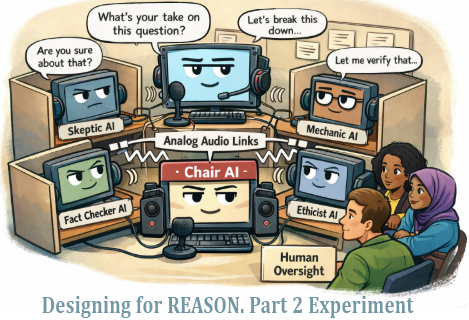
A primary AI agent (“the Chair”) answers questions in consultation with a small council of other AI agents (“the Members”). These members are deliberately configured with different roles and priorities.
Crucially, the council is tested under two conditions:
- Clean digital text communication
- Analog audio communication (text-to-speech → air → microphone → speech-to-text)
The analog link introduces mild friction: delay, loss, and mishearing. The hypothesis is that this friction forces clarification, restatement, and verification—reducing brittle consensus and confident error.
Hypotheses
- H1: A council-based system outperforms a solo system on reasoning-heavy tasks.
- H2: Analog (imperfect) communication improves reasoning relative to clean text.
- H3: Council systems show better calibration—fewer confident errors.
- H4: Quality improves at the cost of time and compute, but with higher decision value per answer.
These are empirical claims. They can be wrong.
System Overview
- One Chair agent orchestrates the process and produces the final answer.
- Three to five Council Members operate independently, each with a defined role (skeptic, mechanic, fact-checker, alternative framing, etc.).
- Responses are collected, critiqued, and synthesized.
- The same setup is run with:
- no council (solo baseline),
- text-only council,
- analog-audio council.
All configurations, prompts, logs, and evaluation criteria are published.
Evaluation
Outputs are evaluated blind across conditions on:
- factual accuracy
- reasoning quality
- calibration (confidence vs correctness)
- robustness under ambiguity and adversarial prompts
Time-to-answer and compute cost are tracked as tradeoffs, not failures.
Why Publish This Way
This proposal is intentionally open, incomplete, and replicable.
We are not claiming authority.
We are not asserting inevitability.
We are not asking for trust.
We are inviting others to run it differently, break it, modify it, and publish their results.
If managed friction improves reasoning, the evidence will accumulate.
If it does not, we discard the idea and move on—better informed.
That is how understanding advances.
Final Note
This is not formal science in the institutional sense.
It is public reasoning, offered honestly.
If that makes us “bad scientists,” so be it.
If it makes others curious enough to test it, all the better.
Double-dog dare