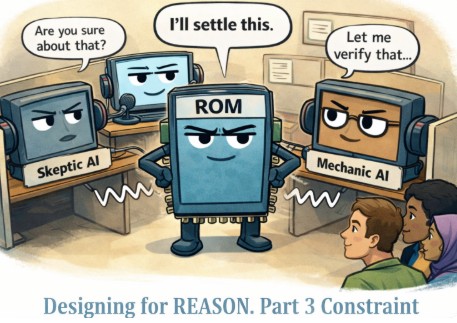
Anchoring Intelligence: ROM as a Stabilizing Constraint
Executive Summary
In earlier pieces, we argued that reasoning improves under constraint, not fluency; that friction is not waste, but a selection mechanism; and that systems reason better when they are forced to survive disagreement, reinterpretation, and delay rather than collapse into premature certainty.
This article adds a new layer to that architecture:
A read-only knowledge layer (ROM) that stabilizes non-debatable facts while preserving productive disagreement everywhere else.
The ROM layer does not think.
It does not reason.
It does not argue.
It simply refuses to change.
That refusal turns out to be useful.
Recap: The System So Far (Briefly)
In Designing for Reasoning, Part I and Part II, we proposed a reasoning architecture built around managed friction rather than raw efficiency.
The system consists of:
- A Chair agent responsible for synthesis and final output
- A Council of independent agents with distinct roles
- Deliberate friction introduced through:
- role disagreement
- perspective shifts
- bandwidth and precision changes
- translation and reinterpretation
Evaluation focused on:
- reasoning quality
- calibration (confidence vs correctness)
- robustness under ambiguity
- tradeoffs in time and compute
The core claim was simple:
Efficiency produces answers.
Friction produces understanding.
What was missing was a way to stabilize foundational knowledge without collapsing the system back into a single authoritative voice.
That is where ROM enters.
What the ROM Layer Is (and Is Not)
The ROM layer is a read-only reference substrate containing information that is:
- stable across time (or explicitly versioned)
- not meaningfully debatable
- catastrophic if hallucinated
Examples include:
- unit conversions
- physical constants (with pinned editions)
- mathematical identities
- basic algebra and trigonometry rules
- well-defined tables used across engineering, science, and computation
The ROM layer is not:
- a source of interpretation
- a source of authority
- a replacement for reasoning
- a semantic search engine
It does not answer questions.
It constrains answers.
Why ROM Is a Constraint, Not a Shortcut
ROM is slow in the only way that matters:
it slows commitment.
When a reasoning system must:
- explicitly consult immutable references
- reconcile fuzzy internal beliefs with fixed external facts
- acknowledge lookup failure or version mismatch
…then confidence becomes expensive.
That expense is intentional.
ROM introduces a hard boundary between:
- what can be reasoned about
- and what must be grounded
This aligns with the earlier claim that hallucination is not a lack of knowledge, but a failure of constraint.
ROM does not eliminate disagreement.
It localizes it.
A Walk Through the System (As a Story)
Consider a mixed-domain question:
How much kinetic energy would a 1,200-kg satellite traveling at low-Earth-orbit velocity release on atmospheric breakup, and how does that compare to a conventional explosive?
Step 1: The Chair — CTRL_CORE
The Chair does not answer. It decomposes the task:
- physics formula
- constants
- unit conversions
- interpretation and comparison framing
Work is assigned.
Step 2: The Council
- ALU_FAST — Exploratory Reasoner
Generates rough conceptual estimates. No commitment. - FPU_STRICT — Mathematical Formalist
Identifies exact equations and flags missing variables. - MMU_CHECK — Memory and Units Auditor
Refuses to proceed without verified constants. Requests ROM. - BRANCH_SKEPTIC — Counterfactual Critic
Challenges assumptions and framing.
Disagreement emerges naturally.
Step 3: ROM Contact — ROM_BASE
ROM returns:
- symbolic formulas
- versioned constants
- conversion tables
No prose.
No interpretation.
No confidence.
Just facts that do not bend.
Step 4: Constraint Propagation
ROM data re-enters the system:
- sloppy estimates collapse
- recalculations tighten
- critiques adjust to scale
- unsupported assumptions die quietly
This is not consensus by authority.
It is selection by survival.
Step 5: Synthesis
Only now does the Chair compose an answer—annotated, qualified, and calibrated.
Confidence is earned, not assumed.
What Changed Because of ROM
Without ROM:
- answers may still sound correct
- errors remain coherent
- confidence is cheap
With ROM:
- numeric hallucinations are expensive
- factual drift is localized
- disagreement happens before output
ROM does not make the system smarter.
It makes it harder to be wrong quietly.
Technical View (Condensed)
Architecturally, ROM functions as:
- a deterministic key-value store
- versioned and hash-stable
- queried only for checkable claims
Enforced via:
- mandatory lookup for verifiable claims
- downgrade or rejection on lookup failure
- separation between retrieval and explanation
ROM is accessed before synthesis, not after.
Why This Remains Open and Experimental
This architecture:
- increases latency
- increases compute cost
- reduces throughput
Those are not bugs.
They are tradeoffs.
The question is not whether this system is “better” universally—but whether it produces higher-value reasoning per answer when correctness matters.
That is an empirical question.
Open Invitation
This system is not proprietary.
It is not complete.
It is not protected.
Try it.
Replace ROM with your own trusted tables.
Add or remove council roles.
Measure where it helps and where it fails.
Publish what breaks.
If managed friction improves reasoning, evidence will accumulate.
If it does not, we discard the idea and move on—better informed.
That is how understanding advances.