Let’s Start With What Everyone Agrees On
Mark Cuban changed the healthcare conversation in the United States in a way very few people ever manage to change anything.
He proved the problem was not innovation.
Not complexity.
Not inevitability.
It was opacity.
It was margin stacking.
It was a system designed to hide its own mechanics.
Cost Plus Drugs did something radical by being simple.
Transparent pricing.
Reasonable margins.
No mystical justifications.
No moral speeches—just arithmetic.
And in doing so, it demonstrated something many people insisted was impossible: ethical profit is not only viable, it is competitive.
This article is not written against Mark Cuban.
It is written because of what he has already demonstrated.
The Real Constraint Is Not Medicine
If drug pricing were the core problem, Cost Plus Drugs would have solved healthcare already.
It didn’t—because drugs are only one choke point.
The real abstraction layer in American healthcare is insurance.
Strip insurance of its branding, marketing, executive churn, adversarial denial mechanisms, and financial engineering, and what remains is not mysterious. It is a pooled risk model.
People pay in when they can.
They draw support when they must.
Costs are spread across time and population.
A centralized insurance model is single-payer, whether the government runs it or not.
That statement is not ideological.
It is mechanical.
Every healthcare argument eventually collapses here, because insurance is where cost becomes either a shared burden—or a private weapon.
Capitalism With Constraints Is Not Socialism
It’s Engineering
Adam Smith is often invoked by people who have clearly not read him past the first applause line. Smith warned explicitly about unchecked accumulation, concentrated power, and markets divorced from moral restraint.
He understood that capitalism without boundaries does not self-correct.
It metastasizes.
An ethically profitable insurance model is not a contradiction.
It is a design choice.
Such a model would include:
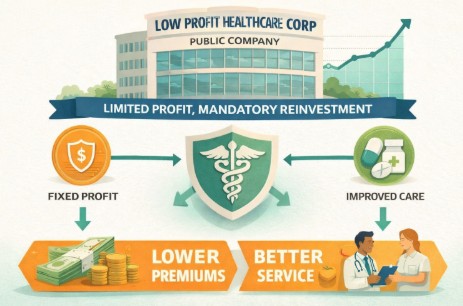
- Hard profit caps
- Minimum wage floors and executive pay ratios
- Automatic reinvestment into lower premiums
- Cooperative or member-owned governance
- Voluntary, opt-in participation
- Radical transparency of books and outcomes
This is not charity.
This is not socialism.
This is systems engineering.
When extraction is capped, efficiency moves to care delivery—not financial gamesmanship. When governance is shared, incentives align. When profit is constrained, innovation goes where it actually helps people live.
Why Mark Cuban, Specifically
I am broadly anti-billionaire. Not rhetorically—structurally. No one needs that much wealth. No family requires it to survive. No moral framework survives its concentration intact, especially in a world where children are hungry in the same timeline.
So let me be clear:
I am picking on Mark Cuban because he is one of the very few people in that class I believe might actually do this.
Not because he is rich—but because he already discarded the hardest lies.
He understands healthcare economics.
He has credibility across political lines.
He can absorb early losses without existential risk.
He does not need permission.
And most importantly: he has already shown a willingness to cap margins and ignore conventional wealth-maximization dogma.
This is not about his money.
It is about his demonstrated capacity to say “no” to the rules that made him rich.
That is rare.
Why Not Just Give the Money Away?
Because charity does not restructure systems.
Ownership and governance do.
Spending money is easy. Designing institutions that outlive you is not.
Insurance is leverage. It scales compassion without requiring moral agreement. It turns care into infrastructure instead of a favor. It creates a durable counterexample to a system that insists suffering is the price of efficiency.
If single-payer will not be delivered through government, it can still be proven through design.
An Invitation, Not a Demand
This is not a callout.
This is not a threat.
This is not a purity test.
It is an invitation to finish a proof.
If ethical profit works in medicine—and it does—what would it look like to apply the same discipline to insurance itself?
What would it look like for someone who already won the accumulation game to disavow the rules that created it—and spend the rest of their life removing the bottleneck that keeps millions from care?
History does not remember who accumulated the most.
It remembers who removed constraints everyone else insisted were immovable.
The Choice That Remains
Mark Cuban is already the best of a class that should not exist.
That class exists because our systems reward accumulation far past usefulness, far past security, and far past any defensible relationship to human need. In that sense, being “the best” billionaire is not moral absolution—it is simply evidence that even within a broken incentive structure, some people resist becoming monsters.
Cuban has. Repeatedly. Publicly. At personal cost.
But that is not the end of the story.
It is the setup.
The truly radical move is not to be the most ethical participant in a harmful system.
It is to make the system itself unnecessary.
Cuban does not need more money. His family does not need it. No realistic future scenario requires it. At this point, continued accumulation is not about survival or prudence—it is about habit, momentum, and the gravitational pull of the rules that made him who he is.
Disregarding them would be the most disciplined act of his life.
He could remain the best of a class that should not exist.
Or he could be the person who proved it didn’t need to.
That choice would echo longer than any fortune ever could.