The Johnstown Tribune Building
Small-City Architecture, the Free Press, and the Quiet Work of Beauty
There are buildings that shout, and buildings that hold.
This one holds.
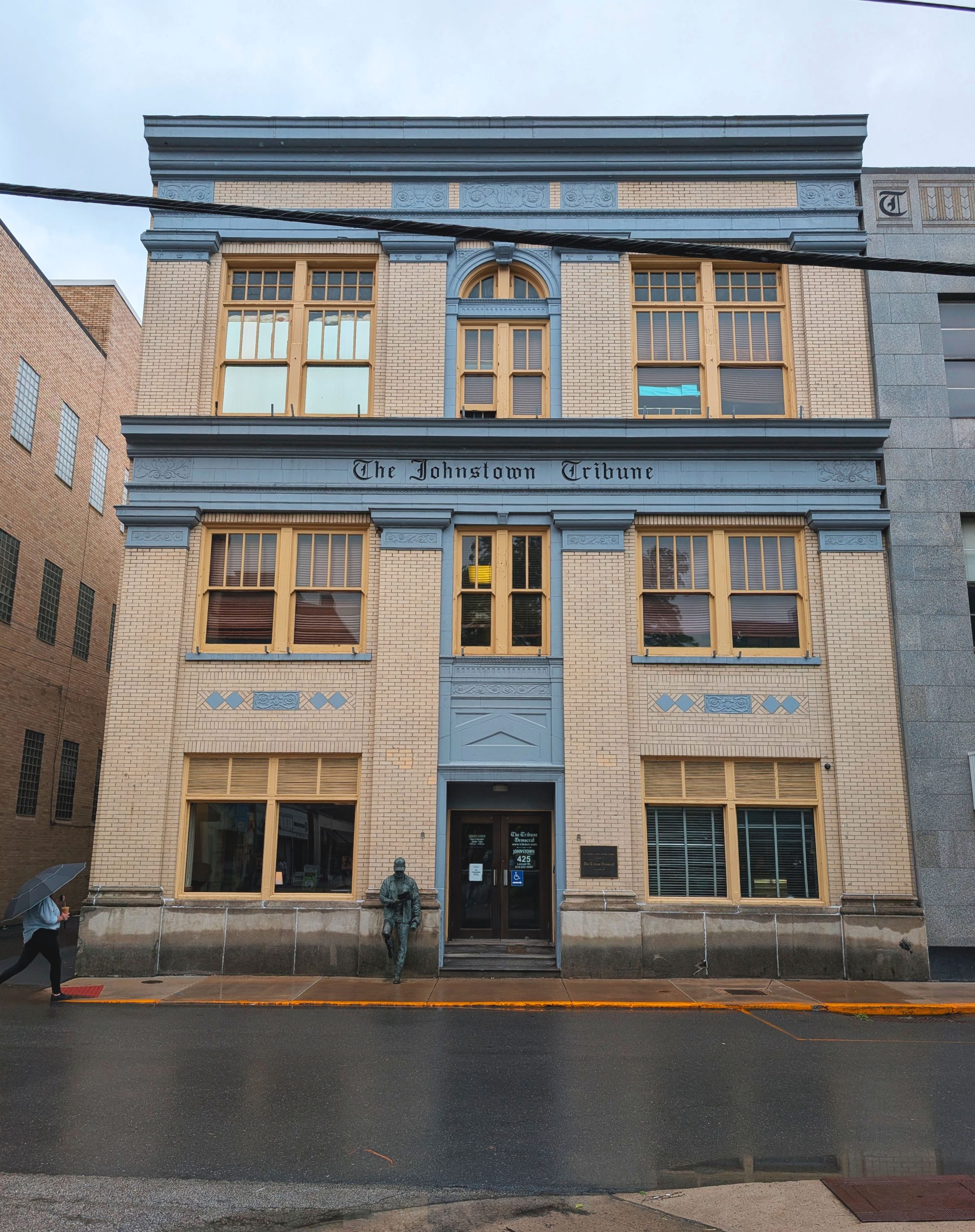
The façade at The Johnstown Tribune Building does not try to dominate the street. It does not beg attention. It stands squarely in the rhythm of the block—brick, symmetry, proportion, ornament restrained enough to age well. It was built to be dependable, not fashionable. That alone tells you what it was for.
Inside those walls lived The Johnstown Tribune, a small-city paper doing the unglamorous work of recording what happened, who said what, who was elected, who was hurt, who helped, who failed. Not mythmaking. Not propaganda. Just the daily accumulation of fact, argument, and public memory.
That matters more than we like to admit.
Architecture as Civic Behavior
Good small-city architecture is not about spectacle. It is about trust.
The Tribune building communicates that trust in brick and stone. The windows are large enough to suggest openness, but not theatrical. The ornamentation exists to reward attention, not demand it. The symmetry calms the eye. Even the name set into the façade feels declarative rather than boastful—this is what happens here.
This is how civic buildings used to behave. They were designed to last longer than the people inside them, and to feel legitimate even when you disagreed with what was written within their walls.
We’ve largely forgotten that standard.
Today, too much new construction is optimized for speed, cost extraction, or visual novelty. It photographs well and ages badly. It treats the street like a backdrop instead of a shared space. In contrast, this building understands the street as a conversation across generations.
That is not nostalgia. That is systems thinking.
The Free Press Is Not a Mood
It’s an Infrastructure
There is a temptation to talk about “the free press” as an abstract ideal—something emotional, something partisan, something that belongs to arguments on cable news.
That’s wrong.
The free press is infrastructure.
It is the physical ability of people to print, distribute, criticize, investigate, and dissent without prior permission. It is messy by design. It is frequently wrong in detail and essential in function. It does not exist to make us comfortable; it exists to make power uncomfortable.
Nothing is more valuable than our inherent right to think as we choose and to express those thoughts without persecution. Only actions are violable by law. Ideas must remain free—or they rot in secret and return as something far worse.
A small-city newspaper building embodies that principle in a way national platforms cannot. It sits where you live. It covers people you know. It cannot hide behind abstraction.
That proximity is its strength.
Density Is Not the Enemy
Yes, this is a dense piece for a Johnstown / Manmade article. That’s intentional.
Small cities deserve serious thought. In fact, they require it more than large ones. Big cities can survive incoherence through sheer momentum. Small cities cannot. They live or die by whether people feel their daily environment is worth caring about.
Architecture plays a larger role here than we usually acknowledge.
When buildings are thoughtful, people behave more thoughtfully. When streets feel respected, residents reciprocate. When beauty is present—not luxury, not excess, but care—it quietly raises the standard of what feels acceptable everywhere else.
The Tribune building does not solve modern media’s problems. But it reminds us that the work was once grounded in place, craft, and continuity.
Those are not outdated values. They are missing ones.
Renewing the Commitment
Renewing our commitment to beauty does not mean freezing cities in amber. It means remembering that everyday environments shape everyday thinking. That how we build reflects what we believe people deserve.
A small city that invests in proportion, material honesty, and human-scale design is making a statement: you matter enough for us to try.
A society that protects the freedom to think and publish—even when it’s inconvenient—is doing the same.
This building stands at the intersection of those ideas.
Quiet. Solid. Still useful.
That’s not just architecture.
That’s civic memory, holding its ground in the rain.