A Local Ownership Model for Johnstown and Cambria County
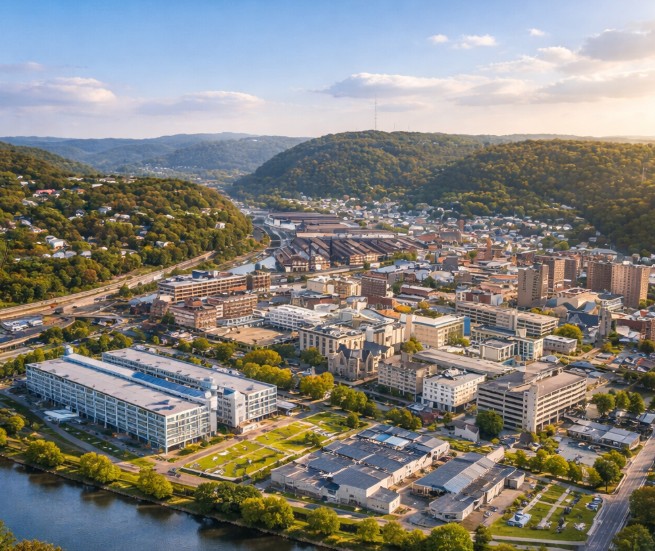
(This could work anywhere and should. Also site selection on the image was for convenience. No plans exist.)
Right now, communities are being told they must accept data centers — along with their energy demands, land-use impacts, and long-term risks — in exchange for jobs, tax base, and vague promises of “innovation.”
That framing is backwards.
Cambria County — and Johnstown in particular — should not be asking which tech firm to bring a data center here. We should be asking why we wouldn’t own one ourselves.
The Core Idea
Instead of courting an external hyperscaler to build a privately controlled data center, the region should:
- Invest in the data center directly
- Lock local government and regional institutions into its founding and governance
- Operate it as civic-scale infrastructure, not extractive real estate
In other words:
Treat compute the way we once treated power, water, and rail.
Why Johnstown Is Uniquely Positioned
Cambria County already has three things most regions don’t.
Energy capacity and industrial legacy
The infrastructure mindset is already here. This is not a community afraid of heavy systems.
Available land and cooling advantages
Climate, topography, and land cost favor long-term operation — not speculative flipping.
A need for durable, non-extractive investment
The region does not need another short-cycle employer. It needs assets that stay.
A publicly anchored data center converts those strengths into permanent leverage.
Why Ownership Matters
When a data center is privately owned and externally controlled:
- The community absorbs environmental cost
- The firm captures long-term value
- Knowledge flows outward
- Design decisions optimize for shareholder return, not regional resilience
When the community is an owner:
- Design can prioritize energy efficiency, waste-heat reuse, and ecological integration
- Power sourcing can align with regional sustainability goals
- Compute capacity can be allocated to:
- local universities
- workforce training
- research partnerships
- civic data archives
- regional modeling and analysis work
This turns a data center from a black box into a knowledge utility.
A Civic Compute Model (High Level)
Structure
- County and municipal participation at founding
- Long-term public stake (not symbolic, not advisory)
- Professional technical operation — this is not amateur hour
Revenue
- Lease excess capacity to private firms
- Host enterprise and research workloads
- Provide secure regional services
- Generate stable returns that feed back into the county
Governance
- Local control over expansion, energy sourcing, and land use
- Transparent reporting
- Public accountability without political micromanagement
Environmental Opportunity (Not Just Mitigation)
If you control the design, you can do more than “reduce harm”:
- Co-locate with renewable generation
- Use waste heat for greenhouses, district heating, or industrial reuse
- Build cooling systems that complement watershed management
- Treat the facility as part of the ecosystem, not an intrusion on it
That is impossible if the center is owned elsewhere.
Why This Scales to the State Level
Pennsylvania doesn’t need one mega data-center strategy.
It needs many locally anchored ones.
A state-level program could:
- Provide seed capital
- Set technical and environmental standards
- Allocate compute infrastructure to counties, not corporations
That approach:
- Keeps power local
- Diffuses economic and operational risk
- Prevents single-point failures
- Builds a distributed, resilient technical backbone
Johnstown could be the pilot.
The Strategic Reframe
This isn’t about “becoming Silicon Valley.”
It’s about owning the next layer of infrastructure instead of renting it.
Data centers are not just buildings. They are:
- energy nodes
- knowledge concentrators
- future decision engines
Communities that own them shape their future.
Communities that host them rent it out.
Johnstown already paid the price of being an extraction zone once.
This time, it should own the machine.