Name is Philip Randolph Wright. Mr. Wright if we are doing business.
Let’s get something straight before we go any further.
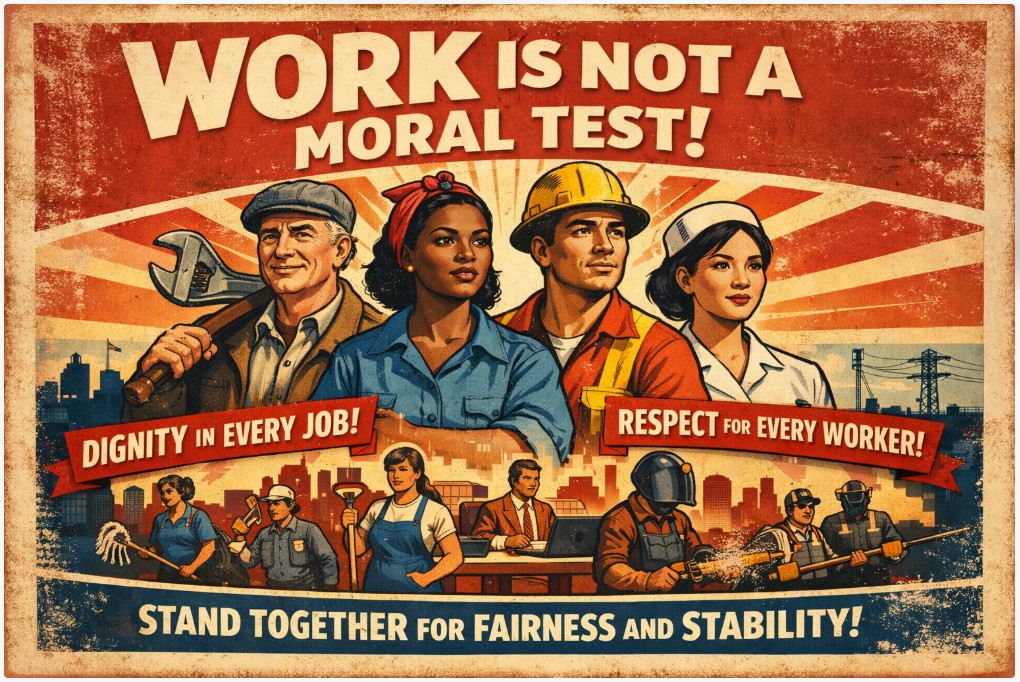
Work is not a moral test.
It never was.
Somewhere along the way, we decided that a person’s job was a verdict on their worth. That pay was a character judgment. That comfort had to be earned not just with effort, but with the right kind of effort, performed in the right kind of way, under the right kind of authority.
That idea didn’t come from workers.
It came from people who needed a reason not to pay them fairly.
My father worked hard his whole life. He wore a uniform. He carried other people’s things. He stood when others sat. He named me after a man who taught America that dignity does not come from status — it comes from standing together. That lesson stuck.
He used to tell me:
“Son, the work is just the work.
The measure is how you do it —
and how you treat the person next to you.”
That’s still true.
The Lie We Built an Economy On
We like to pretend that wages are about merit.
They aren’t.
They’re about leverage.
If pay were about merit, the most necessary jobs would be the most secure. The people who keep systems running would never be one missed paycheck away from disaster. The work that everything depends on would be treated like infrastructure — because that’s what it is.
Instead, we tell ourselves a story.
We say:
- If it paid more, it must matter more.
- If it paid less, it must be easier.
- If you’re struggling, you must have chosen wrong.
That story is useful. It keeps people quiet. It keeps them competing with each other instead of asking harder questions.
But it doesn’t hold up under inspection.
I’ve watched people with immaculate résumés fold under pressure.
I’ve watched people with no titles carry entire operations on their backs.
Skill is real.
Effort is real.
Discipline is real.
But none of those things explain why so many people who do everything right still can’t get their footing.
That’s not failure.
That’s design.
What Work Actually Is
Work is participation.
That’s it.
You show up.
You give time.
You apply effort.
You carry responsibility.
Some people do that with tools.
Some do it with keyboards.
Some do it with bodies worn down over decades.
Some do it in jobs no one notices until they’re gone.
The form changes.
The function doesn’t.
A republic depends on that participation. Not in theory — in practice. Roads don’t maintain themselves. Systems don’t self-correct. People don’t thrive by accident.
If a society relies on someone’s labor, it has already admitted that labor has value.
The argument starts — and should end — right there.
Discipline Is Not Punishment
I believe in discipline. Always have.
But discipline is not deprivation.
And it is not humiliation.
Real discipline builds freedom. It gives people predictability. It lets them plan. It lets them stand up straight because they know where the floor is.
A system that keeps people perpetually unstable is not disciplined.
It’s sloppy.
You don’t motivate people by keeping them scared.
You don’t build excellence by making survival a daily contest.
You don’t strengthen a republic by treating stability like a reward instead of a baseline.
That’s not toughness.
That’s negligence.
Why We Never Say What I Do
People ask sometimes:
“What line of work are you in?”
I usually smile and change the subject.
Because the minute you name a trade, folks start sorting. They decide how much respect to give you. How seriously to listen. Whether your words count as wisdom or complaint.
That tells you everything you need to know about the problem.
Work isn’t supposed to be a hierarchy of dignity.
It’s supposed to be a division of labor.
Different jobs.
Same respect.
If you need someone to do it, you owe them a life that works.
Not luxury.
Not praise.
Stability.
A Republican Truth We Forgot
This isn’t radical.
It’s conservative in the old sense of the word.
A republic cannot survive on desperation. It requires citizens who can think beyond tomorrow, who can participate without fear, who can disagree without risking their families’ survival.
You want civic engagement?
You want responsibility?
You want pride in work?
Then stop treating stability like charity.
Stability is infrastructure.
And like any infrastructure, if you neglect it long enough, it collapses — quietly at first, and then all at once.
The Measure
I’ve never believed in grading people by their titles.
I believe in measure.
- Do you show up?
- Do you do the work honestly?
- Do you respect the people around you?
- Do you leave things better than you found them?
If the answer is yes, then you’ve met your obligation.
The system should meet its own.
Work is not a moral test.
It is a contribution.
And anyone who contributes deserves a fair shot at a steady life.
That’s not politics.
That’s the deal.
Now you know, Jack.