— A Challenge, Not a Comfort —
There’s a line that gets attributed to Khalil Gibran, though like most lines that endure, it may belong to no one in particular:
“A society grows great when old men plant trees whose shade they know they shall never sit in.”
Whether Gibran said it, or someone wiser and quieter did, doesn’t really matter. The idea survived because it needed to.
I won’t pretend to be wise. I don’t think I’ve earned that word yet, and I’m suspicious of anyone who claims they have. I’ve wasted time. I’ve missed chances. I’ve taken longer routes than necessary. Like most people, I learned certain lessons only after they became unavoidable.
But I would like to become wiser.
And if planting trees I will never sit under is how one moves in that direction, then that seems like a reasonable place to begin.
This essay is not really about trees—though it is also, very much, about trees.
The tree is a metaphor for any act whose benefit arrives after you are no longer the beneficiary. Any effort made without expectation of reward, recognition, or control. Any work done because it improves the world slightly, not because it pays you back.
That kind of thinking has fallen out of fashion.
We are trained—subtly, relentlessly—to optimize for short horizons. Quarterly returns. Immediate outcomes. Personal brands. Measurable wins. Even our politics and economics have been compressed into cycles too short to allow roots to take hold.
The result is predictable. We inherit systems built for extraction, not stewardship. Ownership concentrates. Control narrows. People begin to feel as though their lives are being managed by forces they neither elected nor benefit from.
When everything is optimized for harvest, nothing is left to grow.
Planting trees—again, metaphorically—pushes back against that logic. It says: I am willing to work for a future that does not belong to me. It reframes success as continuity rather than conquest.
This is not a call to sainthood. It’s a call to responsibility.
You don’t need to agree on what kind of world should come next. You don’t need to share values, politics, or aesthetics. You only need to accept one premise: that leaving things marginally better than you found them is preferable to leaving them stripped bare.
Plant the tree you know how to plant.
If you’re an engineer, build systems that fail gracefully instead of catastrophically.
If you’re a teacher, teach something that won’t be on the test.
If you’re an artist, make something that reminds people they’re human.
If you’re a neighbor, make your street a little kinder.
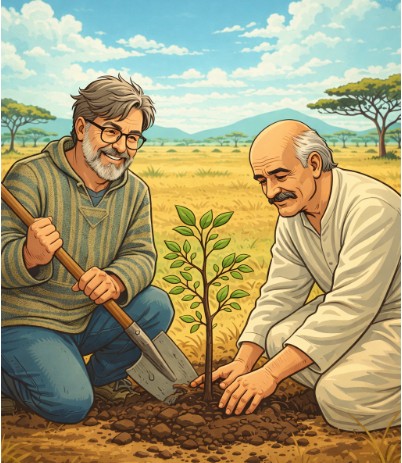
And yes—if you genuinely can’t think of anything else that simply makes things better, plant an actual tree.
Choose a species that fits the soil. Pay attention to where it will thrive. Accept that you won’t control how it grows, or who enjoys it, or what they think of the person who planted it.
That’s the point.
Planting trees—literal or otherwise—is an act that refuses domination as a measure of success. It rejects the idea that the people who own everything should also decide what matters. It insists that ordinary people, doing quiet, competent work, still shape the future.
Someone will enjoy the shade.
You don’t get to choose who.
You don’t get to be thanked.
You don’t even get to be remembered.
If that feels unsatisfying, it’s worth asking why.
Wisdom may not be something we ever arrive at. It may be something we practice, imperfectly, by choosing long horizons over short rewards and stewardship over control.
So consider this a challenge—not to be wise, but to act as though wisdom were possible.
Plant something that outlives you.