Or: What Extreme Wealth Does to a Person
There is a certain kind of wealth that doesn’t simply avoid taxes.
It replaces them.
Not by accident. Not through clever bookkeeping alone. But intentionally—by rerouting money through people instead of systems, through favors instead of obligations, through discretion instead of duty.
That distinction matters.
Because avoiding control is one thing.
Withholding relief is another.
Control Isn’t the Whole Story
I understand the argument about control. I really do.
No one likes being told what to do with their money. There is a long tradition—especially among the wealthy—of framing taxation as confiscation, inefficiency, or moral hazard. We’ve heard every version of it, from libertarian treatises to cocktail-party talking points.
Fine. That debate is old.
But once someone amasses a billion dollars, control is no longer the relevant concern. At that scale, the state isn’t steering you. You can buy privacy, lawyers, distance, insulation. You can opt out of almost everything that constrains ordinary life.
Which leaves only one thing in play: choice.
And choice is where character lives.
A Billion Dollars Is Not Neutral
We talk about extreme wealth as if it’s just arithmetic — a scoreboard outcome, a measure of talent or luck or timing.
It isn’t.
A billion dollars is a moral condition.
To hold that much surplus in a world where people nearby are cold, hungry, sick, or one paycheck from collapse requires a level of internal tolerance that most people never have to cultivate.
This isn’t about global poverty in the abstract. It’s about proximity.
The worker who cleans your office.
The driver who delivers your food.
The neighborhood you pass through on the way to somewhere better.
At a certain point, ignorance stops being plausible. What remains is acceptance.
Paying People Instead of Supporting Systems
Taxes are impersonal. That’s their strength.
They don’t flatter donors.
They don’t reward loyalty.
They don’t require gratitude.
They don’t allow you to decide who is deserving.
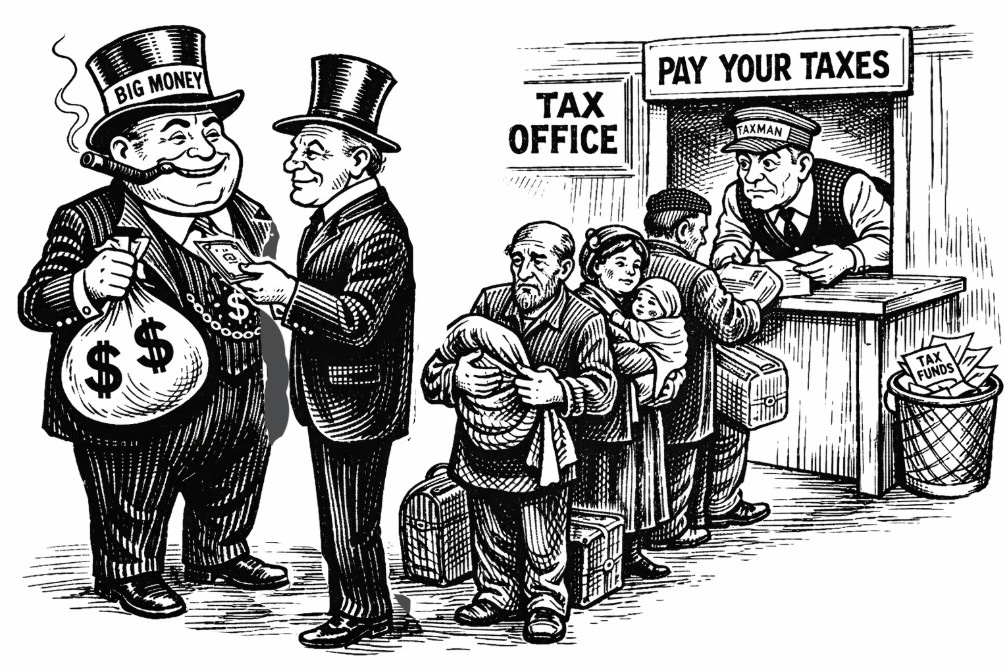
Bribes, “donations,” bespoke exemptions, quiet payments — whatever polite name they go by — do the opposite.
They turn shared obligation into private discretion.
They allow wealth to decide:
- who gets help,
- who gets relief,
- who gets ignored.
That is not efficiency. It is preference masquerading as principle.
And when practiced at scale, it hollows out the idea of a society entirely.