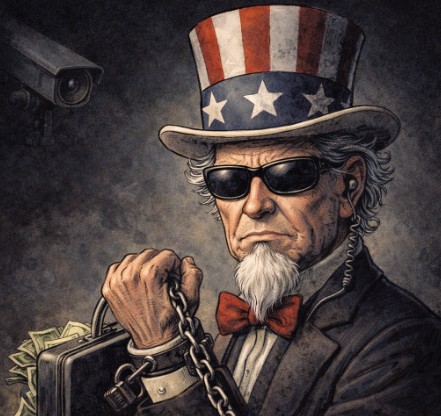
We are told, constantly, that our data is “secure.”
Encrypted.
Protected.
Safeguarded by policy, compliance, and best practices.
This is a comforting story.
It is also a lie.
Modern computing does not operate on a spectrum of secrecy. It operates on a binary.
On or off.
Accessible or inaccessible.
And if something is accessible to anyone, it is accessible to someone else.
Always.
What “Security” Actually Means
Your security systems do not protect your data from thieves.
They protect it from thieves except:
- The people who control the system
- The people who wrote the code
- The people who installed the backdoors
- The people who bought the exploits
- The people who purchased stolen access
- The companies you did business with
- The partners they shared it with
- The brokers who resold it
- The agencies that requested it
- The vendors who mirrored it
In other words:
They protect it from almost no one who matters.
Terms, Conditions, and Surrender
Every time you click “I Agree,” you are not accepting convenience.
You are surrendering control.
You are authorizing:
Collection.
Aggregation.
Analysis.
Retention.
Sharing.
Resale.
Legally.
Permanently.
And almost always without meaningful transparency.
Your “privacy” is not protected.
It is licensed.
The Inversion of Ownership
Here is the uncomfortable truth:
Corporate America and the federal government know more about you than you do.
Your purchasing history.
Your movement patterns.
Your communications metadata.
Your behavioral profiles.
Your psychological indicators.
Your risk scores.
They can retrieve it in seconds.
You cannot.
Try this experiment.
Ask your employer for your complete personnel file.
Especially if you work for the government.
Request:
Every note.
Every evaluation.
Every internal comment.
Every algorithmic score.
Every background profile.
Then wait.
FOIA: The Theater of Transparency
If you file a Freedom of Information Act request, you will learn something important.
Not about your data.
About power.
You will wait months.
Sometimes years.
And when the response comes, it will arrive:
Redacted.
Fragmented.
Contextless.
Information about you will be hidden from you.
In your own file.
In your own name.
At public expense.
That is not transparency.
That is administrative secrecy.
Intellectual Property and Digital Illusion
We spend trillions protecting “intellectual property.”
Patents.
Licenses.
Trade secrets.
Copyright.
Whole economies are built on it.
Yet in practice, digital information is infinitely copyable.
Instantly transferable.
Perfectly replicable.
Impossible to fully contain.
We pretend control exists because admitting otherwise would collapse business models.
Privacy operates the same way.
A necessary fiction.
Why This Matters
Secrecy in a digital society is power.
Not safety.
Not stability.
Not protection.
Power.
It determines:
Who sees.
Who knows.
Who decides.
Who is exposed.
Who is shielded.
And it is almost never the public.
The Case for Radical Transparency
If personal data cannot truly be secured, then the ethical response is not deeper secrecy.
It is symmetry.
If institutions can see us,
we must be able to see them.
If they can profile us,
we must be able to inspect the profiles.
If they can retain our records,
we must have immediate access.
No delays.
No redactions.
No bureaucratic theater.
Government Secrecy: The Narrow Exception
There is only one legitimate category for secrecy:
Active military operations.
Even that must be:
Time-limited.
Judicially supervised.
Continuously audited.
Automatically reviewed.
No permanent black boxes.
No parallel governments.
No classified empires.
Everything else belongs in the open.
The Reality We Live In
We are already transparent.
Our movements.
Our habits.
Our finances.
Our relationships.
Our weaknesses.
Only citizens are expected to pretend otherwise.
Institutions are not.
That imbalance is the real security threat.
The Bottom Line
Web security is not protection.
It is permission management.
Privacy is not preserved.
It is negotiated away.
Secrecy is not safety.
It is leverage.
Until we confront that honestly, we will keep funding systems that watch us while forbidding us from watching back.
And calling it freedom.