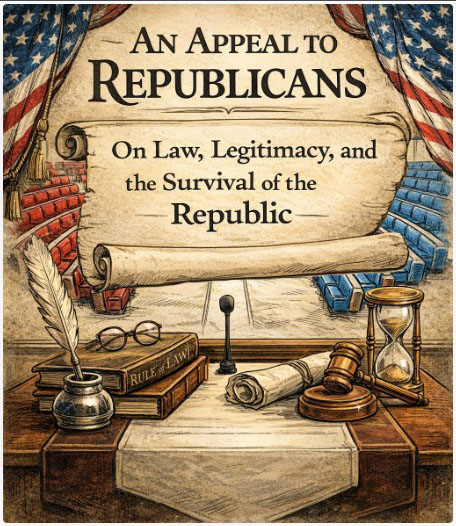
On Law, Legitimacy, and the Survival of the Republic
There comes a moment in every republic when loyalty to party, faction, and temporary advantage must give way to loyalty to the system itself.
We are living in such a moment now.
This is not a question of left versus right.
It is not a question of cultural alignment, ideological purity, or electoral strategy.
It is a question of whether the rule of law remains sovereign in the United States—or whether it is replaced by expedience, immunity, and selective enforcement.
A republic does not collapse when its leaders are imperfect.
It collapses when its leaders are no longer accountable.
For generations, Americans—especially conservatives—have argued, rightly, that no person stands above the law. That phrase has been repeated so often that it risks becoming hollow. Yet its meaning remains as sharp and demanding as ever: power must submit to rules, not the reverse.
The founders did not design this country to be governed by personalities. They designed it to be governed by procedures, constraints, and competing authorities. They understood something modern politics often forgets: human beings are fallible, ambitious, emotional, and tempted by power. Systems exist precisely because virtue alone is not enough.
James Madison did not trust men.
He trusted structure.
And that structure only works when those who benefit from it are willing to restrain themselves.
The Danger of Selective Legitimacy
When enforcement becomes partisan, law becomes theater.
When investigation becomes retaliation, justice becomes factional.
When accountability depends on political alignment, the republic begins to resemble the very systems it once opposed.
At that point, legality is no longer a neutral standard. It becomes a weapon.
And once that transformation occurs, no faction remains safe.
History is unambiguous on this point: regimes that tolerate lawlessness among their allies eventually normalize lawlessness everywhere. Immunity granted today becomes precedent tomorrow. Exceptionalism metastasizes into routine corruption.
No party controls history’s direction indefinitely.
Every dominant faction eventually loses power.
The question is whether it leaves behind functioning institutions—or a hollowed shell waiting to be exploited.
Why This Moment Matters
If action is taken now—firmly, openly, and within constitutional channels—it can be done with clarity and unity. It can be done as a reaffirmation of conservative principles: legality, restraint, institutional integrity, and equal application of the law.
It can be done as Republicans standing together, not against the nation, but for it.
Later, the situation becomes more dangerous.
Later, accountability looks like revenge.
Later, investigation looks like purge.
Later, reform looks like instability.
Delay transforms correction into crisis.
And crisis invites forces that no one ultimately controls.
The International Dimension
The United States does not govern in isolation.
Every action taken—or avoided—is observed, analyzed, and interpreted by allies and adversaries alike.
When legal norms erode here, authoritarians elsewhere celebrate quietly.
When accountability falters here, democratic movements abroad weaken.
When power becomes untethered from law here, every lecture on human rights, governance, and transparency loses credibility.
A nation that abandons its own principles cannot credibly defend them abroad.
The question is not merely how we appear.
It is what we become.
Are we a constitutional republic governed by institutions?
Or a state where loyalty determines legality?
The world is watching, because the answer matters far beyond our borders.
Conservatism and Institutional Stewardship
Conservatism, at its best, is not reactionary.
It is custodial.
It understands that civilization is fragile, that order is hard-won, and that inherited systems deserve respect precisely because they took centuries to build and moments to destroy.
A conservative who defends institutions against corruption—even when inconvenient—is acting in the deepest tradition of the movement.
Burke understood this.
Madison understood this.
Lincoln understood this.
They knew that preserving a republic sometimes requires confronting one’s own allies.
Not with malice.
Not with spectacle.
But with resolve.
The Cost of Inaction
Every day that lawlessness is tolerated, its normalization deepens.
Every day that accountability is deferred, precedent accumulates.
Every day that power escapes scrutiny, citizens lose confidence.
Eventually, legitimacy drains away.
And when legitimacy is gone, only force remains.
No responsible leader should want to test that boundary.
A Call to Responsibility
This is an appeal not to anger, but to conscience.
Not to partisan instinct, but to constitutional duty.
Republicans have the opportunity—now—to demonstrate that their commitment to law is not conditional. That their respect for institutions is not transactional. That their patriotism is not tied to any individual.
To say, plainly and publicly:
We govern under law.
We submit to law.
We correct violations of law.
No exceptions.
That declaration, backed by action, would do more to stabilize the country than any speech, slogan, or campaign.
It would restore faith across divisions.
It would signal maturity to the world.
It would honor the republic’s design.
The Choice Before Us
The choice is not between loyalty and betrayal.
It is between stewardship and abdication.
Between maintenance and decay.
Between gradual correction and eventual collapse.
The founders did not promise that self-government would be easy.
They promised only that it would be possible—if citizens and leaders accepted its discipline.
That discipline is being tested now.
History will record how it was met.