America Needs to Learn How to Build Towns Again
I keep seeing the same map online.
Red counties.
Blue cities.
A thousand arguments layered on top of it.
Who controls whom.
Who tells whom how to live.
Who “really” represents America.
Most of those arguments miss the point.
That map is not a moral document.
It is an infrastructure document.
It shows where opportunity concentrates.
Where networks cluster.
Where capital circulates.
Where people can still build lives.
And where they cannot.
The Real Problem Is Overcrowding and Abandonment
America has done two things at the same time.
We have packed too many people into too few places.
And we have abandoned enormous stretches of our country.
We concentrated jobs, hospitals, universities, venture capital, media, and cultural institutions into a handful of metro regions.
Then we told everyone else to “adapt.”
Cities became pressure cookers.
Rents exploded.
Commutes lengthened.
Schools overloaded.
Healthcare strained.
Politics radicalized.
Meanwhile, thousands of towns lost:
• Their tax base
• Their industries
• Their young people
• Their hospitals
• Their dignity
This is not a cultural failure.
It is a design failure.
Density Isn’t the Enemy. Imbalance Is.
People like to argue about population density.
They miss the real issue.
Density works when it is distributed.
It fails when it is monopolized.
Paris works because France has dozens of strong secondary cities.
Germany works because it has a network of mid-sized industrial towns.
Japan works because opportunity is geographically spread.
America does not do this well.
We built megacities.
Then we forgot how to build towns.
What If We Fixed That — On Purpose?
Here is the simple idea.
Instead of endlessly arguing about who lives where…
What if we deliberately built good places to live again?
Not sprawl.
Not luxury enclaves.
Not “revitalization” that means coffee shops and displacement.
Real towns.
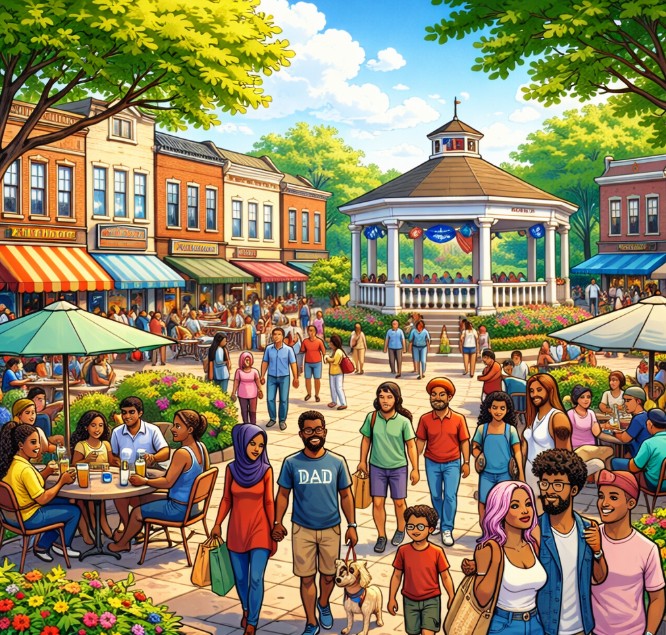
• Walkable cores
• Mixed housing
• Local industry
• Modern utilities
• Strong schools
• Reliable healthcare
• Public spaces
Built next to existing small towns.
Designed to integrate, not replace.
Purpose-Built Growth, Not Accidental Gentrification
This would not mean bidding up old houses until locals are pushed out.
It would mean:
• Rehabilitating what can be saved
• Building new housing at scale
• Adding units before prices spike
• Expanding town footprints responsibly
• New main streets
• New neighborhoods
• New mixed-use blocks
• Old-town design
• Modern infrastructure
• Future-proof systems
We know how to do this.
We just stopped trying.
Infrastructure Is the Foundation of Belonging
People do not move for slogans.
They move for stability.
For safety.
For schools.
For clinics.
For work.
For dignity.
Every successful town needs:
• High-speed internet
• Reliable power
• Clean water
• Waste systems that actually work
• Transportation links
• Healthcare access
• Education pathways
Without this, nothing else matters.
With it, everything becomes possible.
Remote Work Makes This Possible — For the First Time
For the first time in history, millions of Americans can work from almost anywhere.
That is not a lifestyle trend.
It is a structural opportunity.
It allows us to move opportunity instead of forcing people to chase it.
• Remote work hubs
• Regional fabrication centers
• Recycling and materials recovery
• Food processing
• Healthcare support
Every town should make something.
No more bedroom communities.
No more extraction economies.
Integration Happens Through Proximity, Not Lectures
America struggles with race, class, and cultural division.
We talk about it constantly.
We design almost nothing to fix it.
Real integration happens when people:
• Work together
• Send their kids to the same schools
• Depend on the same hospitals
• Volunteer for the same emergencies
• Pay into the same tax base
Shared systems produce shared identity.
Not workshops.
Not hashtags.
Not outrage cycles.
Daily cooperation.
This Is Not About Politics
This is important.
This is not about shifting voting blocks.
This is not about exporting ideology.
This is about fixing a country that has become geographically and economically distorted.
A country this interdependent cannot survive permanent regional resentment.
You do not heal that with arguments.
You heal it with shared prosperity.
Cities Need Relief. Towns Need Investment.
Both sides are being crushed.
Cities are drowning in demand.
Towns are starving for it.
Why would we not rebalance that?
Why would we not reduce pressure where it is extreme…
And increase opportunity where it is scarce?
That is basic systems engineering.
We Used to Know How to Do This
America once specialized in building communities.
• Rail towns
• Mill towns
• Port cities
• University towns
• Manufacturing hubs
They were not perfect.
But they were intentional.
We built places where ordinary people could build lives.
Then we outsourced, centralized, and financialized everything.
And wondered why cohesion collapsed.
A Nation Grows Up When It Builds for the Long Term
Every mature civilization eventually learns this:
You cannot run a country like a startup.
You cannot optimize only for speed and profit.
You have to design for continuity.
For redundancy.
For human scale.
For generational stability.
It is time for America to grow into its shoes.
The Bottom Line
We do not need more arguments about maps.
We need more good places to live.
We need to:
• Build towns again
• Distribute opportunity
• Invest in infrastructure
• Respect local communities