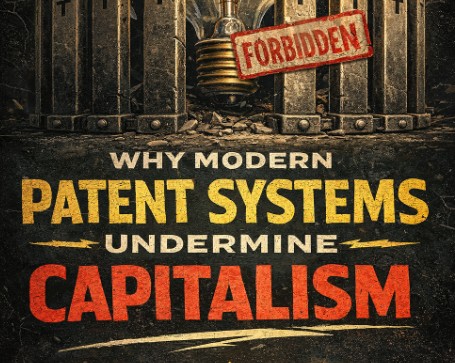
We tend to discuss intellectual property, security, and secrecy as necessary evils—unfortunate but justified costs of innovation. The assumption is simple: guarding ideas is expensive, but the gains outweigh the expense.
That assumption collapses the moment we look past the obvious line items.
This essay begins with the visible dollars spent defending ideas and ends with the invisible losses those defenses impose on human progress itself. What emerges is not a marginal inefficiency, but a systemic drag—one so large that it now outweighs the benefits it claims to protect.
I. The Visible Costs: What We Can Easily Measure
On paper, the costs of secrecy appear manageable.
Across technology, pharmaceuticals, defense, energy, and advanced manufacturing, vast sums are spent each year on:
- Patent drafting, filing, and maintenance
- IP portfolio management
- Litigation and enforcement
- Cybersecurity systems focused on information containment
- Compliance, monitoring, and internal access controls
Conservatively, these consume:
- 5–15% of R&D budgets in most knowledge-intensive industries
- 0.5–5% of annual revenue in enforcement-heavy sectors
- Tens of billions annually in direct legal and security expenditures
Already, this is staggering. Entire research institutes operate on budgets smaller than the legal departments that exist solely to prevent knowledge diffusion.
But even this accounting is misleading—because it only counts what is easy to invoice.
II. The Accounting Error: Treating Secrecy as Neutral
The central mistake is assuming secrecy is merely a “cost of doing business,” like rent or electricity.
It isn’t.
Secrecy is a force multiplier—not of productivity, but of friction.
Every layer of protection:
- Slows communication
- Restricts collaboration
- Forces compartmentalization
- Introduces delay, redundancy, and mistrust
And those effects compound.
The visible costs are only the admission fee. The real bill is paid in lost time, lost coordination, and lost discovery.
III. The Hidden Costs: Where the Real Losses Accumulate
There are four major categories of hidden cost. Each one is harder to measure than legal fees, but each one is larger.
1. Lost Discovery
When information is gated:
- Researchers re-solve known problems
- Errors persist longer
- Breakthroughs arrive later—or not at all
This is not hypothetical. Every scientist has wasted time chasing something that was already known somewhere else, locked behind a paywall, buried in a corporate repository, or trapped inside a classified system.
Human progress slows not because we lack intelligence, but because we block our own ability to share it.
2. Redundant Effort
In secretive systems:
- Teams unknowingly duplicate work
- Competing firms solve identical problems in parallel
- Entire careers are spent rediscovering what already exists
In some industries, we call this “competition.” But that word disguises the underlying waste.
If ten labs repeat the same failed pathway in parallel—without learning from one another—that is not healthy market behavior. That is a knowledge gridlock.
3. Fragmentation of Understanding
Complex systems require a wide base of comprehension. But secrecy drives expertise into narrow silos.
As secrecy increases:
- Fewer people understand the whole system
- Knowledge fragments into silos
- Innovation becomes incremental, not exploratory
- Risk aversion replaces curiosity
This creates a perverse outcome: the more advanced the system becomes, the fewer minds are allowed to meaningfully interact with it.
We don’t just slow discovery—we reduce the size of the thinking surface available to civilization.
4. The Opportunity Cost of Non-Collaboration
The biggest innovations are rarely solitary. They are emergent—built from many minds building on each other’s work.
Secrecy turns that cooperative ecosystem into isolated islands.
And when islands can’t trade ideas, they don’t form continents.
The economy loses not just efficiency, but entirely new categories of progress that only emerge from cross-pollination.
IV. The Social Consequence: Artificial Scarcity at Scale
Secrecy doesn’t only slow innovation. It shapes society.
When knowledge is gated, it becomes scarce by design.
Scarcity drives:
- Monopoly pricing
- Barriers to entry
- Credential gatekeeping
- Inequality of access
And then we pretend the resulting inequality is “natural,” instead of acknowledging it as manufactured.
This becomes most obvious in healthcare and pharmaceuticals. But the pattern holds in energy, housing, education, and even culture.
The social cost of secrecy is not just higher prices. It is the choking of agency—the removal of people’s ability to understand, replicate, and improve the systems that govern their lives.
V. The Incentive Myth, Revisited
The classic defense of secrecy is incentive: “If we don’t protect ideas, no one will create them.”
That argument assumes that the primary motivator for human ingenuity is exclusive ownership.
But history says otherwise.
Humans build because:
- We want to solve problems
- We want status and recognition
- We want to contribute
- We want to compete
- We want to understand the world
- We want to make something that matters
Secrecy is not the engine of innovation. It is a tollbooth we’ve placed on the highway.
Yes, some people innovate for profit. But the question is not whether secrecy can motivate. The question is whether its benefits outweigh its systemic harm.
At this scale, they don’t.
VI. A Different Model: Transparency as Infrastructure
What if we treated transparency the way we treat roads, power grids, and public standards?
Not as an ideal. As infrastructure.
A transparency-based system would:
- Publish research outcomes by default
- Share failures as openly as successes
- Build collaborative repositories of knowledge
- Encourage modular reuse
- Reward attribution and contribution instead of exclusivity
In this world, the “defense budget” of knowledge collapses—and those resources flow back into actual problem-solving.
VII. Side-by-Side Comparison
Here is the simplest way to see it:
Secrecy-based model
- Protect knowledge
- Restrict access
- Create scarcity
- Force duplication
- Slow diffusion
- Concentrate power
- Monetize the bottleneck
Transparency-based model
- Publish knowledge
- Expand access
- Remove scarcity
- Reduce duplication
- Accelerate diffusion
- Distribute capability
- Monetize services, execution, and trust
The second model does not eliminate markets. It changes what markets compete on.
Instead of competing on who can hoard the idea longest, we compete on who can apply it best.
VIII. Envisioning an Open World
In an open world:
- A small lab in a poor country can build on the same knowledge base as a major corporation
- A student can reproduce leading research without begging for access
- A local inventor can iterate without fear of litigation
- Solutions move at the speed of curiosity, not permission
This is not utopian. It is closer to the way science was supposed to operate before we wrapped it in legal armor.
And if you think open knowledge kills innovation, consider this: the internet itself is a monument to open standards and shared protocols.
We didn’t get the modern world by hiding TCP/IP.
IX. The Final Accounting
So what is the full cost of secrecy?
It is:
- The money spent on legal and security infrastructure
- The time wasted on redundancy
- The breakthroughs delayed or lost
- The fragmentation of understanding
- The artificial scarcity imposed on society
- The widening inequality of access
- The invisible ceiling placed on civilization’s collective intelligence
Secrecy is not just expensive.
It is structurally incompatible with accelerating progress.
In the early industrial era, physical scarcity defined limits.
In the knowledge era, we have invented a new scarcity—one made of paper, policy, and fear.
And we pay for it every day, not only in dollars, but in everything we could have built—if we’d been allowed to share.