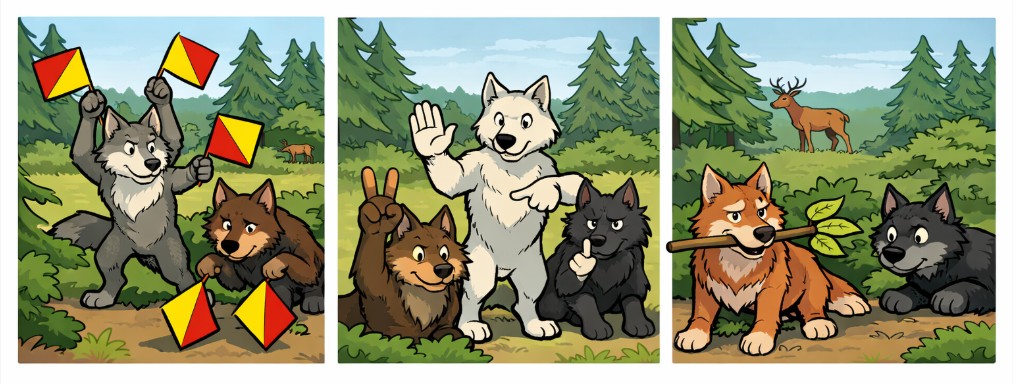
Invisible Communication of the Hunter
A Blue Ribbon Team field proposition, judged on observation.
We spend a lot of time arguing about what predators do—and not nearly enough time asking what predators must be able to coordinate to do it.
If you’ve ever watched a wolf documentary closely, you’ve seen the contradiction: wolves appear to hunt in near silence, yet they coordinate like a team running a practiced drill. Timing, spacing, flank placement, pressure-and-release. Somebody pushes, somebody angles, somebody waits. And it happens across distance, terrain, wind, and chaos.
So here’s my proposition, offered as observation-driven theory—not mysticism, not “telepathy,” not magic.
Canids likely use a largely “invisible” layer of communication while hunting:
- dominated by posture, motion, spacing, and gaze,
- supported by micro-sounds that humans don’t notice,
- and possibly extended by frequencies at the edges of what we hear.
Not because it’s romantic.
Because it’s useful.
The inspiration: when science learns to hear what was always there
The starting point for this thought isn’t canids at all. It comes from an older lesson in animal behavior: we have missed obvious communication channels before simply because they sat outside human senses.
Decades ago, researchers working with elephants at the Washington Park Zoo in Portland, Oregon noticed something strange. Observers described feeling low vibrations around the animals even when they weren’t hearing any obvious calls. That hunch led to formal acoustic study and eventually to the recognition that elephants were communicating using extremely low-frequency rumbles—some below the range of human hearing. What looked like silence turned out to be conversation happening just outside our sensory limits.
That discovery matters here for only one reason: it reminds us that nature does not organize itself around human perception. Species can build entire communication systems in channels we fail to notice until we learn how to measure them. Elephants were not hiding anything; humans simply lacked the tools and assumptions to detect it.
So the elephant story isn’t evidence for canid behavior. It’s a cautionary example. If one social species could communicate in ways we overlooked for generations, it’s reasonable to ask whether other highly coordinated hunters might also rely on signals that feel invisible to us.
Now, back to canids.
First principle: “silent hunting” does not mean “no signals”
Most of what keeps a hunt quiet is selection pressure:
- Loud vocalizations warn prey.
- Loud vocalizations advertise location to rivals.
- Loud vocalizations disrupt timing.
So wolves don’t chatter the way a suburban dog does behind a fence.
But “quiet” in the field can still include communication—just in forms that don’t travel far, don’t carry clearly, and don’t register as “a call” to human ears.
Think punctuation, not conversation.
What we already know: canids communicate heavily without sound
This is the unsexy core that makes the whole theory work.
Wolves and other social canids use a rich visual vocabulary:
- ear position and ear rotation
- tail carriage and tail stiffness
- head angle, muzzle direction, and gaze
- weight shift (forward vs settled)
- gait changes (walk → trot → glide)
- spacing and alignment (parallel, staggered, flanking arcs)
That’s not poetic. That’s mechanics.
In a coordinated hunt, the pack is running an information loop that looks like this:
- Where are you? (position and spacing)
- What are you doing? (gait and posture)
- What am I supposed to do next? (role inference)
If the team has a shared playbook—learned roles, familiar partners, predictable behavior—then half the coordination doesn’t require any “signal” at all. It’s just mutual prediction.
This is where animals can look “psychic.”
What you’re seeing is shared models, not mind reading.
The “invisible communication” layer: micro-vocalizations
Now we get into the part humans miss because we think in big, obvious sounds: bark, howl, yip.
Hunting communication would favor signals that are:
- brief
- low amplitude
- hard to localize
- useful at close range
- masked by wind, snow, brush, and footfall
That points toward a class of sounds that exist across canids, but are rarely treated as “real communication” by casual observers:
- short huffs / forced exhales
- low grunts or throat rumbles
- thin whines (quick, sharp, low carry)
- jaw clacks / tooth snaps
- sneeze-like bursts (short “trigger” cues seen in some social canids)
These aren’t made to travel a mile. They’re made to travel ten feet, at exactly the moment it matters.
Proposition: during hunts, canids use micro-vocalizations as timing marks—a start signal, a hold signal, a directional nudge—while the bulk of meaning rides on body language.
The frequency edge: not “telepathy,” not fantasy—just bandwidth
Here’s where the theory gets interesting without getting silly.
Canids:
- produce sounds across a wide range (howls, whines, growls, barks, yodel-like tones in some breeds),
- and they hear higher frequencies than we do.
So it’s reasonable to propose the pack exploits the “edges”:
- very quiet low tones (close range) and
- very quiet high-frequency-rich cues (also close range)
Not necessarily true infrasound like elephants—canids aren’t built for that kind of long-range subsonic broadcast—but near-threshold, low-amplitude sounds plus high harmonics could absolutely create a communication layer that feels “silent” to humans.
Important constraint:
The more a sound travels, the less “stealth” it is.
So any frequency trick would likely be used at low power and short range, not as a wolf walkie-talkie across a valley.
Prey-aware signaling: “match the channel to the target”
Another piece of the proposition is situational tuning.
Different hunts create different risk profiles:
Small game (often high-vocal, quick-alert prey)
- Any sound can trigger flight.
- Coordination needs to be tight and immediate.
- Expect: mostly posture and micro-cues; any sound is brief and minimal.
Large game (ungulates; heavy-footed; vigilance-based)
- The environment is loud: wind, snow, hooves, brush.
- Coordination is more about roles, angles, pressure, and timing.
- Expect: still mostly silent, but occasional close-range cues may carry less penalty.
If wolves do shift their micro-vocal strategy by context, it wouldn’t be “low for moose, high for rabbits” as a rule. It would be simpler:
Use the least detectable cue that still gets the job done.
Why an Akita makes you notice this
A lot of modern dogs have been shaped into:
- loud alarm barkers,
- human-directed communicators,
- or reactive vocal machines in artificial environments.
Spitz-type and “primitive-ish” breeds often preserve a broader, less standardized vocal palette—more grumbles, yodels, whines, talky noises—paired with a body language system that’s blunt and expressive.
If your Akita seems to have “more sounds” than most dogs, I’d treat that as a clue, not an oddity.
Working proposition:
Dogs with a history of autonomy and small-pack work may preserve a more varied set of low-amplitude, close-range signals that don’t map neatly onto “bark = alert.”
The proposition, stated cleanly
Here’s the thesis in one block, for the record:
Canid pack hunting coordination is primarily visual and role-based, supported by micro-vocalizations and edge-of-band hearing/production that humans underestimate—creating an “invisible” communication layer that appears like silence, and sometimes gets misread as telepathy.
No mysticism required.
Just a predator using every channel it has, while minimizing what the prey can detect.
How you could test it without a lab
This is the part I love: you don’t need grants, just discipline.
If you record a dog (or better: two dogs interacting) and run a spectrogram, look for:
- brief, low-amplitude sound bursts clustered right before action changes
(start, stop, surge, flank, snap attention) - high-frequency spikes or harmonics you didn’t consciously hear
- consistent pairing of ear rotation / head angle changes with those micro-sounds
If the “silent comms” layer exists, it should leave fingerprints:
sound punctuating motion, not replacing it.
Closing note: the hunter is always talking
The mistake is assuming “talking” means “loud enough for humans.”
In the field, the hunter is always communicating—
through posture, angle, timing, breath, and tiny sounds that carry just far enough to matter.
The invisible communication of the hunter isn’t supernatural.
It’s simply what happens when a species evolves teamwork under the rule that the prey must never know you’re coordinating at all.