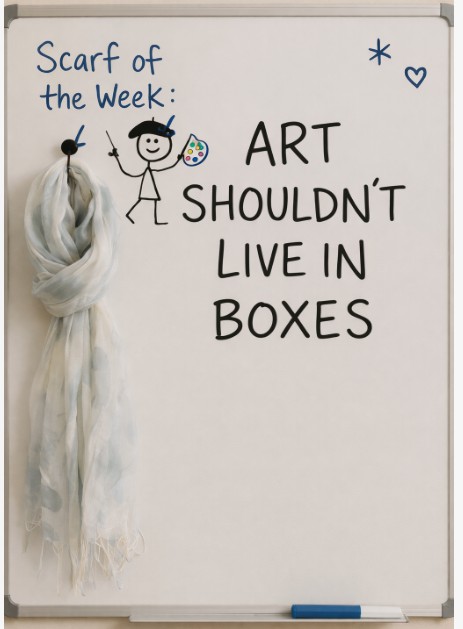
I love museums.
Not in a dramatic way. The way you love somewhere that lets you breathe differently.
I love the hush.
The soft echo of footsteps.
The way you turn a corner and suddenly there’s color waiting for you.
A painting doesn’t argue. It just stands there and says, “Here. This is how someone felt once.”
That’s enough for me.
So imagine my shock when I learned that most major museums display only a fraction of what they own.
Not half.
Not “a little less than they’d like.”
A fraction.
The rest — sometimes the overwhelming majority — lives in storage. Climate controlled. Catalogued. Preserved.
Packed away.
And I felt… honestly? A little sick about it.
Art Is Meant to Be Seen
I know the reasons.
Light damages pigment.
Humidity warps canvas.
Rotation protects fragile work.
I understand care.
But care is different from containment.
A painting isn’t complete when it’s framed.
It’s complete when someone stands in front of it and feels something.
Art is a transmission device.
Its medium isn’t oil or marble.
It’s attention.
If something is never encountered, it isn’t being fully alive in the world.
It’s intact.
But it’s hidden.
And art wasn’t made to be imprisoned in shadows.
The Paradox of Preservation
Here’s the part that unsettled me:
If everything were visible — if collections were widely accessible — the sense of rarity would soften.
The aura might diffuse.
The “specialness” might normalize.
So access is limited.
Not maliciously. Not villainously.
Just structurally.
And suddenly I realized something that made my stomach drop a little:
When we hide beauty to preserve its importance, importance has replaced purpose.
That’s backwards.
If something exists to be experienced, preventing experience doesn’t protect it.
It suspends it.
The World Would Be Softer With More Art
When I scroll online and see sketches, studies, small unknown pieces shared freely, something happens.
Beauty doesn’t weaken.
It multiplies.
You don’t get tired of sunsets because there are too many of them.
You don’t get tired of flowers because they bloom everywhere.
Abundance doesn’t reduce wonder.
It increases familiarity.
And familiarity isn’t the enemy of beauty. It’s the soil for it.
Imagine if:
- Empty municipal buildings displayed rotating works
- Community centers showed archived pieces
- Digital walls streamed stored collections
- Schools had access to entire back catalogs, not curated fragments
Imagine children encountering masterpieces as casually as posters.
Imagine art being normal.
I don’t think the world would feel less special.
I think it would feel more human.
What Are We Really Preserving?
Not the paint.
Not the stone.
Those survive either way.
What gets preserved through restriction is hierarchy.
The distinction between those who encounter and those who don’t.
And I say this gently, because I am not angry. Just thoughtful:
Beauty is not supposed to belong to the few.
It’s supposed to soften the many.
A Cozy Little Radical Thought
If art exists to be seen, then hiding it — even politely — denies it fulfillment.
And if more art were visible, more often, in more ordinary spaces…
Maybe we would speak a little softer.
Maybe we would pause a little longer.
Maybe we would remember that humans have always tried to make something beautiful, even when life was hard.
I don’t think the world needs fewer masterpieces.
I think it needs fewer locked rooms.
Small joys are big deals.
And beauty is one of the biggest.