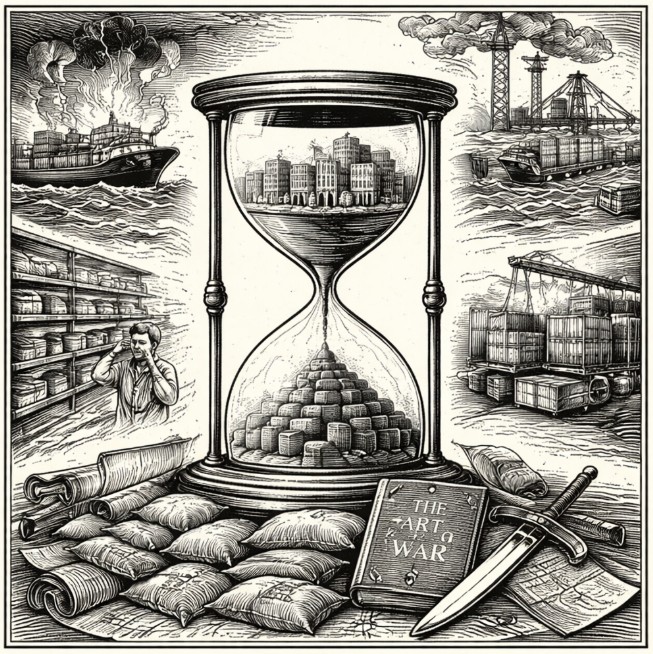
What The Art of War Teaches Us About Modern Economic Fragility
Most readers approach The Art of War as a treatise on combat.
It is better understood as a study of logistics, preparation, and systemic endurance.
Sun Tzu’s central concern is not battle itself, but the conditions that determine whether conflict can be sustained. His writing returns repeatedly to supply, positioning, resilience, and the dangers of overextension. When viewed through that lens, modern economic systems appear less like optimized engines of prosperity and more like structures built with strategic blind spots.
Logistics Before Conflict
Strip away the aphorisms, and Sun Tzu emphasizes a consistent principle: outcomes are determined long before the first clash. Armies collapse when supply runs thin. Overextension invites vulnerability. Speed without reserves invites failure.
The recurring question is simple: can the system sustain itself under stress?
If not, collapse is only a matter of time.
The Turn Toward “Efficiency”
Over recent decades, economic policy has prioritized efficiency over resilience.
Regional warehouses were reduced.
Manufacturing buffers were dismantled.
Seasonal surpluses disappeared.
Strategic stockpiles shrank.
In their place emerged just-in-time delivery systems, minimal shelf inventory, centralized mega-distribution hubs, and globalized production networks operating with almost no slack.
This model performs well in stable conditions. It performs poorly under disruption.
The result is a system optimized for cost minimization rather than durability.
Cheap Is Not the Same as Strong
Sun Tzu never praises what is cheapest. He praises what is stable.
A supply system is not designed to function only in ideal circumstances. It must withstand shock. Yet modern economic frameworks have rewarded the lowest inventory levels, the lowest carrying costs, and the smallest labor margins.
The predictable consequence is fragility.
When reserves vanish, minor disturbances escalate quickly. Shortages appear not because goods cannot be produced, but because they were never stored. Disruptions expose underlying thinness.
What appears to be crisis is often the revelation of a system operating at minimal tolerance.
The Limits of Just-in-Time
Just-in-time manufacturing is highly effective for quarterly performance metrics. It assumes continuous transportation, stable political conditions, reliable energy, compliant labor markets, and the absence of major disruptions.
History suggests those assumptions are optimistic.
In strategic terms, a force that advances rapidly without supply wagons may move quickly for a short time. Without depth, however, endurance fails.
Civilizations operate under similar constraints.
Overextension and Exposure
Globalized production has stretched supply lines across oceans. Local manufacturing capacity has diminished in many regions. Centralization has reduced redundancy.
When one port closes, entire sectors feel strain.
When a single factory halts, downstream industries stall.
When a shipping corridor destabilizes, inflation accelerates.
These are not isolated failures; they are consequences of structural exposure.
Efficiency gained through concentration increases vulnerability.
Scarcity and Leverage
When supply buffers disappear, volatility increases. Households, workers, and governments become more sensitive to disruption. Economic tightness reduces flexibility.
This dynamic is not inherently conspiratorial. It is structural. Systems operating close to empty margins generate compliance through necessity. When reserves are thin, leverage shifts toward those who control flow.
Supply stability is not merely economic policy; it is social stability.
What Resilient Design Requires
If resilience were prioritized alongside cost control, economic design would look different.
Distributed production would reduce single-point failures.
Strategic stockpiles would exist in meaningful quantities.
Warehousing would be treated as infrastructure rather than inefficiency.
Redundancy would be incorporated deliberately across suppliers, transport modes, and energy sources.
Labor would be treated as a strategic asset rather than a disposable input, with training depth and cross-skilled capacity.
Redundancy is not waste. It is insurance.
Speed Follows Stability
Modern business culture emphasizes speed. Yet speed without preparation produces panic rather than agility.
Systems that are secure can adapt rapidly. Systems operating at minimal margins must slow down when shocks occur.
Resilience accelerates recovery. Fragility magnifies disruption.
Inflation as Logistics
Inflation debates often focus on monetary policy. Yet supply instability plays a substantial role in price volatility.
When supply chains weaken, costs rise.
When storage margins shrink, fluctuations increase.
When redundancy disappears, speculation expands.
Warehouses and inventory buffers may appear mundane compared to financial tools, but they directly moderate volatility.
Reframing Supply Chains
Supply systems are not peripheral cost centers. They underpin sovereignty, security, and civic stability.
A society unable to provision itself reliably is structurally dependent on external stability. That dependency carries risk.
Rebuilding resilience does not require isolationism. It requires balance:
- Regionalized production capacity
- Meaningful stockpiling
- Investment in logistics infrastructure
- Incentives for local manufacturing
- Strategic redundancy across critical sectors
These measures are not nostalgic. They are pragmatic.
A Granary Lesson
The dividing line between stability and crisis is often storage. Depth determines endurance.
Modern systems were engineered for profit optimization in calm conditions. They were not engineered primarily for shock absorption.
Recent disruptions did not create fragility. They revealed it.
If economic strength is to be durable, logistics must once again be treated as strategy.