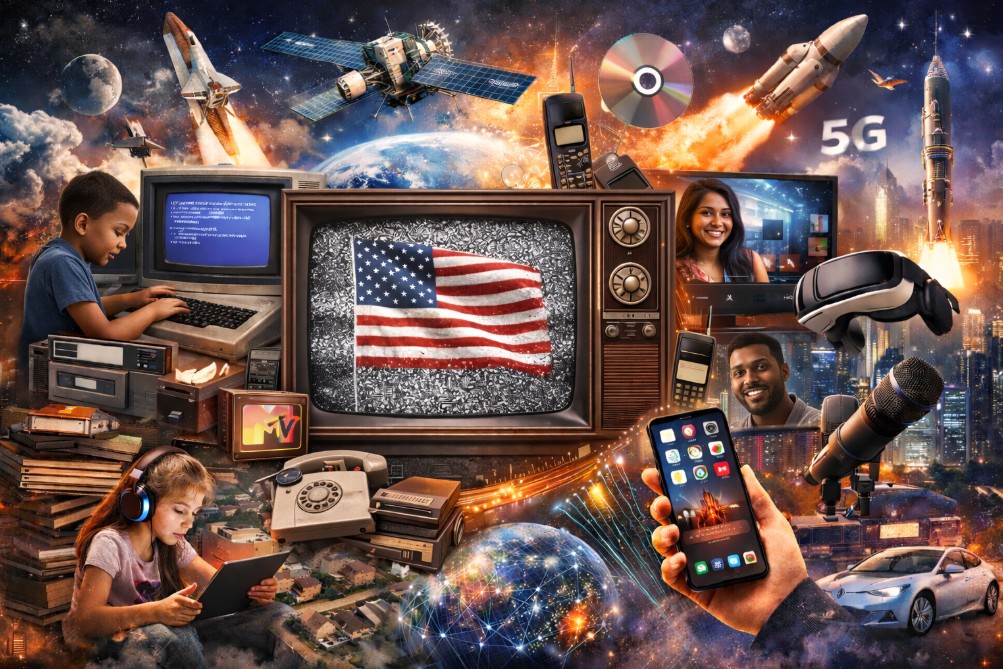
A Gen-X Witness to the Compression of History
I was born in 1972 to a working-class white family in a neighborhood that had only recently integrated, pressed up against an Army base that would be shuttered before the decade was out. We were not destitute. We were not comfortable. We were what used to be common: careful.
We had a toaster oven before we had a microwave. I remember when the microwave arrived—not new, but inherited from a cousin whose family had upgraded. That was the rhythm of technology in our house: second-hand, late to arrive, but miraculous when it did.
Those same cousins had a Commodore 64. So did my best friend. It wasn’t framed as “the dawn of the digital age.” It was a beige machine in a living room. But it was the first time I saw a screen respond to typed intention. A child pressing keys and altering a world.
We had one color television. Thirty-six inches wide and physically enormous. It consumed part of the living room like industrial equipment. It received four channels over the air. The first remote control in our house felt like sorcery—not because it changed what was available, but because it changed who controlled it.
AM. FM. That was the bandwidth of our auditory world.
We did not grow up drowning in signal.
We grew up rationing it.
The Base, the Closure, and the Signal Layer
The Army base nearby hummed with a different world. Men and women in uniform moved through systems that were opaque to us. When I eventually served, the military was refining something civilians barely understood: layered satellite communications. Multiplexing. Redundancy. Encryption. Reliability at scale.
The concept is simple: you can move more information through the same space if you learn how to separate and recombine it properly.
That insight—technical and philosophical—defines the last fifty years.
The Leaps We Survived
In one lifetime, I have watched:
- Analog broadcast become digital distribution
- Rotary phones become pocket supercomputers
- Encyclopedias become search engines
- Mail become email become instant global transmission
- Film become digital sensors
- Handwritten notes become cloud-synced archives
- A modem’s shriek become silent broadband
- Local scarcity become global access
We experienced half a dozen discontinuities that would have felt supernatural in 1900.
A century ago, powered flight was experimental. A hundred years before that, electricity was novelty. A hundred years before that, printing presses were rare infrastructure. Today, a child can access the accumulated literature of 12,000 years of recorded culture from a slab of glass.
That is not incremental change.
That is civilizational compression.
The Democratization of Reach
When I was a child, knowledge was near—but not quite accessible. Libraries closed early. Books were limited. Experts were distant. Computers were exotic.
Now:
- Every child with connectivity can watch lectures from world-class universities
- Every citizen can publish globally
- Every worker can automate tasks that once required departments
- Every family can communicate across oceans without cost
The distance between question and answer has collapsed.
The barrier between creator and audience has thinned.
The friction between idea and distribution has nearly vanished.
This is historically unprecedented.
Freedom as a Technical Condition
We often talk about freedom as political. But freedom is also infrastructural.
A society is freer when:
- Knowledge is not hoarded
- Communication is not monopolized
- Creation does not require gatekeeper permission
- Distribution is not limited to the wealthy
The printing press decentralized authority.
Radio centralized it.
Television concentrated it.
The internet fractured it again.
Now we stand in a strange hybrid moment: the tools of liberation are widespread, but the architecture of power is still consolidating.
Technology alone does not free a people. It provides capacity.
What we do with that capacity determines whether it liberates or enslaves.
The Gen-X Position
Generation X occupies a unique vantage point.
We remember:
- Waiting for information
- Having no access
- Being told “that’s just how it is”
- Calling collect
- Rewinding tapes
- Burning CDs
- Dial-up tones
- The first search engines
- The first social networks
- The first smartphones
We are analog natives and digital adopters.
We understand scarcity and abundance.
We understand silence and noise.
That perspective is not nostalgic—it is diagnostic.
We can see what was gained and what was lost.
The Great Convergence
Twelve thousand years of cultural accumulation—agriculture, metallurgy, writing, mathematics, governance, medicine, engineering—have converged into searchable form.
That convergence is not the endpoint.
It is a beginning.
For the first time in human history:
- Knowledge is not geographically bound
- Tools are not guild-restricted
- Publication is not institutionally controlled
- Collaboration is not proximity-limited
A child in a rural town can design software.
A mechanic can publish engineering insights.
An artist can reach a global audience.
A citizen can audit power.
The ceiling has shifted.
The Question Before Us
The technology is here.
The compression has occurred.
The signal has layered successfully.
The question is no longer Can we?
It is Will we?
Will we:
- Educate deliberately
- Build institutions worthy of the tools
- Encourage curiosity instead of passivity
- Use abundance responsibly
- Defend open access while preventing manipulation
Or will we drown in our own noise?
The Moral Weight of Abundance
Scarcity disciplines behavior.
Abundance tests character.
When knowledge was hard to access, we treasured it.
When communication was limited, we valued it.
Now information is constant. Signal competes with static.
Freedom requires discernment.
Discernment requires education.
Education requires intention.
The tools do not decide the outcome.
We do.
A Lifetime Arc
From toaster ovens to satellites.
From inherited microwaves to global livestreams.
From a borrowed Commodore 64 to pocket devices that eclipse Cold War supercomputers.
From four broadcast channels to infinite streaming libraries.
From AM/FM to planetary mesh networks.
In one lifetime.
That is not evolution.
That is acceleration.
And acceleration amplifies both virtue and vice.
What Are We Going to Do With It?
We stand at a cultural inflection point.
The accumulated knowledge of civilization is accessible.
The tools of creation are distributed.
The means of coordination are global.
Humanity has a chance—not guaranteed, but real—to expand freedom beyond any previous era.
The question is no longer technological.
It is civilizational.
What kind of people will we be with this power?
Will we teach our children to consume—or to build?
Will we use abundance to elevate—or to distract?
Will we defend open knowledge—or commodify it beyond reach?
History has compressed into our hands.
The arc from scarcity to saturation happened within a single human lifespan.
Mine.
Now the responsibility shifts.
What are we going to do with it?