An Architectural Presence More Than a Historical Footnote
Johnstown’s Franklin Street United Methodist Church stands at the corner of Franklin and Locust as a physical argument — not a relic, not a memory, but a case study in purposeful construction and material expression.
Franklin Street United Methodist Church does not ask for your attention. It takes it.
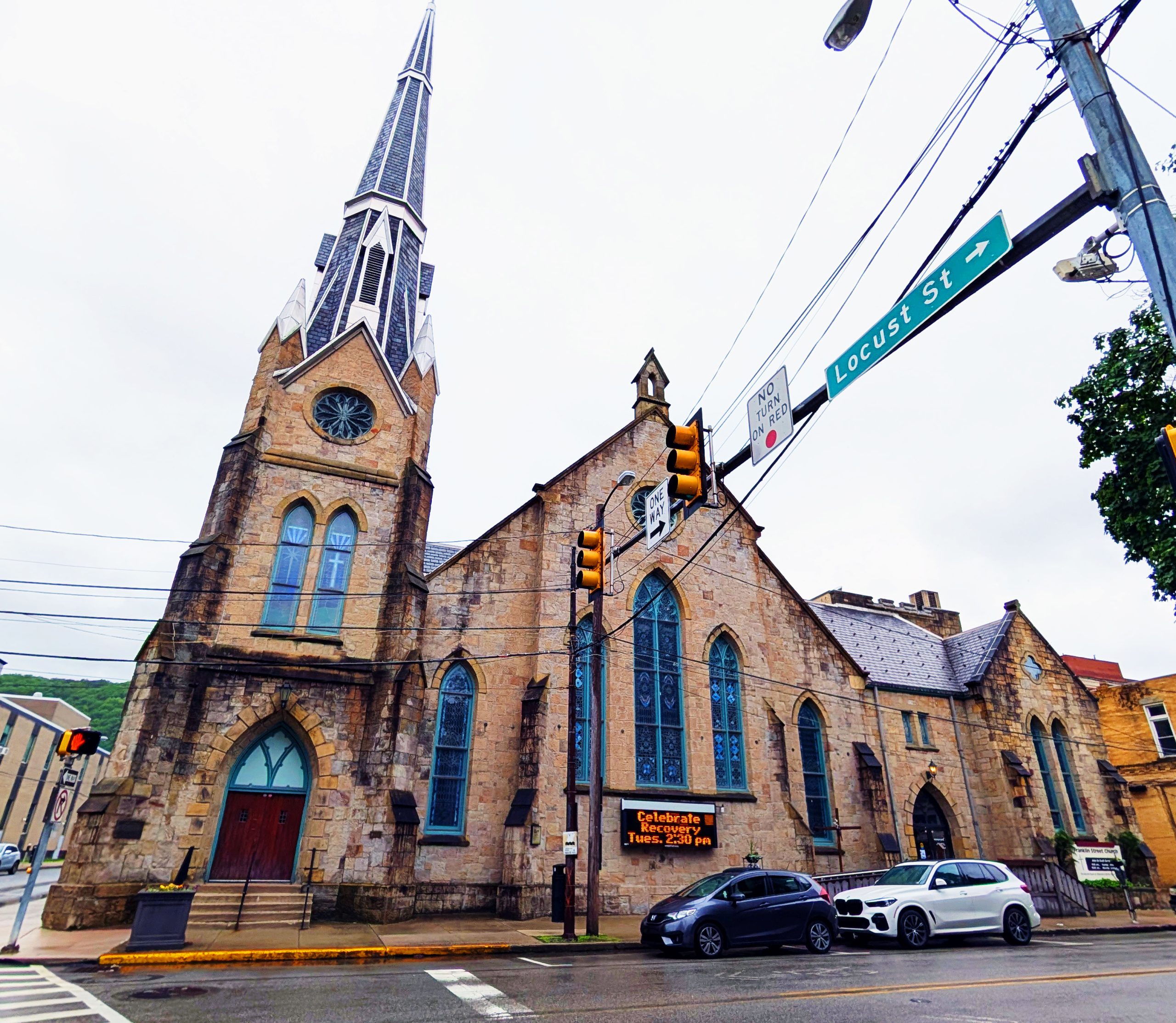
Start with the tower. Even on a gray afternoon — especially on a gray afternoon — the spire reads cleanly against the sky. Slate planes climb upward in sharp, disciplined facets, cut with bright white trim that outlines the geometry like ink on vellum. The contrast is deliberate. It makes the tower legible at a distance. It gives the eye something to lock onto.
This is not accidental ornament. It’s graphic clarity.
The white framing is not decoration for decoration’s sake; it articulates edges, defines angles, and makes the structure intelligible from blocks away. You don’t have to understand Gothic Revival to feel what it’s doing. The building explains itself in line and mass.
And beneath that assertive vertical, the limestone body does something equally important: it grounds the composition.
The sanctuary walls are built in warm, textured limestone — blocks laid in coursed patterns that still show the hand of quarry and mason. The stone is not polished into anonymity. It holds variation. It absorbs light differently across its surface. It feels substantial, because it is.
Tall pointed windows puncture the mass at regular intervals, their arches rising in compression and echoing the spire’s upward movement. The proportions are disciplined — narrow, vertical, rhythmic. This is Gothic vocabulary adapted to a working city, not a European cathedral transplanted wholesale. It is muscular without being clumsy, expressive without being ornate.
The real strength of the building lies in contrast.
Rough limestone against tight slate.
Warm earth tones against cool black and white.
Horizontal mass meeting vertical insistence.
The tower does not try to disappear into the stone. It stands apart from it. That tension — between the grounded and the ascending — is what gives the structure its presence.
And presence is the right word.
This church does not sit back on a lawn. It holds its corner directly. Traffic lights hang in front of it. Wires cross its façade. Cars idle beneath its windows. None of that diminishes it. If anything, the infrastructure emphasizes the scale. The spire slices cleanly through the clutter of modern life.
That’s how you know the architecture works. It doesn’t need isolation to maintain authority.
The congregation’s roots in Johnstown stretch back roughly two centuries, and the present structure dates to the late nineteenth century. Yes, it survived the 1889 flood that reshaped the city’s history. But reducing this building to that single event misses the larger point.
Its endurance is a consequence of how it was built — in stone, with arches that work in compression, with rooflines pitched steeply enough to shed water and weather. The flood is a historical fact. The architecture is the lasting argument.
Walk past it and look carefully.
Notice the depth of the window reveals.
Notice how the rose window sits within the tower’s mass rather than pasted onto it.
Notice how the buttress-like projections along the nave give rhythm and structural articulation at once.
These are not decorative gestures. They are decisions — decisions about gravity, about material, about proportion.
In a city often narrated through disaster and recovery, buildings like this remind us that Johnstown’s identity is also written in design. In stone laid by hand. In slate cut and flashed with care. In geometry meant to last longer than fashion.
The tower rises not as a symbol, but as a form. The limestone holds not as nostalgia, but as mass.
At Franklin and Locust, architecture still speaks plainly.
And sometimes, that’s more than enough.