A Controlled Aquaponic Approach to Domestication of Apios americana
Preface: You Knew This Was Coming
We have written about labor.
We have written about governance.
We have written about infrastructure and institutional design.
So we are permitted — briefly — to return to aquaponics.
Half laugh. Half warning.
Given enough encouragement, we will discuss dissolved oxygen curves, mineralization timing, substrate particle distributions, and flood-cycle kinetics in uncomfortable detail.
But occasionally, a plant emerges that justifies revisiting the engineering.
This is one of those plants.
The Plant: Apios americana
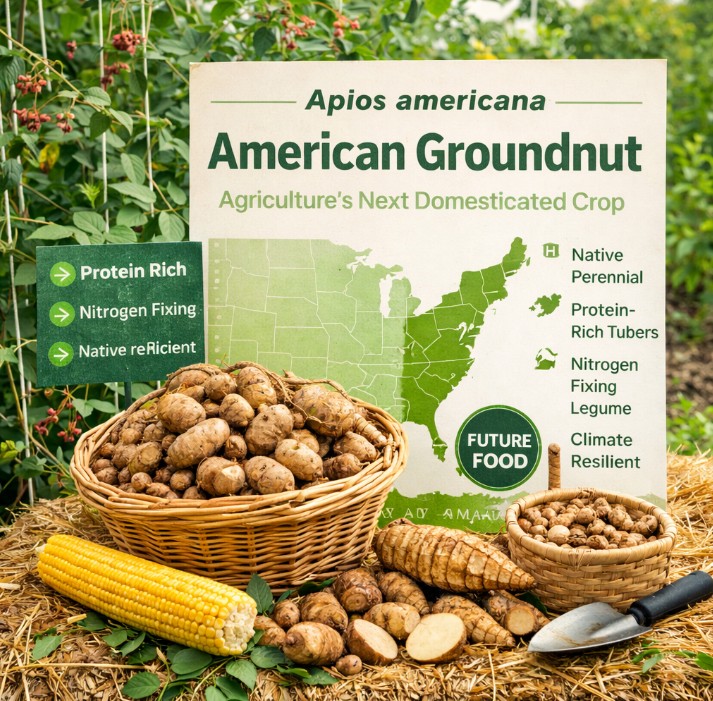
American Groundnut
Groundnut is a perennial nitrogen-fixing vine native to eastern North America. It produces chains of protein- and starch-rich tubers. It tolerates saturated soils. It survives winter dormancy. It grows along riparian systems.
It is resilient.
It is nutritionally significant.
It is historically important.
And it remains under-domesticated.
Yields are inconsistent.
Tuber size varies widely.
Harvest remains labor intensive.
Moisture variability strongly influences morphology.
Most improvement attempts have occurred in soil.
So we ask a narrower question:
What happens when environmental noise is removed?
Hypothesis
A controlled aquaponic media bed — specifically a fast flood / fast drain ebb-and-flow system — may:
- Increase tuber size consistency
- Improve harvest accessibility
- Standardize moisture and oxygen delivery
- Accelerate domestication selection cycles
This is not novelty agriculture.
It is controlled variability reduction.
Soil systems are ecologically rich. They are also chaotic.
Aquaponics allows precise control of:
- Moisture rhythm
- Oxygenation cycles
- Nutrient flux
- Root zone temperature
When environmental variance decreases, genetic variance becomes more visible.
That visibility accelerates domestication.
Proposed System Architecture
Bed Configuration
- Timed ebb-and-flow media bed
- Rapid flood
- Rapid full drain
- Complete oxygen recharge between cycles
The drain phase is the oxygen engine.
This is not static saturation.
It is rhythmic root respiration.
Substrate Composition
Proposed volumetric mix:
- ~50% small pumice stone
- ~50% dime-sized expanded clay aggregate
Functional rationale:
Small pumice:
- Even distributed mechanical pressure
- Consistent contact around developing tubers
- Increased microbial surface area
- Moisture stability without compaction
Expanded clay:
- Void heterogeneity
- Structural variability
- Compaction resistance
The objective is controlled mechanical feedback.
Uniform distributed resistance may encourage spherical swelling rather than elongated chain morphology. Variability in structural resistance may stimulate larger terminal tuber formation.
This is biomechanical influence, not passive growth media.
Nitrogen Moderation Strategy
Apios is a legume. In soil, it fixes nitrogen.
In aquaponics, nitrate is abundant.
Excess nitrate may drive vegetative growth over tuber formation.
To moderate nitrogen surplus, we propose companion nitrate sinks:
- Cherry tomatoes
- Cucumbers
Both are:
- Trellis-compatible
- Prune-manageable
- Aggressive nitrate users
- Economically exportable
System flow:
Fish waste → nitrate → fruit production → nutrient export
Groundnut remains metabolically motivated rather than nutritionally saturated.
This is nutrient economy design.
Greenhouse Layout Concept
- 12–18 inch deep media bed
- Dedicated Apios trellis corridor
- Companion vine on exterior trellis face
- Aggressive pruning to prevent shading
- Aerated fish tank system
- Flood/drain cycles tuned for rapid saturation and full oxygen recovery
Light is manageable.
Plant training is a precision lever.
The system should be stable, repeatable, and minimally instrumented.
Test Metrics
We are not overmanaging variables.
We are isolating signal.
Primary Metrics
- Time to tuber initiation
- Total tuber mass per plant
- Largest individual tuber mass
- Tuber form uniformity
- Harvest efficiency relative to soil control
Secondary Observations
- Vine-to-tuber biomass ratio
- Rhizome structural integrity
- Substrate stability over cycle
If improved uniformity and terminal mass are observed, subsequent cycles apply selection pressure accordingly.
That is domestication through controlled iteration.
Why This Matters
Groundnut is:
- Native
- Perennial
- Protein-rich
- Climate resilient
- Historically relevant
It did not complete domestication during prior agricultural epochs.
Modern agriculture favors annual monocrops.
Perennial starch systems remain underdeveloped.
Aquaponics offers:
- Controlled hydration
- Closed-loop nutrient recapture
- Low external input
- Repeatable environmental conditions
This is not novelty farming.
It is domestication support infrastructure.
Implementation Position
Bright Meadow Group proposes this as a structured pilot study.
We are prepared to:
- Host the trial in-house
- Design and support external implementation
- Partner with university research greenhouses
- Collaborate with regenerative agriculture initiatives
- Document the process transparently
If funded, we will execute.
Methodically.
Publicly.
Iteratively.
Groundnut does not require hype.
It requires disciplined experimentation.
We have discussed resilience, perennial systems, nutrient loops, and regenerative infrastructure for years.
This is the practical expression of those principles.
Let us test it.
This is how Bright Meadow Group solves problems.
For more:
www.brightmeadowgroup.com