On How a Republic Drifts
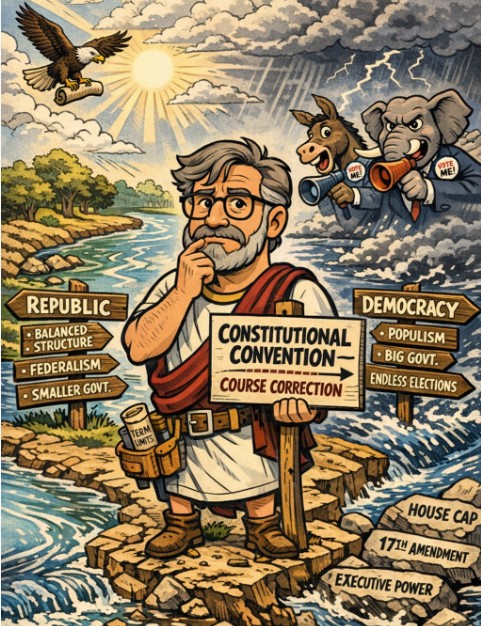
There’s a bend in the old river where the stones shift every spring.
The ice breaks, the water swells, and the bank gives up a few inches. Nothing dramatic. Nothing that would trouble a passerby.
But give it enough seasons and the river you grew up beside becomes a river of a different shape.
That’s how constitutional change happens in a republic. Not with cannon fire. Not with declarations. With inches.
People insist our political troubles arrived overnight. They didn’t. What we’re living through is the long drift of structural incentives — the quiet rearrangement of constitutional stones. We mistook the drift for progress because it felt smoother. More democratic. More immediate.
But structure determines behavior. And behavior, over time, determines culture.
A republic does not collapse into democracy.
It eases into it.
And ours has eased a long way.
I. The House That Outgrew Its Purpose
The House of Representatives was meant to grow with the population — a chamber of neighbors, not strangers. A body close enough to the people that representation felt tangible.
In 1929, Congress capped the House at 435 seats. It was a logistical fix. It became a structural constraint.
A district of forty thousand people cultivates familiarity.
A district approaching a million cultivates fundraising infrastructure.
Scale changes incentives.
When representation stretches too thin, politics becomes less relational and more transactional. That isn’t moral decline. It’s mechanics. A lever moved too far from its fulcrum.
Grammina would have called it “trying to make too much stew in too small a pot.”
She’d have been right.
II. The Senate That Stopped Being a Senate
Before 1913, Senators were selected by state legislatures. The method was imperfect, sometimes corrupt. But it embedded federalism directly into the structure of power. Senators represented states as political entities, not simply statewide electorates.
The Seventeenth Amendment changed that.
It felt democratic. It was democratic. But democracy was not the singular aim of the design.
Balance was.
Once Senators began competing in popular elections, the Senate’s incentives aligned with the House’s. When two chambers chase the same currents of national sentiment, they eventually begin rowing in the same direction.
Federalism did not disappear.
It lost its institutional voice.
III. The Presidency That Became a Prize
The presidency was envisioned as restrained — an executor, not a spectacle. Selected through deliberation, not continuous campaign.
But primaries, national media, and personality-driven politics turned the office into the emotional center of American life. The President became protagonist rather than steward.
Once that shift occurred, every election became existential. Every disagreement felt apocalyptic. Every occupant of the office became either savior or villain.
Democracies run on charisma.
Republics rely on competence.
We gradually confused the two.
IV. What Structure Rewards
When all branches orient themselves toward popularity, the outcomes are predictable:
- A legislature that performs more than it deliberates.
- Judicial appointments framed as spoils rather than stabilizers.
- An electorate drawn toward spectacle because spectacle is what the machinery amplifies.
None of this required bad actors.
It required misaligned incentives.
And incentives, left unexamined, compound.
The drift took a century. The noise arrived only after the machinery was already tilted.
V. The Question No One Wants to Touch
You cannot vote your way out of structural misalignment.
You cannot elect your way out of design flaws.
You cannot replace actors while leaving the stage crooked and expect a different play.
The Constitution contains a repair mechanism.
We have simply been unwilling to consider using it.
A constitutional convention is treated as either fantasy or catastrophe. It is neither. It is maintenance — difficult, risky, necessary maintenance.
House expansion.
Senate structure.
Executive boundaries.
Emergency powers.
Budget discipline.
Term limits.
Administrative scope.
Election mechanics.
These are not ideological questions. They are design questions.
The Founders assumed future generations would adjust the framework as the nation grew. They did not expect perpetual paralysis.
Rivers change. That is not the problem.
Refusing to notice is.
VI. Discipline
This is not about party. It is not nostalgia. It is not some sepia-toned reverence for powdered wigs.
It is restraint.
It is the discipline to prefer structure over passion.
To value durability over dominance.
To repair rather than react.
History suggests republics rarely collapse outright. They evolve into something louder, more centralized, more emotional.
The danger is not explosion.
It is acclimation.
As Grammina once misquoted Cicero,
“Rivers don’t move on purpose. They move because nobody’s watching.”
Maybe it’s time we watch.
Maybe it’s time we talk seriously about structure instead of personalities.
Maybe adulthood begins with the quiet admission that drift exists — and that maintenance is not rebellion.
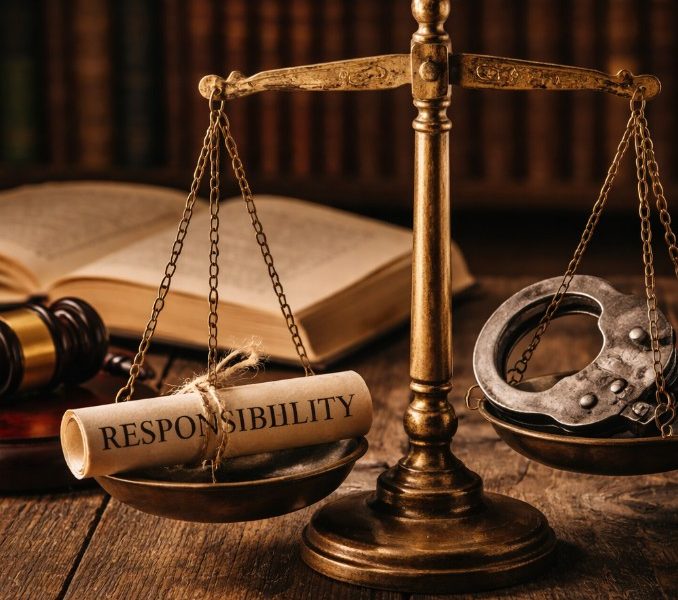
It is responsibility.
What do you think?