Derailments, Technology, and the Opportunity to Rebuild the American Rail System
Catalyst
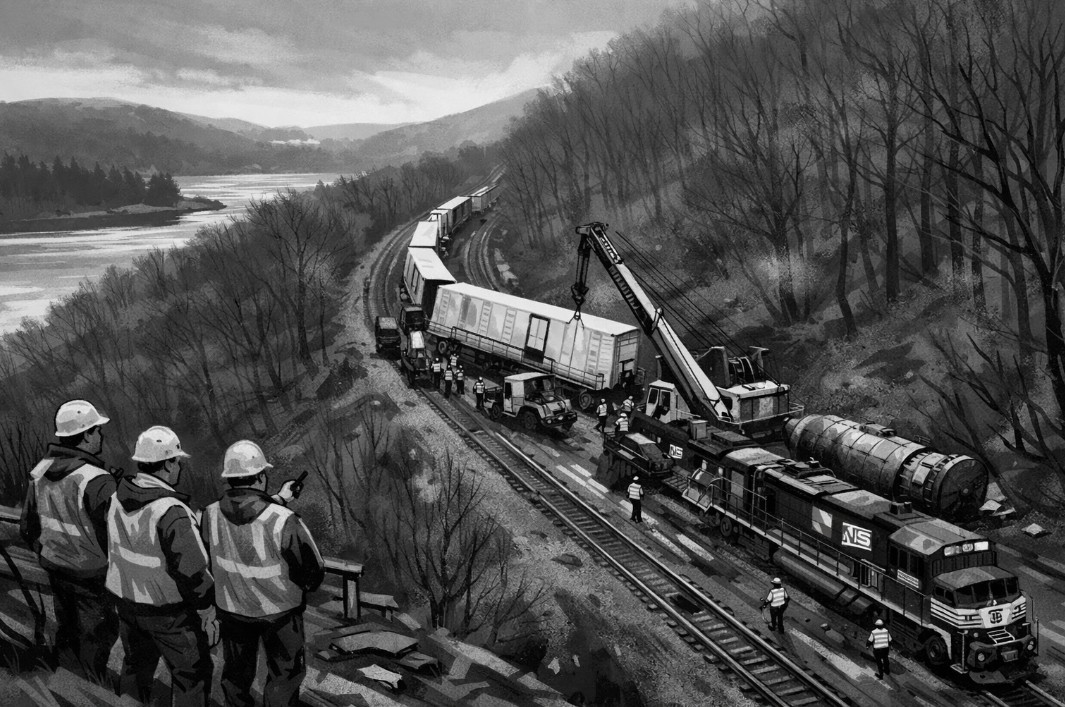
Every so often the news cycle fills with stories about train derailments. A freight train leaves the rails somewhere in the country. Photos circulate. Commentators argue. Politicians promise hearings.
Recently there was another such event in Pennsylvania, fortunately without injuries. Seeing it in the headlines prompted a simple question:
Are derailments actually increasing, or are we just noticing them more?
The answer matters. If the system is getting worse, we have a crisis. If the system is getting safer, then the real question becomes something else entirely:
How do we accelerate the trend?
When the numbers are examined globally and historically, the pattern becomes clear.
The rail system is not collapsing. It is steadily improving.
And that improvement points toward a much larger opportunity.
What the Data Actually Shows
In the United States alone, railroads operate roughly 140,000 miles of track, moving about 40 percent of all freight in the country. At that scale, incidents will happen.
But the long-term safety trend is unmistakable.
In the late 1970s the United States recorded roughly 9,000 derailments per year.
Today the number is closer to 1,000–1,300 annually.
That is an improvement of roughly 85 percent over four decades.
Most derailments that occur today are minor events in rail yards—one or two cars leaving the rails at low speed during switching operations. They rarely involve injuries and almost never resemble the catastrophic crashes people imagine when they hear the word derailment.
In other words, the modern rail system is already dramatically safer than the one Americans remember from a generation ago.
The key question becomes:
Why did safety improve so much?
The Revolution in Rail Technology
Railroads did not become safer because of a single law or regulatory intervention. They became safer because of technology layered across the system.
Several advances changed the risk profile of rail transport.
Track Monitoring Systems
Modern railways deploy inspection vehicles that scan track geometry with lasers and ultrasonic sensors. These systems detect:
- microfractures in rails
- alignment problems
- subtle deformation in the track bed
Problems that once required human inspection can now be detected long before failure.
Bearing and Equipment Sensors
Trackside detectors monitor passing trains for overheating bearings, known as “hot boxes.” These sensors automatically alert dispatchers before mechanical failure can cascade into derailment.
Positive Train Control
Automatic braking systems now prevent trains from exceeding safe speeds or entering occupied track segments. Positive Train Control systems act as a final automated safety layer if human operators make an error.
Predictive Maintenance
Railroads increasingly rely on predictive analytics. Data from sensors, inspections, and operational logs allow maintenance teams to intervene before infrastructure fails.
Each layer reduced risk slightly.
Together they changed the entire safety curve.
The Lesson Hidden in the Numbers
When people see derailments in the news, the instinct is to ask for more enforcement, more regulation, more oversight.
But the actual improvement in rail safety did not come from expanding regulatory frameworks alone.
It came from engineering advancement.
Every time a railroad replaced older infrastructure with improved materials, better sensors, or smarter control systems, the risk of derailment declined.
Technology—not paperwork—moved the needle.
That lesson should shape the next phase of American rail policy.
The Strategic Question
If technology made rail dramatically safer over the last 40 years, what happens if we accelerate the upgrade cycle across the entire network?
Instead of focusing primarily on compliance regimes and enforcement layers, the United States could adopt a different strategic posture:
Upgrade the system itself.
Imagine a national rail modernization strategy built around a simple principle:
Every mile of track rebuilt should be rebuilt with the best technology available at the time.
This means:
- continuous track monitoring
- integrated sensor networks
- modern signaling systems
- advanced braking technologies
- automated inspection platforms
Not as experimental pilots, but as standard infrastructure.
Safety Through System Design
The most effective safety systems are not reactive.
They are designed into the system itself.
A railroad that continuously monitors track geometry, equipment temperature, braking performance, and train speed will prevent most accidents long before a human regulator ever enters the conversation.
The safest system is the one that detects problems automatically and corrects them immediately.
This is already happening in fragments across the rail industry.
The opportunity now is to scale it nationwide.
Why This Matters for High-Speed Rail
Modern high-speed rail systems around the world—from France and Japan to Spain and China—operate with safety records that rival commercial aviation.
These systems rely on the same technological principles already transforming freight rail:
- automated train control
- continuous track monitoring
- redundant braking systems
- integrated infrastructure design
High-speed rail does not require inventing new safety paradigms.
It requires applying the best existing ones consistently.
If the United States commits to upgrading its rail infrastructure as it is rebuilt, it lays the groundwork not only for safer freight movement but also for the eventual expansion of high-speed passenger corridors.
The Economic Multiplier
Rail modernization is not simply a safety project.
It is an economic strategy.
Upgrading the rail network improves:
- freight efficiency
- logistics reliability
- industrial supply chains
- regional connectivity
High-speed passenger rail further transforms the landscape by compressing travel time between cities, creating what economists call expanded labor markets.
When cities become effectively closer together, economic activity expands.
Rail modernization becomes a catalyst for growth.
The Bright Meadow Perspective
The derailments that occasionally appear in the news are not evidence that rail is failing.
They are reminders that infrastructure is a living system.
The long-term trend shows that rail safety improves when engineering advances are integrated into the network.
The path forward is therefore not simply tighter oversight.
It is systemwide technological renewal.
Investing in smarter infrastructure, better monitoring, and modern control systems will make rail safer, faster, and more efficient.
And if we build those improvements into every mile of track as it is rebuilt, we do something more than reduce derailments.
We prepare the United States for the next generation of rail transportation.
The Real Opportunity
America’s railroads helped build the industrial economy of the 19th century.
In the 21st century they could help power a new era of mobility, logistics, and regional development.
But that future depends on a simple decision:
Do we treat rail infrastructure as something to regulate, or something to modernize?
The data suggests the answer is clear.
Technology made rail safer.
Doubling down on that technological progress can make it one of the safest—and most powerful—transport systems in the country’s future.