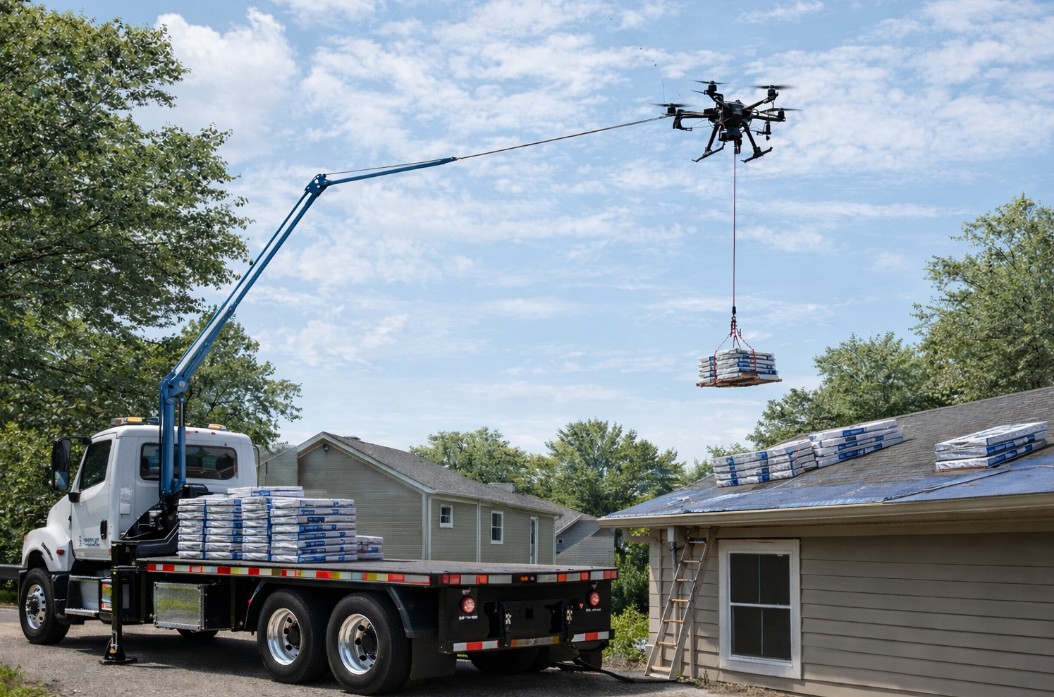
A Bright Meadow Group Systems Solution for Construction Supply and Jobsite Efficiency
Overview
Across residential and light commercial construction, one of the most persistent inefficiencies is not craftsmanship, equipment, or workforce capacity.
It is logistics.
Materials arrive at ground level. Crews spend hours staging them manually. Fatigue sets in before productive work begins, and valuable crew time is consumed by repetitive motion rather than skilled labor.
This pattern repeats daily across roofing, siding, solar installation, exterior renovation, and light commercial construction.
The result is predictable:
• delayed job starts
• worker fatigue and injury risk
• unnecessary handling of materials
• reduced crew productivity
• lower supplier throughput
Bright Meadow Group proposes a practical systems solution designed to remove this bottleneck using existing, proven technologies combined in a new operational architecture.
The result is Aerial Material Logistics (AML)—a controlled, truck-based system for placing construction materials directly where the work occurs.
Not on the ground.
On the roof, wall, or staging surface where crews begin their work.
The Problem: Gravity and Repetition
Construction work often begins with a hidden phase that is rarely acknowledged in project planning: staging.
Bundles, tools, and materials must be moved from the delivery vehicle to the work surface. This process typically involves:
• unloading at ground level
• ladder or hoist transport
• repeated manual lifting
• re-distribution across the work area
On a typical residential roofing job, staging alone can consume one to two hours of crew time before productive work begins.
This is not a training issue.
It is not a motivation issue.
It is a structural inefficiency created by gravity and legacy workflows.
The Bright Meadow Group Approach
Bright Meadow Group specializes in identifying systemic inefficiencies and solving them through integrated design rather than incremental improvement.
The Aerial Material Logistics system eliminates staging by moving materials directly from the delivery vehicle to the work surface through a controlled aerial lift platform.
Rather than relying on cranes or manual handling, the system combines:
• a supplier delivery truck
• a lightweight boom envelope
• a tethered industrial drone lift module
• standardized load interfaces
Together these components create a bounded aerial material handling system designed specifically for light construction logistics.
System Architecture
1. Mobile Logistics Platform
The base of the system is a supplier-grade delivery truck equipped with:
• power generation or high-capacity batteries
• material staging racks
• operator interface and safety controls
• stabilizing outriggers
• data and safety interlocks
The truck acts as a mobile logistics hub, allowing suppliers to deliver and place materials in a single operation.
2. Structural Boom Envelope
The boom is not intended to function as a traditional crane.
Instead, it provides three critical functions:
Operating Envelope
The boom defines a controlled three-dimensional work zone within which the lift system operates. This prevents uncontrolled flight or lateral drift.
Tether and Power Path
A tether supplies power and provides a physical safety link between the lift module and the truck.
Visual and Regulatory Legibility
The boom ensures that the system is recognizable as construction equipment rather than an unrestrained aerial vehicle, simplifying regulatory acceptance and jobsite comfort.
The boom does not perform the lift.
It defines and stabilizes the environment in which the lift occurs.
3. Aerial Lift Module
At the center of the system is an industrial, tether-capable drone lift platform that performs the majority of the lifting work.
The lift module provides:
• vertical material transport
• active stabilization of suspended loads
• precise placement capability
• controlled ascent and descent
Equipped with redundant motors, sensors, and load monitoring systems, the platform functions less like an aircraft and more like a self-stabilizing lifting head.
4. Standardized Load Interface
Predictability is essential for safety and speed.
The system is designed around small, repeatable loads such as:
• individual roofing bundles
• tool totes
• underlayment rolls
• solar panel cartons
• accessory material kits
Loads attach through a passive self-leveling interface designed to reduce swing and simplify alignment.
Placement Automation
Construction work contains large amounts of repetition.
Once roof geometry or staging zones are identified, the system can define standard placement locations.
Materials can then be delivered along repeatable lift paths, allowing crews to receive supplies exactly where they are needed.
Over time, staging becomes:
• faster
• calmer
• more predictable
Automation here is simple and deliberate.
It does not rely on speculative artificial intelligence—only repeatable motion and controlled lift paths.
Safety Philosophy
The Aerial Material Logistics system is designed around bounded operation.
Key safety principles include:
• operation restricted to a boom-defined envelope
• tethered power eliminating free flight
• conservative load limits
• wind speed operational gating
• clear ground exclusion zones
• dead-man operator controls
The system’s most dangerous potential failure—uncontrolled aerial motion—is structurally prevented through physical and operational constraints.
Operational Benefits
For Construction Material Suppliers
• increased delivery efficiency
• higher daily delivery throughput
• premium “roof-ready” delivery service
• stronger contractor relationships
• differentiation in competitive markets
For Contractors
• immediate job start capability
• reduced worker fatigue
• fewer lifting injuries
• more productive crews
• faster project completion
Recovering even one hour per job compounds rapidly across crews and seasons.
Applications Across Construction
While roofing provides the clearest starting point, the system applies broadly across light construction logistics.
Potential applications include:
• roofing installation
• siding installation
• solar panel placement
• HVAC rooftop staging
• exterior renovation materials
• debris removal during demolition
The platform is designed to support repetitive material movement rather than heavy construction loads, making it ideally suited for light and mid-scale construction operations.
Why This Solution Is Viable Now
Every major component of this system already exists in industrial use:
• tether-capable drone lift platforms
• industrial multirotor stabilization systems
• light boom trucks
• load sensing and control systems
• computer-assisted placement
The innovation lies not in inventing new technology but in integrating existing technologies around a persistent industry bottleneck.
The Bright Meadow Group Role
Bright Meadow Group provides systems analysis, design integration, and deployment strategy for emerging operational solutions.
For the Aerial Material Logistics platform, Bright Meadow Group offers:
• feasibility analysis
• system architecture design
• regulatory pathway analysis
• supplier integration strategy
• contractor pilot programs
• operational workflow design
Our focus is not only on technology, but on ensuring that the system integrates smoothly into real construction workflows.
Closing
Construction productivity has historically improved through better tools, better materials, and better training.
Yet some of the largest gains remain hidden in logistics.
Aerial Material Logistics addresses one of the most persistent inefficiencies in light construction: getting materials to the place where work actually happens.
Start the job with materials already where they are needed.
Less strain on workers.
More productive crews.
More efficient suppliers.
That is not speculative technology.
It is simply good systems design.