For most of human history, ideas were guarded like treasure.
Inventors hid notebooks. Companies locked research behind patents. Governments buried plans inside committees. Knowledge moved slowly, and progress depended on who controlled information rather than who could use it.
That system made sense when knowledge itself was scarce.
It makes far less sense now.
We live in a moment where the accumulated knowledge of humanity sits a few keystrokes away. Machine learning systems can analyze patterns across centuries of research in seconds. A person with curiosity and discipline can design systems that once required entire institutions.
The bottleneck is no longer knowledge.
The bottleneck is how freely we allow it to circulate.
The Old Model: Guard the Idea
The twentieth century rewarded secrecy.
If you had a clever idea, the rules were simple:
Protect it.
Patent it.
Control it.
Extract value from it.
This approach created enormous industries and enormous fortunes, but it also created a culture of jealous ownership of ideas.
Two people might independently discover solutions to the same problem and spend years competing instead of collaborating.
Entire fields evolved behind walls.
Progress happened—but slower than it could have.
The New Reality: Ideas Are No Longer the Scarce Resource
Today the environment has changed.
The growth of machine learning since the first transistor was invented has transformed the landscape of discovery. Systems that can analyze vast bodies of research, simulate processes, and explore design possibilities are now accessible to ordinary individuals.
What once required large laboratories now requires curiosity and time.
When the cost of generating ideas drops this low, guarding them becomes less important than sharing them quickly enough that others can improve them.
The advantage no longer belongs to the person who hides knowledge.
It belongs to the network that spreads it.
Open Source Is Not Just for Software
The open-source movement in computing demonstrated something remarkable.
When programmers released their code freely—inviting anyone to examine, improve, and extend it—the software often became better and more resilient than proprietary alternatives.
Thousands of contributors replaced a single closed team.
The same principle can apply beyond software.
It can apply to:
- urban planning
- ecological engineering
- civic infrastructure
- tourism development
- cultural institutions
Instead of guarding ideas about how cities might improve themselves, those ideas can be discussed openly, refined publicly, and adopted anywhere.
When someone builds something better, everyone benefits.
Building Ideas in Public
Everything produced by this company is intentionally visible.
Concepts are written about openly. Designs are shared. Experiments are described as they happen.
This is not a marketing strategy.
It is a thesis.
The belief is simple: humanity’s best opportunity at this point in history is to abandon the reflex of secrecy and recognize our shared interests.
We do not need to compete over every insight.
We need to help each other do great things faster.
If someone can run with an idea faster than its originator, that is not a loss. It is proof that the idea was worth sharing.
The End of Artificial Scarcity
Much of the modern concept of wealth depends on controlling scarce resources.
But ideas are not like oil or land.
Ideas multiply when shared.
When one person uses an idea, it does not disappear for everyone else. It becomes a starting point for the next innovation.
In a world where knowledge flows freely and machines can assist with discovery, the value shifts from owning ideas to applying them creatively.
When communities cooperate rather than compete over every concept, the artificial scarcity that drives much conflict begins to dissolve.
Struggle, in many cases, is not an unavoidable law of nature.
It is a product of the systems we built.
Civic Creativity as a Shared Project
Cities provide a powerful example of what open creativity can accomplish.
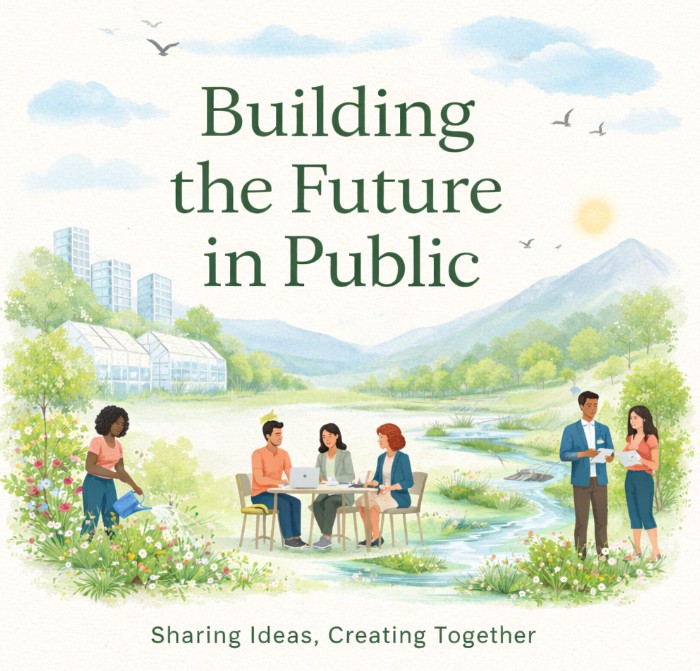
Imagine a place where people openly discuss possibilities:
- a museum that celebrates the strange stories of the region
- a municipal garden that doubles as a water-cleaning ecosystem
- ecological infrastructure that captures nutrients and turns them into life
None of these ideas need to remain locked inside private proposals.
They can exist in the public conversation, where anyone interested can help refine them.
Some will remain ideas.
Some will evolve.
Some will eventually be built.
And when they are built, the community will already feel a sense of ownership—because the ideas were never hidden from them.
Filtering the Noise
Open discussion does not mean chaos.
Good ideas still require discipline. Markets still require clarity. Projects still need focus.
The practical rule is simple: work on a few things at a time and apply the 80/20 principle so attention does not fragment.
But openness remains the guiding principle.
Ideas should circulate freely enough that anyone who sees a better path can contribute.
The Role of Machines
Machine learning makes this openness more powerful.
Modern systems can help analyze complex problems, test designs, and reveal patterns that human researchers might miss. Instead of replacing human creativity, they amplify it.
But the technology only reaches its potential when the knowledge feeding it is widely available.
When research, designs, and concepts are hidden, machines cannot help synthesize them.
When knowledge flows freely, machines help humanity connect ideas faster than ever before.
A Different Kind of Competition
Open collaboration does not eliminate competition. It changes its nature.
Instead of competing to hide knowledge, people compete to build the best version of an idea.
Instead of hoarding insights, innovators try to implement them more elegantly and more quickly.
The result is not less progress.
It is accelerated progress.
A Simple Principle
The guiding principle is straightforward:
Share what you know.
Build what you can.
Help others build something better.
If someone improves the idea, celebrate it.
If someone builds it before you do, the world still benefits.
And if enough people adopt this mindset, the pace of human progress increases dramatically.
The Opportunity in Front of Us
Humanity now possesses tools that earlier generations could barely imagine.
The knowledge of centuries sits within reach. Machines can help us synthesize and explore that knowledge. Global communication allows ideas to travel instantly.
The only remaining barrier is cultural.
We must decide whether to continue guarding ideas out of habit—or to treat knowledge as a shared resource that everyone can build upon.
If we choose openness, the results could be extraordinary.
Because once people stop protecting every idea and start helping each other realize them, something surprising happens:
Great things begin to appear everywhere.
And no single person has to build the future alone.