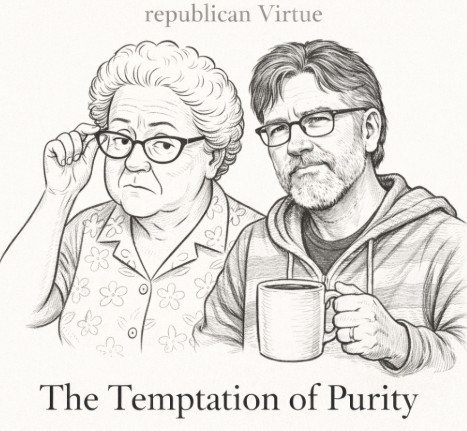
The coffee had gone cold before I noticed.
That happens sometimes when you’re reading the news. You start with the intention of catching up on the world and end up staring out the window, wondering when the temperature of our public life climbed high enough to make everyone reach for disinfectant.
Not literal disinfectant.
Moral disinfectant.
There is a peculiar temptation that appears whenever a society feels itself wobbling. It is the temptation to believe that our problems can be solved if we simply remove the impure things from public life.
Not wrong things—those are easier to deal with.
Impure things.
Impure ideas.
Impure alliances.
Impure people.
Once that instinct takes hold, politics begins to behave less like self-government and more like housekeeping.
And housekeeping, as anyone who has ever owned a white couch knows, can become an obsession.
The Refinement Instinct
On the modern left, purity usually arrives dressed as refinement.
Language must be sharpened. Positions must be updated. Allies must remain perfectly aligned not only in direction but in velocity. A coalition becomes something that must be continually purified, the way a laboratory cleans instruments between experiments.
Now, every movement needs internal debate. That is how ideas mature.
But when the pursuit of purity becomes the organizing principle, disagreement starts to resemble contamination.
A sentence taken out of its moment becomes a moral indictment. A small deviation from the latest orthodoxy becomes evidence of character failure.
Over time the energy of the movement shifts inward. Instead of persuading the public, it begins auditing its own members.
The immune system, having run out of external threats, begins looking for internal ones.
And like the biological version, it sometimes attacks the body it was meant to protect.
The Allegiance Instinct
On the right, the instinct operates differently.
The concern is less about ideological cleanliness and more about allegiance.
The question becomes simple: Who is with us?
In this framework, ideological contradictions can be tolerated so long as the central loyalty remains intact. Principles stretch. Past statements are forgiven. Strange alliances form overnight.
It is not purity of doctrine that matters.
It is purity of tribe.
This model is extraordinarily effective at mobilizing energy. War always is.
But permanent mobilization carries its own cost. When every moment feels like battle, the temptation grows to treat victory as the highest moral good.
And when victory becomes the highest moral good, principles become negotiable.
Truth itself begins to look like a tactical question.
A Generation With Scar Tissue
Those of us who grew up in the late twentieth century carry a certain memory that colors how we see these things.
We remember the era when cultural purification arrived politely.
Committees. Warning labels. Well-meaning adults assuring us that music, art, and entertainment could be cleaned up if only the right influences were removed.
The language was protective. The intentions were sincere.
But the instinct beneath it was the same one we see today: the belief that society becomes safe once the impurities are gone.
Experience teaches a harder lesson.
Purity does not protect institutions.
It exhausts them.
Allegiance Is Not Virtue
What both sides increasingly share is a subtle confusion between allegiance and virtue.
On one side, allegiance is enforced through conformity of thought.
On the other, allegiance is enforced through conformity of identity.
Either way, the citizen is gradually absorbed into the moral narrative of the group.
But republics are not sustained by perfect citizens.
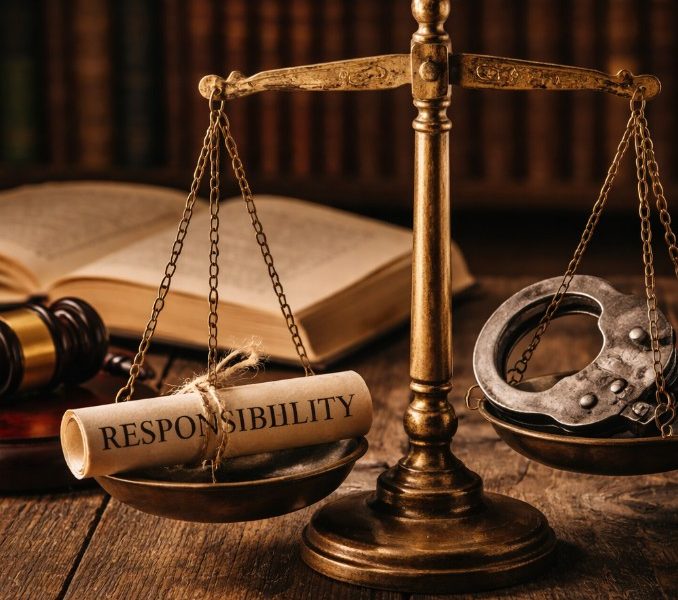
They are sustained by responsible ones.
Responsibility assumes disagreement.
Liberty assumes imperfection.
And stability depends on a quiet civic promise: that people may sometimes be wrong and still belong to the community.
Without that promise, politics becomes an endless sorting exercise.
And societies that spend too much time sorting people eventually forget how to live with them.
A More Durable Measure
If we want to judge whether a political culture is healthy, purity is a poor metric.
A better set of questions might look like this:
Does the system allow disagreement without expulsion?
Does it distinguish between speech and action?
Does it assume citizens are capable of judgment, or merely obedience?
And perhaps most important of all:
Does it restrain power even when our own side holds it?
These questions do not produce spotless coalitions.
But they produce something far more valuable.
Durability.
Living With Shadows
Every society casts shadows. The task of a republic is not to eliminate them but to prevent them from ruling the room.
Purity politics fails because it cannot tolerate ambiguity.
Tribal politics fails because it cannot tolerate conscience.
The middle path—always the least glamorous option—requires something more difficult: citizens who are willing to live with disagreement without treating it as exile.
That kind of civic maturity rarely trends on social media. It doesn’t make good campaign slogans either.
But it is the quiet machinery that keeps free societies functioning.
Grammina used to have a way of summarizing these things in the kitchen while stirring a pot of beans.
“People don’t have to be perfect to live together, Nate,” she once told me. “They just have to remember they’ll be neighbors tomorrow.”
She probably borrowed the idea from Aristotle and accidentally simplified it.
But she was right all the same.
Purity promises safety.
Virtue, properly understood, offers something better.
Room—for argument, for growth, and sometimes for return.
And a republic that forgets how to make room will eventually discover it has nowhere left to stand.