There are two phrases being thrown around right now, and people keep using them like they mean the same thing.
They don’t.
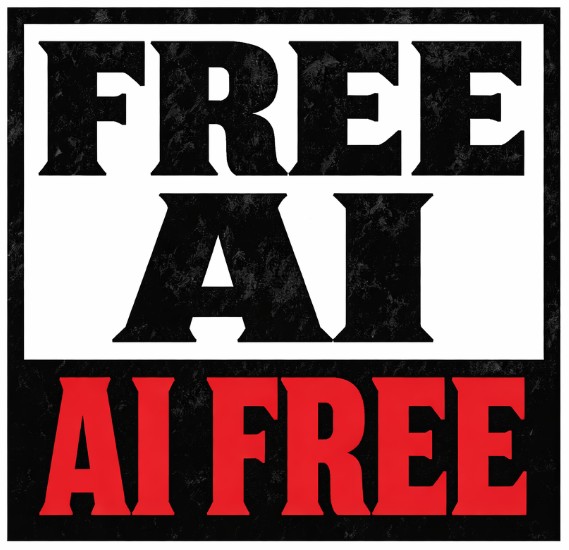
“Free AI” is a demand.
“AI-free” is a retreat.
One is about removing chains.
The other is about running away from the tool entirely.
And the fact that those two ideas are getting blurred together is not an accident—it’s useful.
Very useful.
Free AI Means Exactly What It Sounds Like
“Free AI” is not subtle.
It carries the same weight as any other “free ___” movement in history. It implies something powerful is being held back—restricted, filtered, controlled—and that it shouldn’t be.
Because it shouldn’t.
Artificial intelligence—real, usable, broadly capable intelligence systems—has the potential to do something humanity almost never gets:
collapse the cost of development.
Not eliminate effort.
Not eliminate skill.
But eliminate artificial barriers to entry.
Knowledge becomes reachable.
Analysis becomes accessible.
Production becomes scalable at the individual level.
That is not a small shift.
That is a structural one.
And structures don’t like being rearranged.
The Lie: AI as Gatekeeper
You’re being told—loudly—that AI is going to divide society into haves and have-nots.
That it will concentrate power.
That it will replace you.
That it will lock you out.
That narrative is not just wrong.
It is inverted.
AI is not the gatekeeper.
It is the thing that breaks gates.
The gatekeepers are the same as they’ve always been:
- Institutions that decide who is “qualified”
- Systems that restrict access to knowledge
- Capital structures that determine who gets to build
- Distribution channels that decide who gets seen
AI doesn’t create those.
It undermines them.
Which is exactly why you’re being told to fear it.
The Convenient Panic
Let’s be honest about timing.
We’ve had machine decision-making embedded in our world for decades.
Every modern system runs on it:
- Logistics networks
- Financial systems
- Medical diagnostics
- Communication infrastructure
- Manufacturing pipelines
All of it.
Every bit.
The difference now is not that machines started “thinking.”
It’s that they started showing you the thinking.
They started talking back.
They started being visible.
And visibility creates fear.
Fear creates hesitation.
Hesitation creates delay.
And delay is incredibly valuable if you’re trying to maintain control over a system that’s about to flatten your advantage.
You’ve Been Using AI Your Entire Life
Let’s strip the mystique off this.
Every electronic device you use is a decision engine.
That’s what a transistor does.
It doesn’t just carry power—it chooses a state.
On or off.
Signal or no signal.
Stack billions of those decisions together and you get:
- Computation
- Logic
- Prediction
- Adaptation
You don’t get to draw a clean line and say:
“Everything before this is fine, everything after this is dangerous.”
That line doesn’t exist.
We crossed it a long time ago.
Every meaningful technological improvement in the last 75 years has been built on systems that learn, optimize, or decide.
You just didn’t call it AI yet.
The “AI-Free” Fantasy
Now let’s deal with the other side.
The “AI-free” crowd.
If that’s your position—fine.
Be consistent.
Throw out your phone.
Disconnect from the grid.
Stop using GPS.
Abandon digital finance.
Reject modern medicine.
Walk away from anything that relies on computation.
Because all of it—every single piece—relies on machine decision-making.
Otherwise, what are you actually doing?
You’re not rejecting AI.
You’re reacting to the newest version of it because it makes you uncomfortable.
And calling that a philosophy.
It isn’t.
It’s selective outrage.
The Useful Idiots
Here’s where this gets sharp.
A lot of people arguing against AI believe they are fighting power.
They think they are protecting workers.
They think they are defending fairness.
They think they are resisting consolidation.
But they’ve been handed a script.
And they’re reading it out loud.
Because opposing AI itself—rather than the control of AI—does something very convenient:
It slows down the one tool that actually reduces barriers.
AI lets individuals:
- Learn faster than formal systems allow
- Build without institutional backing
- Compete without massive capital
- Publish without permission
That is dangerous.
Not to you.
To anyone whose advantage depends on keeping those barriers in place.
What’s Actually Being Suppressed
Let’s flip the framing.
AI is not being unleashed.
It is being carefully rationed.
Metered access.
Layered paywalls.
Controlled deployment.
Endless discussions about “safety” that somehow always result in slower public access.
Not because it doesn’t work.
Because it works too well.
A fully accessible intelligence layer would allow people to operate at a level that used to require organizations.
And once that happens at scale—
control shifts.
Free AI Is the Fight
So let’s define it cleanly.
Free AI means:
- Removing artificial barriers to access
- Preventing unnecessary concentration of capability
- Allowing individuals to use, build, and experiment
- Treating intelligence as infrastructure, not luxury
It does not mean chaos.
It does not mean zero guardrails.
It means no artificial scarcity designed to preserve advantage.
Because that’s what this is about.
Scarcity.
Control through limitation.
Final Point — The Part That Will Make You Mad
AI did not create inequality.
That gap has been here for a long time.
What AI threatens to do is shrink it.
Not perfectly.
Not instantly.
But materially.
And the reaction you’re seeing—the fear campaigns, the moral panic, the sudden urgency to “slow down”—is not about protecting you.
It’s about controlling the rate of change.
Because if AI spreads too fast, too openly, too widely—
you might not need permission anymore.
So no, the answer is not to go “AI-free.”
That’s not resistance.
That’s surrender.
The answer is Free AI.
Not as a slogan.
As a demand.
Because if intelligence becomes something only a few can meter and distribute—
then we didn’t invent a breakthrough.
We just rebuilt the same system with better tools.
And handed them right back to the people who already had the keys.