There is a particular kind of building that doesn’t make the news.
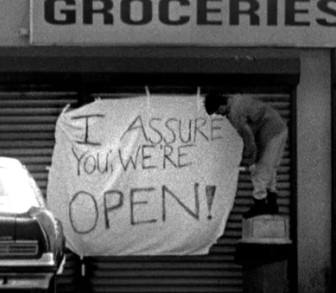
It opens on time. It closes on time. The staff knows the regulars. The floors get mopped. The lights stay on. Nobody cuts a ribbon. Nobody holds a press conference. It just works, the way it worked last Tuesday and the Tuesday before that, going back further than anyone counted.
We’ve gotten very good at noticing when things break. We have whole industries built around the documentation of failure — feeds and alerts and breaking news chyrons that exist for no other purpose than to tell you something has gone wrong. Somewhere there is a control room full of people whose entire professional purpose is to make sure you hear about the collapse before the dust settles. And plenty has collapsed. That part isn’t wrong.
What we’ve gotten worse at is noticing the things that held.
The librarian who showed up. The water treatment plant that ran its cycle in the dark before anyone was awake to notice. The school that opened its doors on a Monday that felt, to everyone inside it, like an act of stubbornness against the surrounding chaos. The clerk who processed the form, correctly, on the first try, and didn’t expect a medal for it. Not heroes. Not stories. Just the background hum of a civilization that is, despite everything, still mostly working.
There is a particular kind of learned helplessness that comes from only watching the failures. You start to believe that nothing holds. That every institution is compromised, every system is captured, every person is running some angle. And once you believe that completely, something shifts — you stop expecting anything to work, and then you stop demanding that it does, and then you stop participating in the maintenance of the things that were, in fact, still working. The cynicism becomes the damage.
Institutions are not self-sustaining. They are not magic. They hold because people inside them decide, every single day, to do the work. Not because the system compels them. Not because anyone is watching. Not because the pay is remarkable or the recognition is forthcoming. Because they understand, on some level they may not even be able to articulate, that consistency is not glamorous but it is foundational — and that the alternative is not freedom or disruption or creative destruction. It is just a different kind of chaos, and a worse one, because it is the kind that takes generations to repair.
The buildings that don’t make the news are the ones worth paying attention to. Not because they’re perfect. Because they showed up.
That’s the short version of what we believe here. And it connects directly to what the Cernunnos Foundation family of projects has always been about — though we don’t always say it plainly enough, and this seems like a good moment to say it plainly.
When we talk about protecting wildlands, we don’t mean only rivers and forests and the things you can photograph at golden hour and post without a caption because the image speaks for itself. We mean the wildness in how people think. The part of the human mind that refuses to accept the first answer, that keeps pulling at the thread even when the sweater looks fine, that builds systems in its head long before it ever picks up a tool. That is a wildland too. It needs tending. It goes fallow faster than any field if you leave it alone long enough.
What we publish — the thought experiments, the structural proposals, the deep dives into aquaponics and copper-age economics and the civil architecture of small forgotten buildings — is not miscellaneous. It is a curriculum without a classroom, assembled on the theory that the people who are going to build the next version of things need to have been thinking seriously about what went wrong with the last version. Not forensically. In the way that a good mechanic looks at a failed part and sees not just the failure but the design flaw that made the failure inevitable.
You can’t protect what you haven’t thought through. You can’t think your way to a better future if no one is putting serious ideas in front of you and saying: here, sit with this for a minute. That’s not a small job. It is, in many ways, the whole job. The Cernunnos Foundation exists to do that work — and Blue Ribbon Team is where most of it lands, one post at a time, without fanfare, like the buildings that don’t make the news.
Enjoy the thought experiments. That’s not a throwaway line. We mean it.
We took a short break here. Life intervened in the best possible way — the kind you don’t explain. Thank you for tolerating the silence. Thank you for still being here. The traffic held better than we expected, which tells us something we already suspected about this readership: you’re not here for the volume. You’re here for the work.
We’re back. The queue is full.
Coming up in the weeks ahead, we’ll be running a series of pieces on law and power as competing frameworks for organizing society — how they differ, where they collapse into each other, and why the distinction between them matters right now. Three pieces, written to be read together or separately depending on how much time you have and how much patience you’re carrying on a given day. We think you’ll find them worth the hour.
And on April 1st — yes, April 1st, and no, that is not a joke, we are simply terrible at the calendar and it happens to be the start of the quarter — the fully updated River Refugium Project whitepaper will be published in its complete form on the Cernunnos Foundation website. The RRP has grown considerably since its last public release. It represents a serious evolution in both scope and thinking, and we’re proud of where it landed. After the full release, we’ll be serializing it in digestible sections here on Blue Ribbon Team for readers who prefer to take their infrastructure theory one chapter at a time. Both versions will be worth your time, for different reasons.
We’ll see you tomorrow.