America has spent so many years arguing like a tired empire that we have nearly forgotten how a confident nation sounds.
We bicker over fences, quotas, chokepoints, tariffs, migrant flows, port delays, trucking bottlenecks, rail congestion, cartel corridors, and the slow hollowing-out of the interior. We argue over who gets to move through the border, who gets stopped at it, and who profits from it.
All the while, we keep thinking too small.
If you are serious about border security, be serious.
If you are serious about commerce, be serious.
If you are serious about American power and industrial self-confidence, stop talking in half-measures and start talking like a civilization that once cut continents apart and stitched oceans together.
Build the canals.
Not one. Two.
One along the Canadian border. One along the Mexican border.
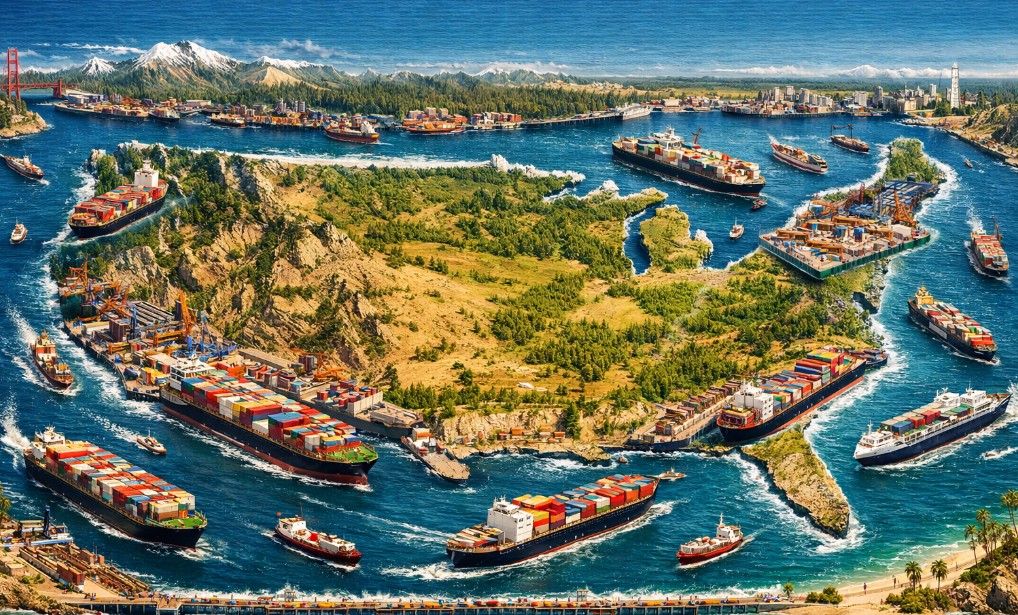
Not drainage ditches. Not decorative waterways. Not a tourist ribbon with a bike path next to it. A continental defensive-commercial earthwork so large it becomes the defining public works achievement of the century — a swale-shaped canal system, half a mile wide, four hundred feet deep, cut across the full length of both borders, mined through mountain chains where necessary, terraced, fortified, ported, railed, roaded, powered, and industrialized from end to end.
Yes. It sounds ridiculous.
Good.
America used to do ridiculous things on purpose.
The transcontinental railroad was ridiculous until it was done. Hoover Dam was ridiculous until it was built. The Panama Canal was ridiculous until somebody decided the cost of not doing it was greater than the cost of doing it. The interstate highway system was ridiculous in scale. The moonshot was ridiculous in concept.
The problem is not that this idea is too big.
The problem is that we have become too small.
A canalized border solves multiple problems at once, which is exactly what great infrastructure is supposed to do. It is a hard physical barrier, a monitored logistics corridor, a water-management system, a linear industrial zone, a shipping spine, a manufacturing magnet, and a declaration that the United States intends not merely to participate in world trade but to dominate the terms of its movement.
People love to pretend there is a conflict between secure borders and open commerce. There is not. A weak border is bad for both. An unmanaged border enriches black markets, criminal networks, and exploitative labor systems. A hardened, engineered border with controlled points of entry is exactly what a commercial republic should want. You cannot have clean trade without controlled crossings. You cannot have efficient legal movement without making illegal movement difficult, expensive, and obvious.
The same nation that wants lawful entry and sovereign control should also want freight efficiency, modern ports, and large-scale industrial throughput.
That is what these canals would be: not isolation, but mastery.
Here is what it looks like on the ground.
Every few dozen miles along the corridor: a hardened shipping node. Freight transfer. Container handling. Bulk materials movement. Rail spurs. Secure customs complexes. Warehousing. Processing. Repair docks.
And powering all of it — substations, solar fields, gas peakers, modular nuclear where practical, desalination in the south where needed, surveillance arrays, drone patrol platforms, radar masts, defense installations woven into the same corridor.
This is not merely a canal.
It is a new American edge condition.
The excavated spoil alone becomes material wealth — aggregate, fill, stone, strategic minerals, structural material, and saleable inputs feeding decades of parallel development. The canal does not just move water and freight. It is simultaneously a mining program, a logistics program, a defense program, and a land-development program wearing one uniform.
The geometry matters too. A swale profile implies controlled earthwork, stable shoulders, terraces, drainage logic, and functional layering — patrol roads at multiple elevations, rail lines where needed, sensor arrays, utility galleries, cargo staging. You do not dig a trench and hope. You engineer a permanent national feature.
And mining through mountains? That is a work order, not a philosophical objection. The nation that split the atom and tunneled beneath rivers can bore, cut, drill, and blast a level freight-security corridor wherever it deems fit.
Yes, it would be expensive.
Everything worth building is expensive when a nation has gone soft and forgotten how to reckon in generations. The first objection will always be the price tag. Never the price of the alternative.
What is the cost of a border that remains a patchwork problem?
What is the cost of funneling national commercial ambition through a narrower and narrower set of coastal chokepoints while the interior hollows out?
What is the cost of ceding infrastructure imagination to China, Gulf monarchies, and every other ambitious state that still understands that concrete, steel, and dredged earth are instruments of policy?
The status quo is not cheap. It is merely billed differently — in crime, delay, erosion, weak enforcement, fragile supply chains, decayed towns, underused manpower, and a public stripped of belief in grand undertakings.
A border canal system reverses that psychology.
It says to the country: we are still capable of continent-scale intent.
It would create hundreds of thousands of direct jobs and many more indirect ones. It would reawaken tunneling trades, heavy civil construction, inland marine industries, steel fabrication, hydraulic engineering, and all the ugly, necessary, foundational work upon which actual nations are built. It would pour money not into coasts and finance centers but into the guts of the country — equipment yards, fabrication shops, cement plants, railworks, training pipelines, industrial towns.
A country does not become strong merely by consuming technology. It becomes strong by making things at frightening scale.
The real opposition would not come from engineers. Engineers solve problems.
It would come from people offended by magnitude itself. People who hear a large idea and immediately explain why ambition is embarrassing. People who confuse cynicism with intelligence and think decline is a form of maturity.
A country this large cannot be managed by timid minds forever.
This is not anti-trade nationalism. It is pro-American trade supremacy.
It says: the world may sell, buy, ship, and move. But America will own the systems through which lawful movement becomes wealth. We will secure entry. We will monitor flow. We will harden our physical boundaries. And in the same gesture we will build the greatest shipping and logistics architecture on earth.
Not because the world is kind.
Because power respects capacity.
The best border is not a hole in a fence.
It is a system — one that knows who moves, what moves, where it moves, why it moves, and how much revenue, leverage, and industrial strength that movement generates for the nation controlling it.
Build the canals. Build the ports. Build the rail. Build the industrial belts and the new towns and the fabrication yards that make the whole thing breathe. Let the project run for decades. Let schoolchildren grow up assuming America does things that alter maps. Let the world understand that the United States is not done building history.
Too expensive?
Perhaps.
So was becoming America.