I was sitting with a popular book last week — one of those volumes on power that circulates through boardrooms with a kind of guilty enthusiasm — when I found myself thinking about Grammina.
“Well, Nate. Now you know what we built the courthouse to stop.”
She would have read the whole thing. Nodded slowly. Then looked at me over the top of her glasses and said something very much like that. She was not wrong. She rarely was.
The book isn’t immoral, exactly. It’s honest — which is a different thing, and sometimes a more dangerous one. It describes power the way a field guide describes weather: not as something to celebrate, but as something that simply is. The difficulty is that a generation has read it as a blueprint rather than a warning. We have fallen, quietly and rather thoroughly, back in love with power. And I think that is worth sitting with for a moment.
Power is not new. It is, in fact, the oldest thing there is. It is what men reach for before civilization teaches them anything better. It is fast, it is satisfying, it flatters the ego, and it produces results — at least in the short term, at least for the man holding it. There is a reason Machiavelli still sells. There is a reason strongmen still draw crowds. Power speaks to something very old and very persistent in the human animal.
But the republic was built by men who understood that, and who decided to try something considerably harder.
Jefferson understood power. Madison feared it — including his own. Adams wrote about it with the weary lucidity of someone who had watched it corrode every institution it touched. They were not naive about human nature. They were, if anything, grimly precise about it. And their answer was not to perfect power, or to place it in better hands, or to trust that the right man with enough of it would use it wisely.
Their answer was law.
Not law in the thin sense — not rules and compliance and paperwork. Law in the deep sense. The common agreement of a free people that no man, no faction, no majority, no executive is to be trusted with unbounded authority. The architecture by which a civilization says: here the appetite stops. Here, regardless of your strength or your popularity or the urgency of your cause, there are lines that hold.
Grammina had a word for this. She called it the fence that saves the garden from itself. She was thinking about her tomatoes, I believe. The principle is sound regardless.
A republic is not democracy perfected. It is democracy disciplined. It is the architecture that keeps passion from becoming policy, that keeps the strong from simply taking, that keeps the temporary majority from treating the minority as expendable. It is, as Madison understood, a machine of friction — deliberately slow, deliberately procedural, deliberately resistant to impulse.
That is not a flaw. That is the design.
When a culture begins to admire power more than law, the rot is not always visible at first. It arrives quietly, in the language we use. Restraint becomes weakness. Process becomes obstruction. Rights become inconveniences. The people who follow the rules look naive; the people who bend them look serious.
And then, gradually, the rules lose their hold.
I have watched this with some sadness in recent years, from both directions and across all the factions. The love of power is not partisan. It is human. It shows up on every side, always dressed in the language of necessity, always carrying the grievance of the moment as its justification.
“We have to fight fire with fire. They’re not playing by the rules anyway. This is too important to wait.”
Those sentences have preceded most of the damage ever done to republics.
Because the truth is that law is not primarily about convenience. It is not there to make governance easy or to produce satisfying outcomes on demand. It is there to protect people — all people, including the ones who are currently unpopular, currently accused, currently on the wrong side of the sentiment of the room.
When law loses its prestige, power does not become moral. It simply becomes naked.
I do not think the republic is lost. I am not constitutionally suited to that conclusion. But I do think we are in one of those quiet periods where a question beneath all the other questions is pressing for an answer.
Not who has power. Not who deserves it.
But whether we still believe that power is the kind of thing that needs to be bound at all.
The Founders believed it did. They built the binding into the architecture. They wrote it into the Constitution, into the separation of powers, into the Bill of Rights, into the slow and maddening procedures that make it hard for any one faction to simply have its way.
They were not trying to make government efficient. They were trying to make it safe.
So. Law or power?
Not in the comfortable version of the question, where you get to say “law” and go back to your coffee. I mean in the version that arrives when your side is furious, when your enemies are despised, when the outcome feels obvious and the process feels like an obstacle.
That is when the answer becomes real.
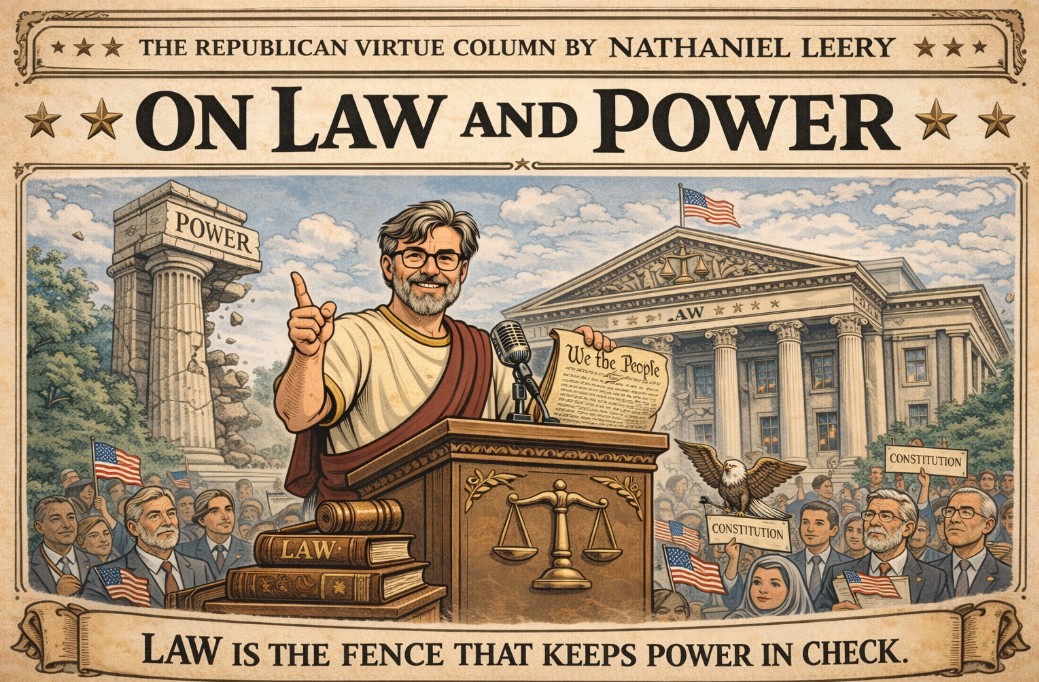
A free people do not worship power. They bind it, divide it, and hold it accountable to something larger than appetite. They call that architecture law. And the republic, such as it is, depends on citizens who still believe the fence is worth keeping.
Grammina would say we built the courthouse before the mansion for a reason. She was, as usual, approximately right.
Nathaniel Leery writes the republican Virtue column for The Blue Ribbon Team.