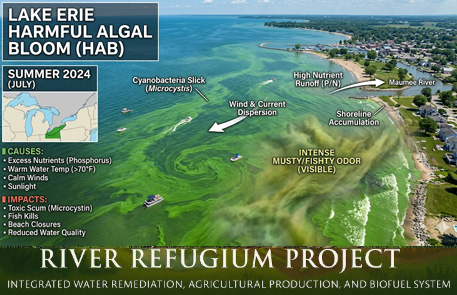
There is a green slick spreading across Lake Erie every summer.
We call it a problem.
We issue reports.
We argue about fertilizer application rates and regulatory thresholds.
And then we let it come back again next year.
Let’s stop pretending we don’t understand what we’re looking at.
That bloom is not just pollution.
It is raw material.
The Misread
We have framed the Lake Erie bloom as an environmental failure.
It is.
But more importantly, it is a systems failure of imagination.
We are staring at millions of tons of fast-growing, nutrient-dense biomass — fed continuously by agricultural runoff — and treating it like an inconvenience instead of an input stream.
If this same volume of biological material were being produced in a controlled facility, it would be called an industry.
Out in the lake, we call it a crisis.
The Geography
Look at the shoreline.
Toledo. Cleveland. Erie. Buffalo.
These cities were not accidents.
They were built where water, transport, and industry intersected.
And now they sit with underused port infrastructure, vacant or underutilized factories, skilled labor pools that remember how to build things, and political pressure to “revitalize” without a clear mechanism.
Meanwhile, just offshore, a continuous biomass event repeats itself every year.
We have separated the problem from the solution by about five miles of water and fifty years of thinking.
The Proposal (Simple, Not Easy)
Each city gets at least one facility.
Not a research lab.
Not a pilot program that disappears in a white paper.
A working industrial plant.
Inputs: Algal biomass harvested from Lake Erie. Nutrient-rich water streams. Supplemental organic waste streams (regional).
Core processes: Hydrothermal liquefaction (wet biomass → bio-crude). Hydrothermal carbonization (solids → hydrochar). Nutrient recovery (phosphorus, nitrogen). Water polishing through controlled biological systems.
Outputs: Fuel precursors. Carbon materials. Soil amendments. Industrial inputs. Cleaned water returned to system.
This is not speculative chemistry.
This is known process engineering applied to the wrong problem set for the last twenty years.
What Changes When You Treat It as Industry
Right now: the bloom is a cost.
In this model: the bloom is inventory.
That shift cascades. Removal becomes harvesting. Mitigation becomes production scheduling. Cleanup funding becomes revenue stacking. Environmental compliance becomes supply security.
And critically: the worse the bloom gets, the more feedstock you have.
That is a rare inversion of a crisis.
The Factory Model
Picture this clearly.
Not futuristic. Not speculative.
A retrofitted facility on the waterfront in Erie.
Barges or intake systems bring in dense algal slurry.
Inside: continuous flow reactors, thermal cycling systems, separation and recovery lines, adjacent greenhouse/aquaponic systems polishing effluent and producing secondary biomass.
Outside: jobs, truck traffic, rail connections, output leaving the facility as product, not waste.
This is not a cleanup site.
It is a manufacturing node.
Why This Works Here
You cannot drop this system anywhere and expect it to function.
Lake Erie’s western basin behaves like a natural growth reactor: shallow, warm, nutrient-loaded, predictable bloom cycles.
Pair that with Rust Belt infrastructure, and you get something unusual:
A naturally occurring biological production system feeding into dormant industrial capacity.
That pairing is not common.
The Objection Layer (Let’s Address It Directly)
“It’s toxic.”
Yes. And hydrothermal processing destroys those toxins.
“It’s seasonal.”
So are most agricultural inputs. Industry already handles this with storage and flow management.
“It’s too expensive.”
We are already paying to monitor it, mitigate it, and suffer its consequences. The cost exists. It is just not productive.
“It won’t scale.”
The bloom already scales. That’s the problem.
The Real Question
Not whether this is possible.
Not whether the chemistry works.
Not whether the bloom will continue.
The real question is: do we continue treating Lake Erie as a liability, or do we convert it into a production system?
Because the current strategy is to spend money forever and produce nothing.
This alternative produces something — and reduces the problem as a side effect.
A Regional Strategy, Not a Single Bet
This is not one plant.
This is a network.
Toledo → primary intake zone.
Cleveland → processing + distribution.
Erie → integrated demonstration node.
Buffalo → expansion + materials output.
Each city participates. Each city benefits. Each city rebuilds a piece of what it used to be — without pretending it’s still 1955.
Who’s In?
This is where it gets uncomfortable.
Because this does not wait for permission very well.
Municipal leaders can greenlight sites. State agencies can redirect cleanup funding. Private capital can underwrite facilities. Federal programs can be aligned after the fact.
But none of that happens until someone says:
“We are going to build one.”
Not study one.
Not model one.
Not convene a panel about one.
Build one.
Final Thought
We like to talk about bringing manufacturing back.
We argue about supply chains, geopolitics, and labor.
All of that matters.
But right now, on the surface of Lake Erie, we have a domestic, renewable, continuously generated industrial input — and we are ignoring it because we met it as a problem instead of an opportunity.
The Rust Belt does not need nostalgia.
It needs a new feedstock.
Lake Erie is already providing it.
The only question left is:
Who’s in?
Bright Meadow Group
Systems Analysis and Solutions Consulting
robert@brightmeadowgroup.com | www.cernunnosfoundation.com
River Remediation + Resource Recovery Series | Open Access | No Paywall
If you would like to read more on the River Refugium Project and its systems, follow this link.
One thought on “Lake Eries Green Slick”
Comments are closed.