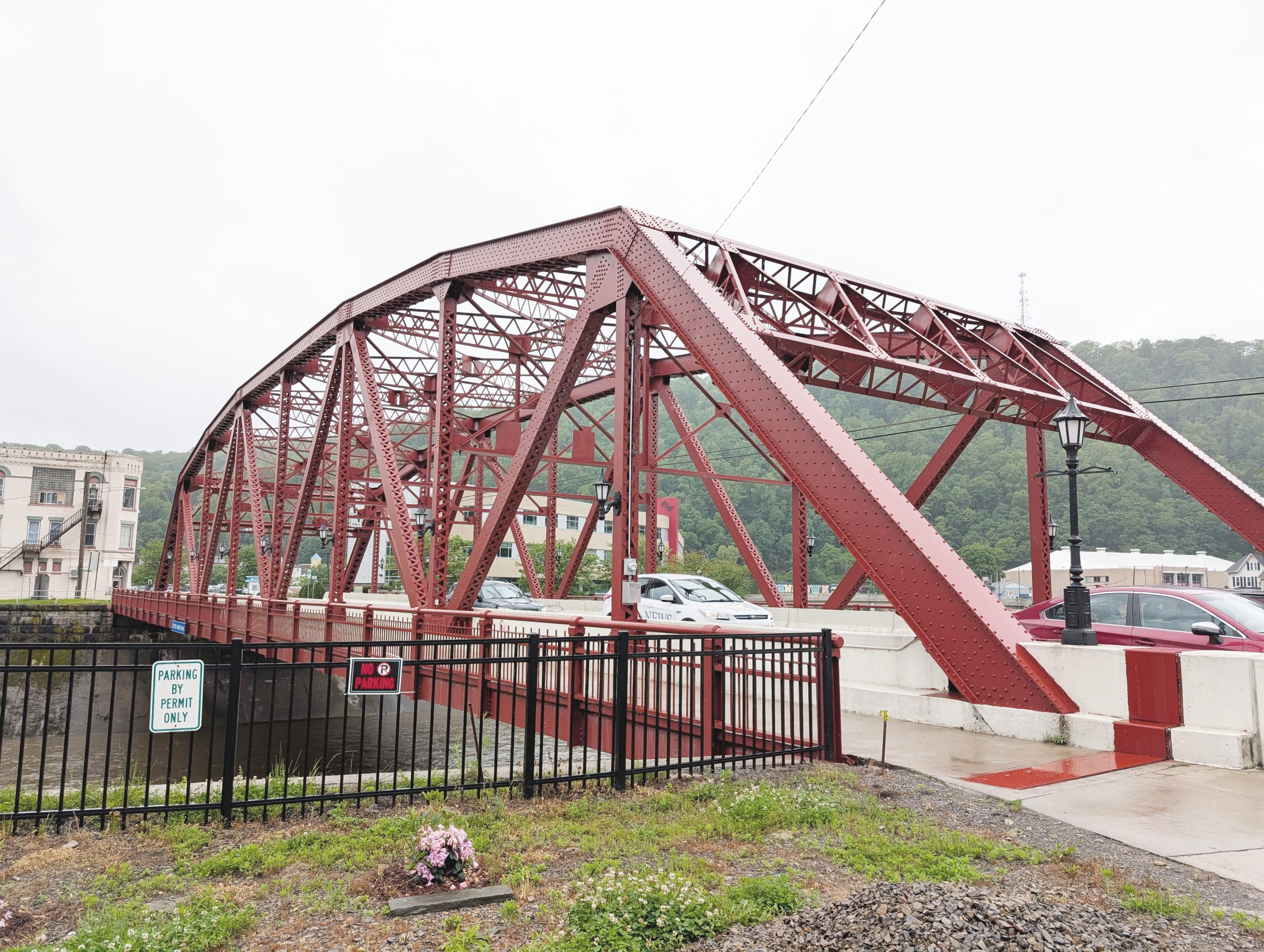
Johnstown is a city that wears its engineering in the open. Rivers converge here, railroads thread through the valley, and the infrastructure that keeps the place moving is rarely subtle. The red steel truss bridge standing in downtown is a perfect example.
Where stone bridges rely on mass, this bridge relies on geometry.
The structure is a classic riveted steel through-truss, a design that became standard across American industrial towns in the early twentieth century. Instead of resisting loads with sheer weight, the bridge distributes forces through a repeating lattice of triangles. Each member either carries tension or compression, passing the load through the frame until it reaches the abutments at each end.
It is structural logic made visible.
Riveted Construction
One of the most striking details is the field of rivets that covers nearly every connection. Before welding became common in bridge construction, structural members were joined using hot-driven steel rivets.
A typical crew worked in coordinated teams:
- one worker heating rivets in a forge
- one tossing the glowing metal bolt across the span
- another catching it in a metal bucket
- two more driving it into place with pneumatic hammers
Each rivet shrank as it cooled, clamping the steel plates together with tremendous force. The result was a structure that behaved almost like a single continuous piece of metal.
Thousands of those rivets are visible in the bridge’s gusset plates and chords, giving the structure its distinctive industrial texture.
The Pratt Truss Logic
The pattern of diagonals reveals the bridge’s engineering lineage. It follows the logic of the Pratt truss, one of the most widely used American bridge designs.
In a Pratt system:
- vertical members carry compression
- diagonal members carry tension
That division of labor allowed engineers to use slender steel members efficiently while still supporting heavy loads from vehicles, railcars, or street traffic.
The triangular geometry also prevents the structure from deforming under uneven loads, giving the bridge its remarkable stiffness.
Built for an Industrial City
Bridges like this were common in places like Johnstown for a reason.
The region was one of the great steel-producing centers of the United States, and the material used to build these bridges often came from mills only a few miles away. Infrastructure, industry, and landscape formed a tight loop here: steel mills produced the metal, railroads carried it, and bridges like this allowed both to move through the narrow river valleys.
Painted in the familiar oxide red common to industrial steel, the bridge still reflects that heritage.
Structure as Landscape
Seen from the riverbank, the bridge becomes almost skeletal — a repeating framework of diagonals, verticals, and horizontal chords cutting across the sky.
The design is not decorative, yet the geometry creates its own visual rhythm. Triangles repeat from one end of the span to the other, each one transferring force to the next in a continuous chain of structural logic.
It is engineering stripped down to its essentials.
And in a city shaped by steel, rivers, and industry, that clarity feels exactly right.