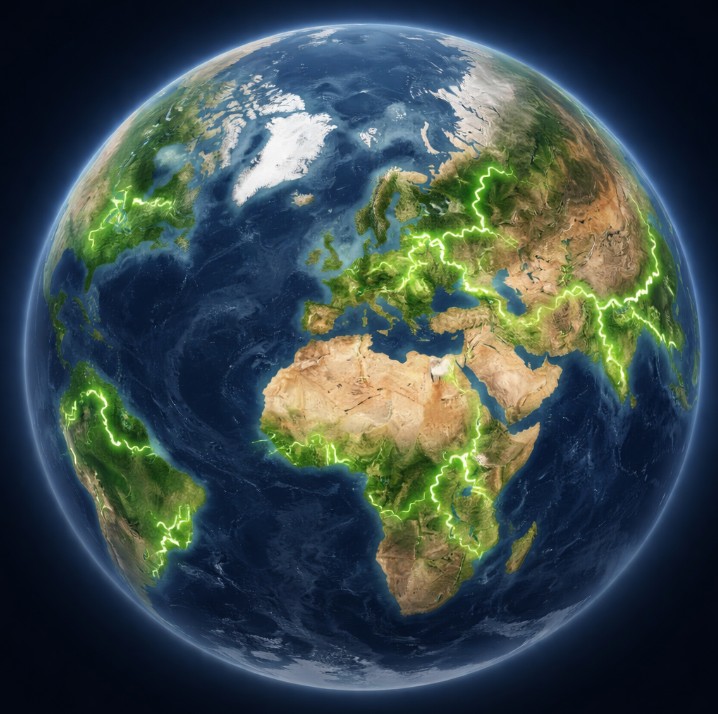
The River Refugium Project
Turning Nutrient Pollution into Energy, Ecology, and Opportunity
For most of the modern era, nutrient pollution has been treated as an unavoidable byproduct of civilization. Fertilizers feed crops. Cities produce waste. Rivers carry the excess downstream. Eventually, those nutrients accumulate in lakes, deltas, and coastal waters where they fuel algal blooms and expanding “dead zones.”
From the Gulf of Mexico to the Black Sea, from South Asia to South America, the story repeats itself: too much nitrogen and phosphorus flowing through watersheds that were never designed to handle the scale of modern agriculture and urbanization.
The typical response has been regulatory—reduce runoff, upgrade treatment plants, build filtration systems. All of those approaches are important, but they share one fundamental assumption:
Nutrients in rivers are a problem that must be removed.
The River Refugium Project (RRP) begins from a different premise.
Nutrient pollution is not waste.
It is misplaced fertility.
If intercepted and redirected through biological systems, those same nutrients can produce enormous amounts of plant and aquatic biomass. That biomass can support aquaculture, ecological restoration, and—through modern hydrothermal technologies—renewable energy production.
Instead of spending money to remove nutrients from rivers, we can harvest them.
The Core Idea
The River Refugium Project proposes building networks of engineered ecological refugia along major rivers and tributaries.
These systems function as biological interception zones where nutrient-rich water flows through highly productive ecosystems designed to capture nitrogen and phosphorus.
Typical refugium systems include:
- aquatic plant wetlands
- algae and macrophyte production zones
- polyculture aquaculture systems
- mechanical wetlands integrated with river floodplains
As nutrients enter these systems, they are converted into living biomass—plants, algae, and aquatic organisms.
The harvested biomass then feeds into downstream processing systems, particularly Hydrothermal Liquefaction (HTL) and Hydrothermal Carbonization (HTC).
These technologies convert wet biomass into:
- bio-oil
- biochar
- recoverable nutrients
Because HTL works directly with wet biomass, it pairs naturally with aquatic systems where drying feedstock is impractical.
In other words, the River Refugium Project transforms rivers from nutrient pipelines into biological refineries.
The outcome is a hybrid infrastructure system combining:
- river restoration
- aquaculture expansion
- renewable energy production
- nutrient recycling
Where Would This Matter Most?
While nutrient pollution exists worldwide, some river systems present a particularly powerful combination of conditions:
- High nutrient loading
- Warm climates with strong biological productivity
- Growing energy demand
- River morphology suitable for floodplain interception
Using those criteria, we evaluated major global river systems and identified twelve basins where the River Refugium model could deliver the greatest combined ecological and economic benefit.
The ranking emphasizes nutrient load first, followed by biomass productivity, energy demand, and deployment practicality.
Twelve River Systems Where the River Refugium Project Could Have the Greatest Impact
1. Ganges–Brahmaputra Basin (India and Bangladesh)
Few river systems carry the population and nutrient pressures of the Ganges basin. Agricultural runoff, urban discharge, and dense settlement create some of the most nutrient-loaded waterways on Earth.
At the same time, the basin has enormous biological productivity and strong demand for alternative energy sources.
Floodplain refugium systems could simultaneously improve water quality, support aquaculture, and generate biomass for bio-oil production.
2. Mississippi River Basin (United States)
The Mississippi drains roughly forty percent of the continental United States and carries massive fertilizer loads from the agricultural Midwest.
Those nutrients ultimately fuel the seasonal dead zone in the Gulf of Mexico.
The basin’s enormous floodplains and existing agricultural infrastructure make it an ideal location for large-scale refugium systems capable of converting excess nutrients into biomass energy.
This is, in fact, the river system where the River Refugium concept was originally developed.
3. Yangtze River Basin (China)
China’s largest river basin combines dense population centers with intensive agriculture, creating significant nutrient loads throughout the watershed.
At the same time, China has become a global leader in environmental restoration and renewable energy development, making large-scale ecological infrastructure increasingly attractive.
4. Paraná–La Plata Basin (Brazil, Paraguay, Argentina)
The Paraná system drains one of the most productive agricultural regions in the world.
Soy cultivation and fertilizer use create substantial nutrient flows through the watershed. Combined with warm climates and vast floodplains, the region offers excellent conditions for high-productivity aquatic biomass systems.
5. Nile River Basin (Egypt and Sudan)
The Nile’s downstream reaches carry nutrient loads from upstream agriculture while supporting dense populations that depend on limited water resources.
Systems that improve water quality while producing renewable biomass would be particularly valuable in this region.
6. Mekong River Basin (Vietnam, Cambodia, Laos, Thailand)
The Mekong is already one of the most productive aquaculture rivers in the world. Its delta supports vast fish production and integrated agricultural systems.
Refugium systems could integrate naturally with existing aquaculture practices, increasing productivity while improving water quality.
7. Pearl River Basin (Southern China)
The Pearl River Delta is among the most densely populated industrial regions on Earth.
Heavy urbanization and industrial activity create persistent nutrient pressures in downstream coastal waters.
Large-scale aquatic biomass systems could provide filtration while generating valuable feedstock for energy production.
8. Niger River Basin (West Africa)
Rapid population growth and expanding agriculture are increasing nutrient loads in the Niger basin.
Given the region’s sunlight, warm temperatures, and extensive river systems, biological nutrient capture could operate very efficiently.
9. Magdalena River Basin (Colombia)
Colombia’s primary river system supports dense agricultural regions and large fisheries.
Refugium systems could complement floodplain agriculture while improving water quality downstream.
10. Agricultural Tributaries of the Amazon Basin (Brazil)
While the Amazon itself is not heavily nutrient polluted, several tributaries draining agricultural regions are beginning to show increasing nutrient loads.
Because of the basin’s extraordinary biological productivity, even modest refugium systems could generate substantial biomass.
11. Danube River Basin (Central and Eastern Europe)
The Danube carries agricultural nutrients into the Black Sea, contributing to coastal eutrophication.
Interceptive ecological infrastructure along tributaries could significantly reduce these nutrient flows.
12. Indus River Basin (Pakistan)
Heavy irrigation agriculture contributes large nutrient loads to the Indus system.
With strong sunlight and warm temperatures, aquatic biomass systems could operate effectively while improving water quality.
Not a Rescue Mission — A Shared Opportunity
The River Refugium Project is not about one region saving another.
In fact, the concept was originally developed with the Mississippi River Basin in mind.
The United States itself faces massive nutrient management challenges, particularly in agricultural watersheds.
What the global analysis shows is something simple:
Many regions of the world face the same structural problem.
excess nutrients
+ productive rivers
+ growing energy demand
That combination creates an opportunity.
Instead of spending enormous resources removing nutrients from water, societies can redirect those nutrients into productive biological systems.
The same process that cleans rivers can also produce:
- food
- biomass
- renewable fuel
Rivers as Living Infrastructure
The River Refugium Project asks us to think differently about rivers.
For centuries, rivers have been treated primarily as transportation corridors and waste conduits. Yet they are also biological engines capable of transforming sunlight, nutrients, and water into life.
Modern ecological engineering allows us to guide that process.
By building networks of productive refugia along major rivers, we can transform nutrient pollution into a renewable resource while restoring the health of downstream ecosystems.
The nutrients already exist.
The rivers already flow.
The biology already works.
What remains is building the systems that connect them.
Download the Full River Refugium Project Whitepaper
This article provides an overview of the concept and highlights several river basins where the model could be especially valuable.
For readers interested in the full technical framework—including system design, nutrient capture pathways, and biomass-to-bio-oil conversion—download the complete River Refugium Project Whitepaper below.
Download the full whitepaper here:
[River Refugium Project Full Whitepaper] This is located at the Cernunnos Foundation RRP file.
The whitepaper explores the engineering, ecological, and economic foundations of the project in greater depth and outlines how river-scale refugium systems could become a new form of regenerative infrastructure for the 21st century.