There is something about civic buildings that has always stopped me in my tracks.
I can drive past a strip mall without noticing it. A big box store barely registers. But put a courthouse, a library, or a city hall in front of me—something built with real intention—and I slow down immediately. I want to see how it sits on the land. I want to look at the stonework, the symmetry, the roofline, and the little details that tell you someone cared about the building long before it was finished.
Part of that instinct probably comes from growing up in Indiana.
Indiana is blessed—almost unfairly so—when it comes to courthouses. The state sits on top of some of the finest limestone deposits in North America, and during the late nineteenth and early twentieth centuries those quarries fed an entire generation of courthouse construction. When counties decided to build, they built big: carved limestone blocks, massive columns, clock towers, domes, pediments, elaborate staircases. And because the quarries and the craftsmen were nearby, they could afford to do it properly.
A county courthouse was meant to say something.
It told you the county believed in itself.
It told you the law mattered.
It told you the community expected the building to stand there long after the people who commissioned it were gone.
When I moved east, I assumed that era of courthouse grandeur might be something unique to Indiana. After all, the combination of material, money, and skilled craftsmen that produced those buildings was pretty specific to that place and moment in time.
But as it turns out, Pennsylvania is holding its own.
Drive through the old industrial counties here and you start seeing the same impulse expressed in brick and stone instead of Indiana limestone. These were places that believed in permanence. They believed that civic institutions should look like they meant something.
Which brings me to the Cambria County Courthouse.
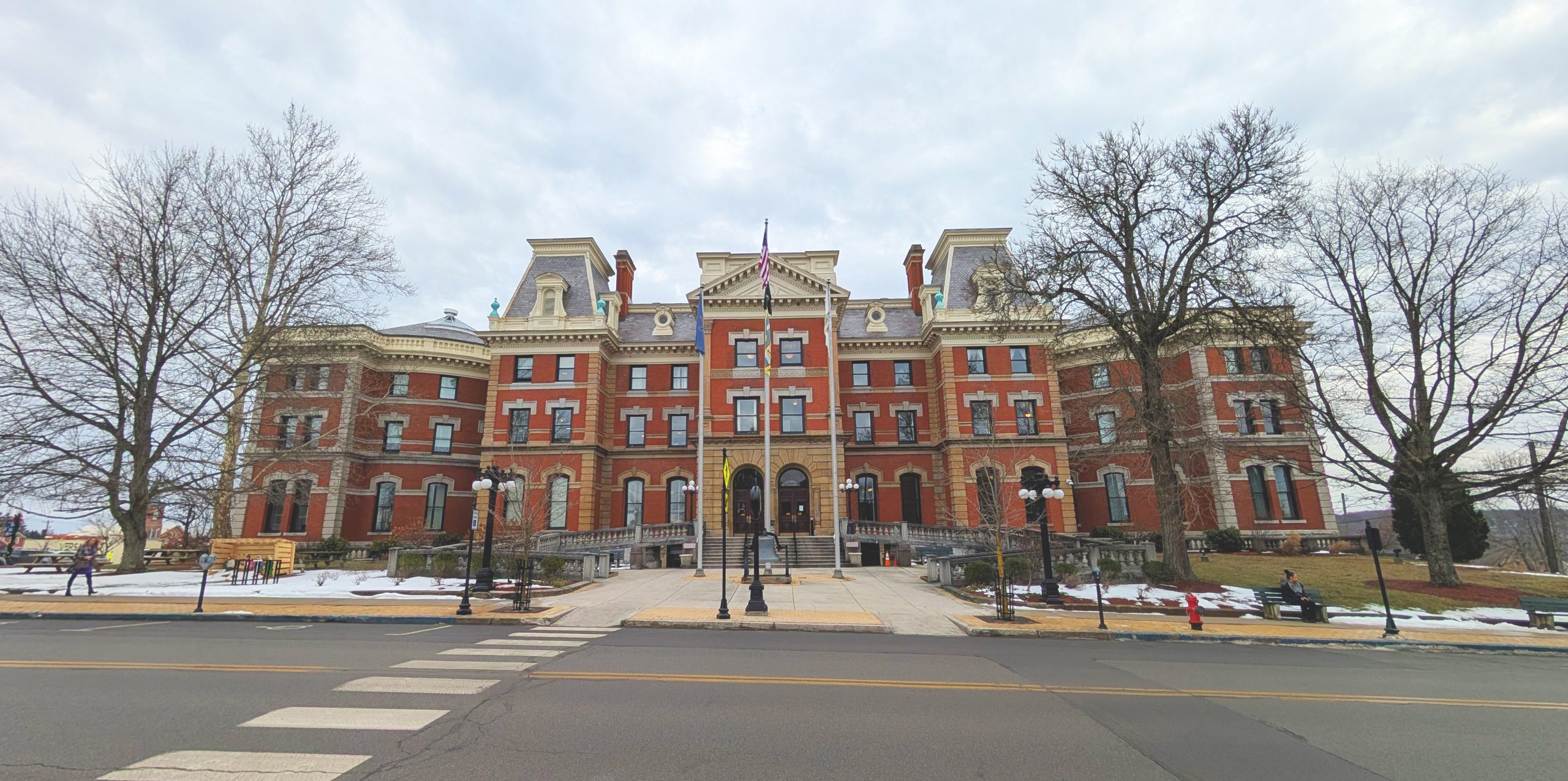
Standing across the street and looking up at the building, you immediately feel that same sense of intention. The structure rises in balanced wings from a strong central entrance, the roofline crowned with classical details and dormers that give the whole façade a sense of height and authority. The deep red brick contrasts with pale stone trim, creating a layered look that keeps your eye moving across the building.
The mansard roof and projecting center section give the courthouse a distinctive profile—one that would have looked just as impressive to someone approaching by horse and carriage in the 1880s as it does to someone walking up the street today.
This was not designed to disappear into the background.
Courthouses rarely are.
They occupy a special place in American architecture because they represent something bigger than the individual functions happening inside them. Marriage licenses are issued there. Property is recorded there. Trials are held there. Elections are administered there. The quiet machinery of local government—most of the things that actually shape daily life—passes through these halls.
Because of that, earlier generations believed these buildings deserved weight and dignity.
And you can see that belief in the details.
The broad steps that lift visitors above the street before they enter. The symmetry that gives the building visual stability. The ornamental stonework that reminds you this wasn’t designed by a spreadsheet—it was drawn by an architect who expected people to stand outside and admire it.
It is civic architecture with a little pride in it.
That pride matters more than we sometimes realize.
For most of American history, towns invested real effort in their public buildings. City halls, courthouses, libraries, post offices—they were meant to be beautiful as well as functional. They were statements about the community itself.
We don’t always build that way anymore.
Efficiency tends to win. Budgets shrink. Architecture gets simplified until civic buildings start looking like office parks with flags out front.
Which is why it’s such a pleasure to stumble across structures like this one.
Standing on the street in front of the courthouse, you can still feel a little of that older philosophy. The building isn’t flashy. It isn’t trying to impress tourists. But it carries the quiet confidence of something built to last.
And for someone who grew up around Indiana’s limestone giants, that is a welcome discovery.
Pennsylvania, it turns out, is doing just fine.