Name’s Philip Randolph Wright.
Mister Wright if we are doing business.
And before anybody asks me what’s wrong with the labor movement these days, let me save you the trouble — it forgot what it was built for.
See, a labor movement ain’t supposed to look like a crab bucket.
But that’s what I see most mornings.
One crew mad at another crew.
Old trades glaring at new trades.
Union against non-union.
Public workers against private workers.
Skilled men against “unskilled” men — a word I’ve never respected much.
Everybody tugging at each other’s boots while the owners sit up on the dock watching the show.
Now that right there is not an accident.
That is strategy.
Owners have been doing that trick since the first man figured out he could make two hungry men fight over one loaf of bread instead of asking why the bakery had locked doors.
Divide the workers.
Label the workers.
Rank the workers.
Then let them argue among themselves while the gilded hand signs the checks and writes the rules.
I’ve seen it my whole life.
I saw it in factories.
Saw it in construction yards.
Saw it in uniform too, if we’re being honest.
Separate the slaves into manageable groups.
Once they stop looking up, the system runs smooth as polished brass.
Now the tragedy is this:
Labor used to know better.
The old timers understood something simple that we seem to have misplaced somewhere between pension negotiations and television arguments.
The labor movement was never built on wealth.
It was built to protect people from wealth.
That’s a sentence that makes some folks uncomfortable, but truth has that habit.
Because wealth — real wealth — has a strange sickness that comes with it sometimes.
It starts making numbers feel more important than people.
Ledgers start mattering more than lives.
A spreadsheet gets treated with more care than the man who turns the wrench that makes the spreadsheet possible.
That disease is old.
And labor was the medicine.
Not revenge.
Not envy.
Medicine.
The early labor men and women weren’t chasing riches.
They were chasing dignity.
They wanted a man to go home with his fingers still attached.
They wanted a woman to work a job without being worked to death.
They wanted a child in a classroom instead of a coal chute.
That’s what the movement was for.
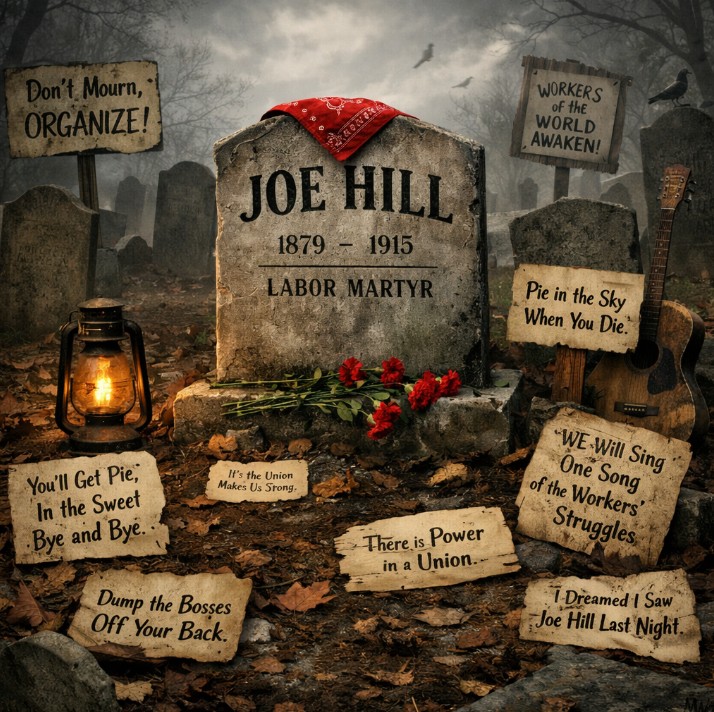
And a Swedish immigrant named Joe Hill understood that about as clearly as anybody who ever walked a picket line.
Joe Hill didn’t organize with speeches alone.
He used songs.
Because songs travel.
A speech stays in the hall.
A song rides the rails.
And that man could take a room full of tired workers, half of them speaking different languages, and give them something they all understood.
Solidarity.
Not envy.
Not status.
Solidarity.
Which is exactly why the powerful feared him.
You see, nothing scares wealth more than workers realizing they are the same people.
Not immigrants versus natives.
Not trades versus trades.
Not city versus country.
Just workers.
Once that idea gets loose, the whole house of cards starts wobbling.
So Joe Hill ended up before a firing squad in Utah in 1915.
Whether the charge was true or false has been argued for a hundred years.
But one thing is beyond argument.
They killed a man.
And they accidentally made a legend.
Because labor martyrs have a habit of doing that.
You can shoot a body.
You cannot shoot an idea.
Now somewhere along the way the modern labor movement started forgetting that.
Started thinking the mission was winning arguments instead of protecting people.
Started acting like politics was the job instead of solidarity.
And once that happened, the wedge slid right back in.
Workers fighting workers again.
Just the way the owners prefer it.
Now I’m an old man.
I’ve buried enough good men to know mourning has its place.
But there comes a point where mourning turns into an excuse.
And I’ve been hearing a song about Joe Hill for most of my life.
A good one too.
Mr. Woody Guthrie made sure of that.
But I’ve decided something lately.
I’m not going to mourn Joe Hill one more day.
Because the whole point of that story was never the death.
The point was the work.
Joe Hill ain’t dead.
Not as long as workers remember what the movement was built for.
Protect people.
Stand together.
And never forget who benefits when we start fighting each other.
Now check your measure, then check your motive.
Do the job right.
Do it the Wright way.
Well… now you know, Jack