The Part of Aquaponics Most Systems Get Wrong
One of the quiet misunderstandings in aquaponics hides in a single word: refugium.
Technically speaking, an aquaponic system is itself a refugium. It is a controlled ecological loop where fish waste is converted into plant nutrients. But that technical definition misses the way experienced aquarists use the term.
In the aquarium hobby, a refugium is something more specific. It is a separate set of tanks where water can be conditioned, stabilized, and biologically processed before it returns to the main system.
And this is exactly the step most aquaponic systems skip.
Instead, many systems copy the habits of beginner aquarists: they install a series of filters, perhaps add carbon, and assume the job is done. That approach can keep fish alive, but it does not necessarily prepare the water in a way that maximizes plant health or nutrient uptake.
If the goal is simply to raise fish and grow some plants, filtration is enough.
If the goal is robust plant production, the waste stream needs to be prepared.
Preparing the Nutrient Stream
Fish waste does not begin as ideal plant fertilizer.
It must pass through several biological and physical transformations before plants can efficiently absorb it. Aeration, microbial communities, temperature, and contact surfaces all influence this process.
This is where a refugium approach becomes valuable.
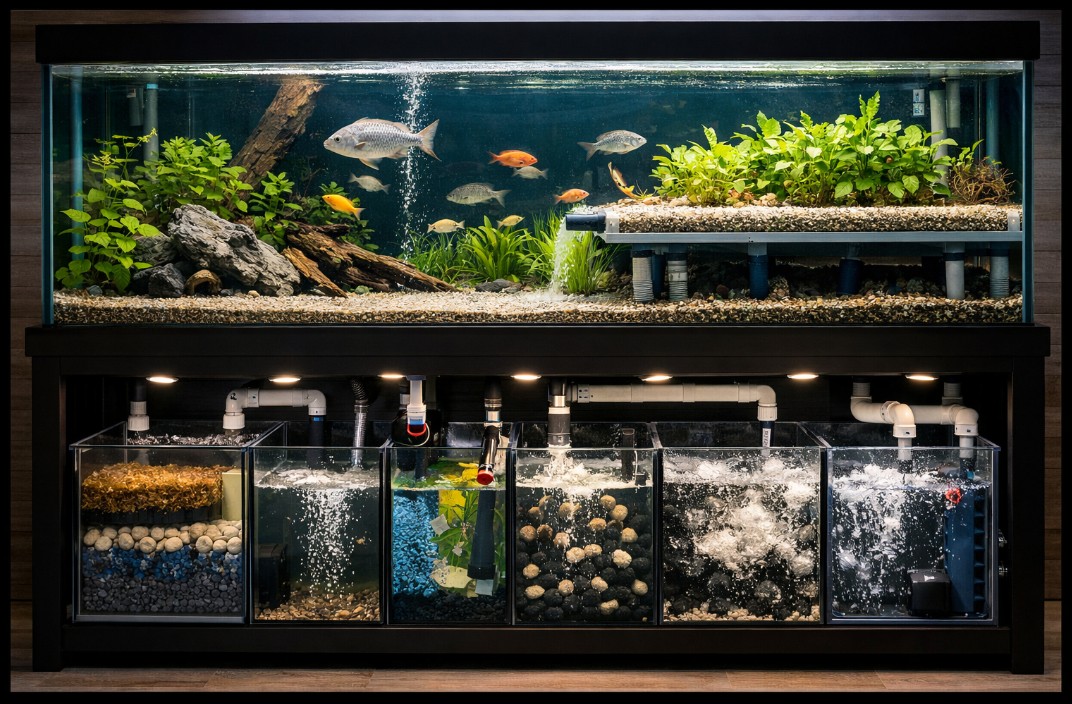
Rather than sending fish waste directly to plant beds, the water moves through a sequence of conditioning tanks that allow different biological processes to occur.
The idea is simple: treat the nutrient stream before the plants see it.
A Simple Four-Tank Refugium Concept
Every system will ultimately need its own adjustments based on crop type, fish species, and water chemistry. But a practical starting framework is a four-tank refugium sequence.
Tank One: Static Settlement
The first tank operates without aeration and without heating. It contains static media.
This stage allows heavier solids to settle and encourages the early stages of microbial breakdown. It functions primarily as a stabilization chamber where the raw waste stream begins to organize biologically.
Tank Two: Aerated Conditioning
The second tank introduces aeration.
Oxygen encourages aerobic microbial communities that continue breaking down organic waste and begin transforming nutrients into plant-available forms.
This stage increases biological activity and prepares the water for further processing.
Tank Three: Warm Biological Reactor
The third tank adds both aeration and heat, along with buoyant floating media.
Warm temperatures accelerate microbial metabolism. The floating media dramatically increases surface area for bacterial colonization. This stage acts as a biological reactor where much of the nutrient transformation occurs.
Tank Four: High-Energy Oxygenation
The fourth tank returns the water to a cooler state but introduces heavy aeration and vigorous media movement.
This stage performs two important functions:
- It saturates the water with oxygen.
- It ensures nutrients remain suspended and biologically active.
By the end of this stage the water is nutrient-rich, oxygenated, and biologically mature—ready for plant uptake.
Building the Microbial Community
At startup, it is beneficial to inoculate the refugium tanks with commercially available aquarium bacteria cultures.
Interestingly, using multiple brands—especially those produced in different regions—can help create a more diverse microbial ecosystem. Aquarium hobbyists have spent decades refining these bacterial blends, and aquaponics can benefit from that accumulated experience.
Over time the system will stabilize and develop its own microbial balance.
Testing and Monitoring
A simple but important addition is a testing tank or monitoring point both before and after the refugium sequence.
Tracking variables such as:
- dissolved oxygen
- pH
- temperature
- ammonia, nitrite, and nitrate
allows operators to observe how the conditioning process affects the water before it returns to the plant beds and eventually back to the fish.
Soil and the “Groundwater” Concept
One reason systems such as those used by Will Allen perform well is that soil remains present around plant roots. Soil contains microbial and mineral complexity that purely hydroponic systems often lack.
My own approach doubles down on this idea by allowing perennial plants within a system to interact with what I call groundwater aquaponics—a hybrid between hydroponic circulation and soil-mediated nutrient exchange.
But even without soil, the key insight remains:
The nutrient stream must be biologically prepared before plants receive it.
The Real Game in Aquaponics
Fish are relatively easy to raise.
Plants are relatively easy to grow.
The difficult part—the part that determines whether a system thrives or struggles—is nutrient preparation.
Once the waste stream is properly conditioned, the rest of the system becomes far simpler.
At that point, aquaponics stops being a balancing act between fish and plants and starts behaving like what it really is:
a controlled ecosystem designed to convert waste into food.
Aquaponics systems succeed or fail in the quiet spaces between tanks. Pumps, fish, and plants are the visible parts. The invisible part—the preparation of the nutrient stream—is where the real engineering lives.
Designing those biological transitions properly is not complicated, but it does require careful observation, thoughtful sequencing, and a willingness to treat the system as a living ecology rather than a plumbing diagram. The refugium approach is one way to bring that thinking into practical greenhouse systems, turning fish waste into something plants can actually use efficiently.
If you are planning or refining a greenhouse aquaponics installation and want help thinking through system design, nutrient preparation, or biological conditioning stages, Bright Meadow Group provides consulting on regenerative greenhouse systems, aquaponics architecture, and integrated ecological engineering.
Bright Meadow Group is based in Johnstown, Pennsylvania, and works with growers, builders, and organizations looking to design systems that are both productive and biologically resilient.
Sometimes the difference between a system that merely runs and one that truly performs is simply having someone step in, look at the whole loop, and ask the right questions. Bright Meadow Group exists to do exactly that.
Our full River Refugium Project (Massive ecological project based on aquaponics) whitepaper is available for download here.