The Dutch Colonial Revival and How One Geometry Conquered the Midwest
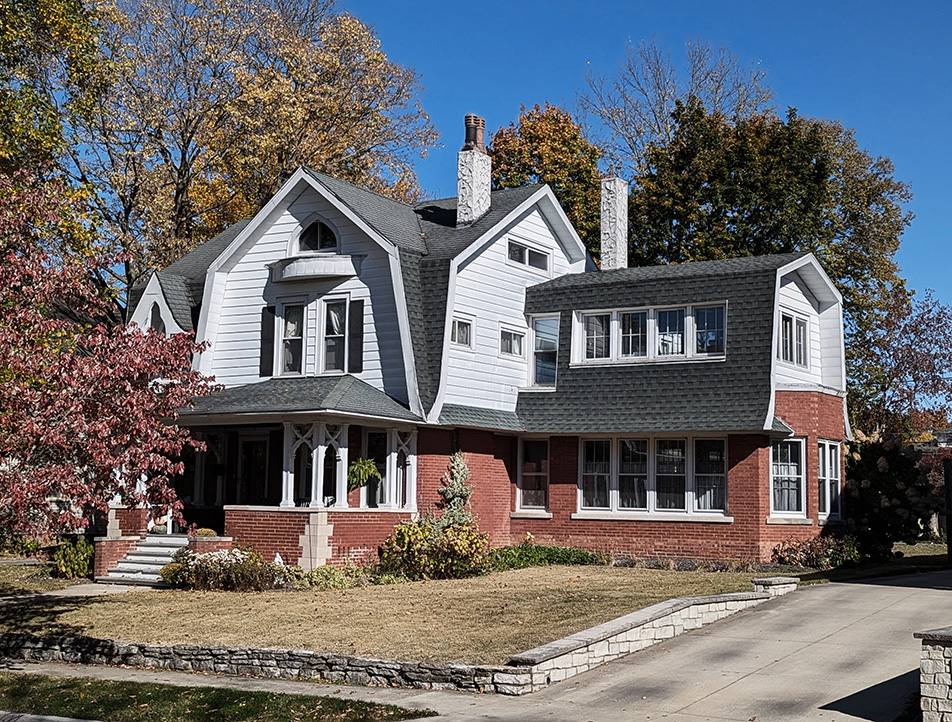
This photograph could have been taken on a dozen different streets. That is not a criticism — it is the point.
The house in front of you is a Dutch Colonial Revival, and sometime in the first two decades of the twentieth century, versions of it went up in nearly every mid-sized city and prosperous small town from Johnstown, Pennsylvania to the Missouri border. In the Ohio River valley. Along the rail lines threading through Indiana and Kentucky. On the better residential streets of a hundred county seats that no longer make anyone’s architectural tour.
The gambrel roof. The brick first floor. The clapboard above. The wraparound porch with its decorative brackets. The wide shed dormer punched across the front face. You have seen this house. You may have grown up in one. What you probably have not been told is why it works as well as it does — and why the roof, specifically, is a piece of genuinely clever engineering dressed up as a style choice.
What It Is
The Dutch Colonial Revival arrived as a named type in 1907, when architect Aymar Embury II presented the gambrel-roofed house in a Garden City competition. The following year he published a defining article in International Studio, and by 1913 his book The Dutch Colonial House had given the form a name, a history, and a blueprint that builders could follow anywhere.
What followed was a minor flood. Sears offered gambrel-roofed kit homes through its catalog. Aladdin called theirs “The Lancaster” and described it as “one of the most truly artistic” designs available. By the late 1910s, pattern books circulating through the Midwest were thick with variations. A builder in Cincinnati or Evansville or Wheeling could order the plans, source the brick locally, and have a Dutch Colonial standing inside a year.
This particular example belongs to the early wave — probably 1905 to 1915. The evidence is in the details that haven’t been scrubbed away yet. The Gothic-arched window in the front gable dormer, the pointed tracery flanking it, the cross-hatched decorative brackets on the porch columns — those are Queen Anne holdovers, Victorian ornament applied to a form that was already moving past Victorian complexity. Dutch Colonial homes from this era commonly exhibit Queen Anne characteristics; by the 1920s the style had simplified and the sentiment had passed. This house sits right at the seam.
How It Works
The gambrel roof solves a problem that every builder and every family understood without needing to name it: how do you get a full second floor — real ceiling height, real room volume, real livable space — without building what looks like a tall, boxy two-story house?
A standard gable roof rises to a single ridge. The usable floor area on the upper story gets eaten by the slope from both sides. The further from the ridge you get, the lower the ceiling drops, until whole sections of the floor become unusable crawl space. You end up with a generous footprint on paper and cramped, slanted rooms in practice.
The gambrel breaks that slope into two planes. A steep lower section rises almost vertically from the eave — fast enough that it functions structurally more like a wall than a roof. Then a shallower upper section carries the remaining rise to the ridge at a gentler angle. The inflection point between those two slopes is where all the space is recovered. The second floor gains full standing height across nearly the entire footprint of the house.
The wide shed dormer across the front face completes the system. It is not decorative. It is the mechanism that delivers daylight and cross-ventilation into what would otherwise be the darkest reach of the upper floor. Together, the gambrel geometry and the shed dormer turn what reads from the street as a roof into what functions inside as a full story.
The gap between apparent size and actual size is not a side effect. It is the entire value proposition. These houses consistently contained more usable square footage than they appeared to from any exterior view, which made them genuinely attractive to growing families who wanted space without the visual bulk — or the tax implications — of a tall two-story box. In some jurisdictions the tucked-under second floor counted differently than a full story for assessment purposes. The gambrel was practical all the way down.
The brick-to-clapboard transition at the roofline break is doing two jobs simultaneously. Brick at grade handles moisture, frost heave, and impact — the threats that accumulate at the base of any structure over decades. Clapboard above keeps the upper mass light, both visually and structurally, and allows the gambrel to read as a roof rather than as a second story. The eye is guided toward the right interpretation. The interior is under no such obligation.
The Story
The Ohio River valley and the broader Midwest adopted the Dutch Colonial Revival for reasons that had nothing to do with Dutch heritage and everything to do with practical calculation. The region was building fast — Purdue towns, river towns, rail towns, county seats that needed respectable middle-class housing stock quickly and affordably. The gambrel form delivered exactly that.
Catalog architecture made it possible at scale. When Sears published its Book of Modern Homes and Aladdin shipped pre-cut lumber kits by rail, the same design could go up in Lafayette and Louisville and Steubenville within the same construction season. Local builders adapted proportions, material, and ornament to what was available and affordable nearby. The red brick first floor on this example reflects regional material preference and supply — brick was cheap and plentiful in much of the Ohio valley, and it signaled permanence in a way that clapboard alone did not.
The two chimneys visible from the street place this house in a transitional heating moment. Coal furnaces and early forced-air systems were becoming standard, but chimneys were still expected — functionally for backup heat and aesthetically because a house without them still read as unfinished to an eye trained on Victorian domesticity. These chimneys are real, but they are also declarations: that this household was permanent, established, and not cutting corners.
What It Says Now
The house is intact. Brick clean, clapboard holding, porch upright — which last point matters more than it sounds, since the porch is almost always the first element to go on houses of this vintage when maintenance slips.
What it says now is what it said when it was new: someone made a thoroughly practical decision and dressed it up just enough to look like a style choice. They wanted space. The gambrel gave it to them without making the house look like it was trying too hard. They wanted some ornament. The Gothic dormer details and the bracketed porch columns gave them that without the full expense of a Queen Anne.
There are thousands of these houses still standing between the Alleghenies and the Mississippi. Most people drive past them without a second thought. That, too, was part of the design — to fit in, to look like they belong, to make the neighborhood feel continuous and settled.
They do belong. They just happen to be bigger on the inside than they look.