The City of Johnstown’s draft Comprehensive Plan, Forging the Future, landed in February. I’m new here — three blocks outside the city line, close enough to Roxbury to walk it. Treat what follows as an outsider’s read, with whatever weight that earns.
The plan is honest. That deserves saying first. It names what people who live here already know. The rental registry where as few as one in four properties are enrolled. The third of owner-occupied homes whose owners are over 65 and one tragedy away from becoming rentals. The 13% of jobs in the city held by people who actually live here. It looks at the population pyramid and says out loud that 25-to-34-year-olds are leaving faster than any other group, and women are leaving faster than men. It tells the truth about the income picture — a city median of $34,784 against a state median more than twice that. None of those are comfortable facts. The plan puts them on the page anyway.
Where the plan fails is the next move.
Diagnostic work is the easy part. Anyone with a spreadsheet and an honest eye can describe the problem. The hard part is committing to a mechanism that will fix it, with a number attached and a date. The plan doesn’t do that. It says “near-term” and “immediate” without saying how many or how much. It says “utilize conservatorship” without saying how many petitions a year. It says “strengthen code enforcement” without saying how many inspectors or what they cost.
That gap matters because the legal tools already exist. Pennsylvania’s Act 135 of 2008 lets a court appoint a conservator to take control of a blighted property, do the rehab, and recover costs. The Johnstown Redevelopment Authority can file today. The Urban Redevelopment Law lets the JRA take certified blighted property by eminent domain with just compensation. None of this needs Harrisburg’s permission or new legislation. It needs a city government that has decided the absentee landlord game is over.
So here is the teeth the plan needs.
Landlords. A public threshold. Tax-delinquent for two years AND code-violated AND vacant equals automatic Land Bank acquisition pipeline. No exceptions, no negotiated extensions, no shell-company shuffles. Twenty Act 135 petitions a year, minimum. The shell-company-to-shell-company sales the plan acknowledges happen aren’t a quirk. They’re the business model. Break the model.
Police as a feature, not a surveillance system. Visible. Uniformed. Marked. Civic pride wears the badge on the sleeve, not a wire under the shirt. The plan praises resident satisfaction with emergency services and walks past the question of presence. Plainclothes work and unmarked cars have their use in a city the size of Pittsburgh. In a city of 18,000 with a perception problem, what you want is the opposite — officers people recognize, on streets where their absence is the whole problem. A heavier state police footprint in the area has been on local politicians’ radar for a while. Wherever it lands, the 56/219 exchange is the natural site. It serves the highway traffic the state police actually patrol, sits within reach of the city without dropping a barracks into a neighborhood, and shares a corner with the roundabout that nobody can quite figure out how to use. Presence supports tourism the same way clean streets do. It makes the place feel like somewhere people are paying attention.
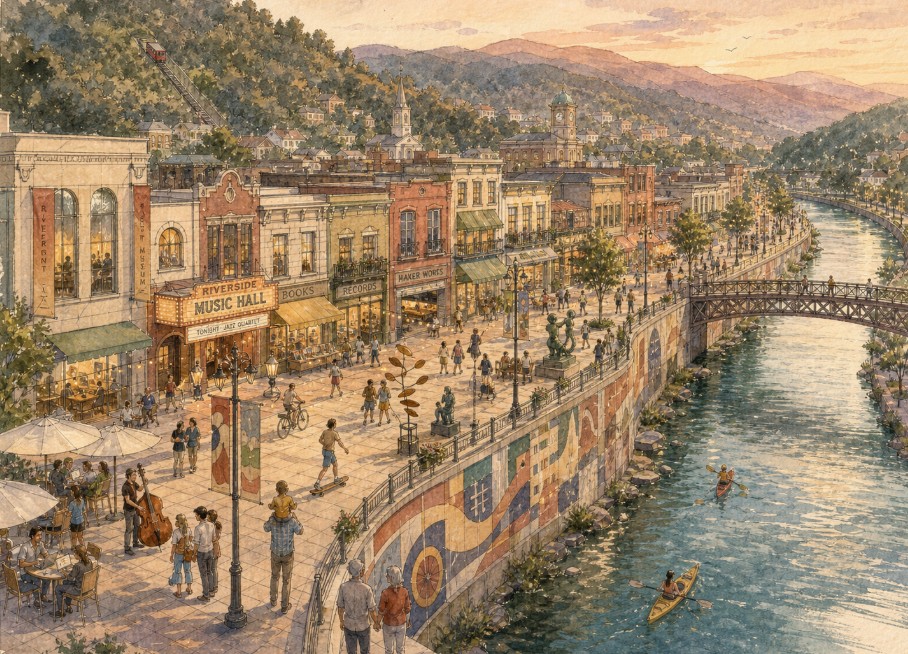
The rivers. The Army Corps’ floodwalls aren’t going anywhere. Thirty years of policy and a few billion dollars say so. Stop pretending otherwise. Look at Paris instead. The Seine runs through the city walled and channeled, and the city built directly to the wall — cafes, bookshops, galleries, restaurants, apartments above. The quays are paved. They are crowded. They are one of the most photographed waterfronts on earth, and not a single inch of it is “natural.” It works because the city decided the wall was the front porch, not the back fence. Johnstown can do the same. Build to the wall. Pave the top. Call it a promenade and treat it like one — cafes spilling onto the walk, vendors, lighting, benches, a continuous walkable spine from one end of the city to the other. Where the levee ends and the river runs natural, beautify hard: trail, trees, access, light. Treat the floodwall as the asset it is.
The region. Pennsylvania’s Inter-municipal Cooperation Act has been on the books since 1996. Westmont, Southmont, Upper Yoder, Stonycreek, Ferndale — the working tax base lives in these townships and spends its money in Johnstown. The plan names the Cambria County Planning Commission as a partner ten different ways and never proposes a formal compact with the neighbors. That’s the asymmetry that has to break. The fix is straightforward and belongs in the plan as a published, named invitation. List the neighboring municipalities. List the points of contact. Invite formal cooperative agreements under Act 177 for shared services, joint planning, revenue sharing where it makes sense. Make the invitation public so the silence on the other end is also public.
Bandwidth. A destination economy isn’t just weekend visitors. It’s remote workers, specialized industry, small operators who can run their work from anywhere — provided “anywhere” has reception. The mountains here are unforgiving on signal. The first infrastructure investment that makes every other goal in this plan easier is the one the plan doesn’t mention: the best 5G coverage these hills can support, the densest fiber the budget will buy, and free public wifi blanketing downtown and every neighborhood corridor. Public wifi alone moves the wealth needle in a community where 27% of households don’t own a vehicle and gig work is everyone’s second job. The plan should commit to this in writing. Connection is wealth. Wealth is connection.
Vision. Call it the Austin of Appalachia. The label will work or it won’t, but the model is the point. Austin’s pre-boom run was built on three things — a music scene the city actively protected, commercial real estate cheap enough that small operators could take risks, and a clear municipal commitment to culture as the asset. Johnstown has the bones. The arts community is here. The Bottle Works is here. The murals are here. The heritage is here. It’s quieter than it should be because the city has not yet decided to make it the loudest thing in the room.
I just moved from a city that spent twenty years cycling through gentrification. Every neighborhood that found its identity found it through the artists who showed up first. They cleaned up blocks the city had given up on. They drew the foot traffic that brought the cafes that brought the rents that — yes — eventually pushed them out. That last step is the one Johnstown can avoid by writing the protections in now. Land trusts. Renter equity. Deed-restricted live-work studios. The plan mentions these in a single paragraph. They should be the first chapter.
The diagnostic in this plan is clear. The vision underneath it is reasonable. What it lacks is the willingness to put a number on the thing and pick a fight with the people benefiting from the status quo. That is the only part of a plan that actually changes anything.
If you have opinions on the plan…send them to jrutledge@johnstownpa.gov
John Rutledge
Community and Economic Development Director
City of Johnstown
401 Main Street
Johnstown, PA 15901
That’s not me. That is Johnstown’s point of contact for the plan.