Water scarcity is the bugaboo of the next century, and it is a lie.
Two-thirds of this planet’s surface is water. Beneath the surface, aquifers sit in stone in volumes that dwarf every river and lake combined — fresh, brackish, saline, hot, cold, pressurized, ancient. Hydrogen is the most abundant element in the universe. Oxygen is the third. The molecule that frightens our forecasters is built from the two cheapest building blocks in existence, and we already know how to break it apart and put it back together with electricity, mechanical pressure, gravity, heat, membranes, and the patient bias of a salt gradient.
We are not running out of water. We are running out of the imagination to use it correctly.
That is a different and much smaller problem.
—
Drop the scarcity frame for a second. Look at what water actually is.
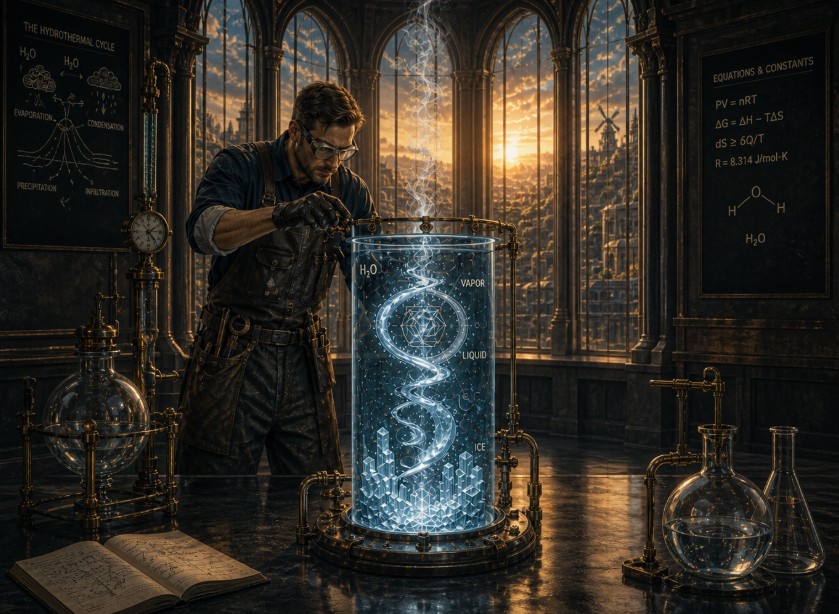
It is the only common substance on Earth that exists, at ordinary planetary conditions, in all three classical phases — solid, liquid, vapor — and slips between them at temperatures and pressures that human bodies, human machines, and human industries can tolerate. Boil a kettle. Freeze a tray. Watch a cloud. Water rehearses its identities in front of you every day and never loses itself.
Then push it harder. At 374°C and 22.1 MPa, water crosses its critical point. Past that line, the distinction between liquid and gas dissolves. What you have is supercritical water — a dense, reactive medium that behaves like neither phase and dissolves things ordinary water refuses to touch, including organics that liquid water normally rejects. The hydrogen bonds break down. The dielectric constant collapses. The solvent rules invert.
This is not a curiosity. This is the doorway.
Because water is the liminal material. The between. The bardo of states. And not just its own states — every other material we know how to manipulate changes state through water or because of water. Metals are smelted in the presence of steam. Concrete cures by hydration. Cells live and die by osmotic pressure. Rocks weather by hydrolysis. Carbon cycles through the planet on its back. The chemistry we call “life” is a set of reactions that only happen because a bent triatomic molecule with an outsized dipole is willing to play translator between everything else.
Water is not the resource. Water is the operating system.
—
This is where hydrothermal carbonization and hydrothermal liquefaction stop being lab curiosities and start being the punchline.
HTC takes wet biomass — sewage sludge, manure, food waste, brewery spent grain, agricultural slop, anything organic and dripping — and holds it in liquid water at roughly 180 to 280°C under enough pressure to keep the water from boiling off. What comes out is hydrochar: a stable, carbon-dense solid. The water you would have spent fossil energy evaporating is instead doing the work. It is the pressure vessel. It is the solvent. It is the reaction stage. It is the chaperone walking biology back to mineral.
HTL pushes harder. Push the same kind of feedstocks into the 250-to-374°C range, several to tens of megapascals, and water stops being water in the polite sense. It becomes the supercritical or near-supercritical reactor that cracks long biological molecules into shorter ones. What comes out is biocrude — a hydrocarbon liquid you can refine into fuel — alongside aqueous nutrient streams, gases, and solids you can recover separately. Algae, animal waste, fats, oils, greases, raw municipal sludge: all of it stops being garbage and starts being feedstock the moment water is recognized as the engine instead of the obstacle.
Read that without flinching. The thing we throw away because it is too wet to burn is exactly the thing that becomes valuable when water is allowed to be more than wet.
Drying wet waste to incinerate it is one of the great stupidities of twentieth-century thermal engineering. It is the industrial equivalent of pumping a flooded basement so you can build a fire on the floor. Hydrothermal processing inverts that logic. Keep the water. Use the water. Let the water be what it has always been: the medium in which matter changes costume.
—
So when someone tells you the next century’s wars will be fought over water, listen carefully to what they are actually saying.
They are saying: I cannot imagine a civilization that knows how to clean, move, recover, and transform its own water. They are saying: I assume the future is the present with shortages. They are saying: the only verbs I have for water are pump, drain, and hoard.
That is not a forecast. That is a confession.
The verbs we actually need are different. Phase. Pressurize. Crack. Carbonize. Liquefy. Recover. Recharge. Mediate. Translate. Carry.
Water is not valuable because it is scarce. The molecule is cosmically ordinary — H is everywhere, O is everywhere, and the universe is full of places where they meet. What is not ordinary is what the molecule does. Water is the answer to so many riddles in chemistry, biology, geology, and engineering precisely because it refuses to commit to one form. It carries heat. It carries salt. It carries nutrients. It carries waste. It carries memory of every basin it has touched. It dissolves what nothing else dissolves. It freezes upward. It expands when it should contract. It supports life because it breaks the rules that other small molecules obey.
The bardo. The between. The bard.
The substance that tells the rest of the periodic table what it is allowed to become.
—
The future is not in storing more water. The future is in understanding what state the water is in, what it is carrying, and what it can be persuaded to become.
Learn hydrothermal carbonization. Learn hydrothermal liquefaction. Learn supercritical water oxidation while you are at it. Learn what your wet waste stream actually is — feedstock, not failure. Learn that the molecule running through every river, every cloud, every cell, every reactor, every aquifer, every ocean is not a resource to be rationed.
It is the medium in which the next century will be built, melted, dissolved, recombined, and rebuilt again.
We are not running out of water.
We are running out of excuses for not knowing what it is.