The Hundred-Year Inheritance:
Why America’s Landfills Are the Next Material Frontier
The headlines about landfill capacity want to be a problem. They will be, if we let them. But before we accept that frame, we should look at what a landfill actually is.
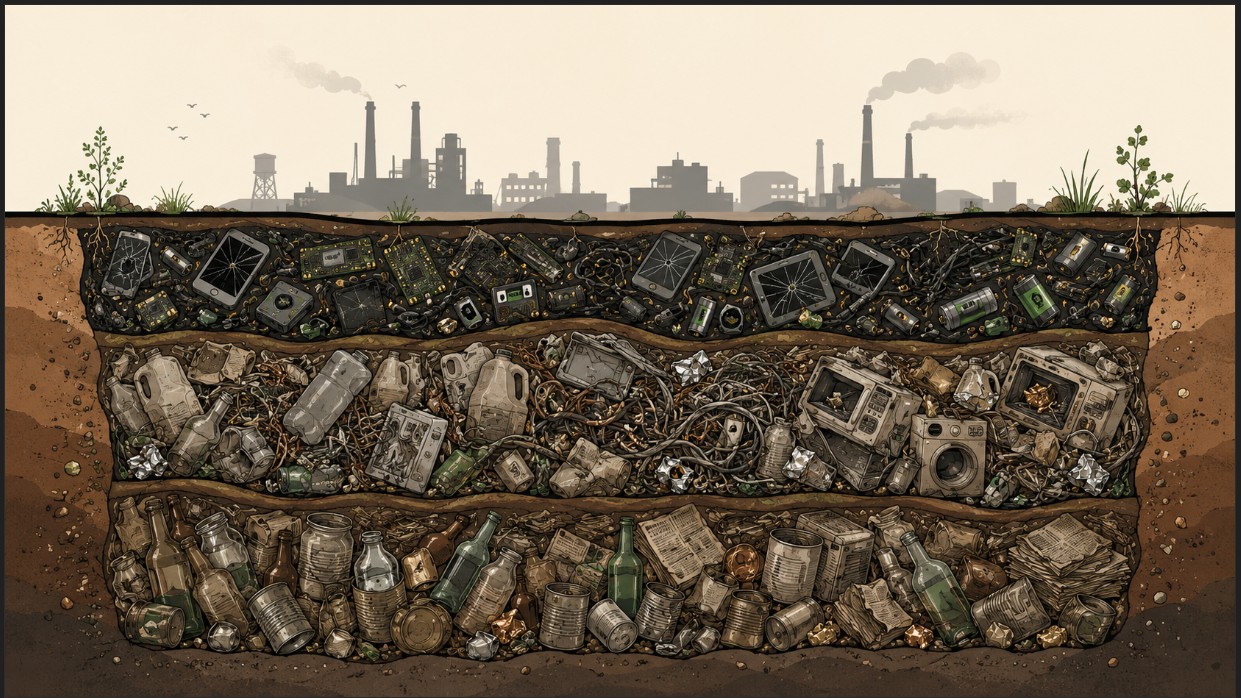
A landfill is a hundred years of consumption decisions, sorted by gravity and time, concentrated into a known location with surveyed boundaries and documented strata. It is the most thoroughly mapped ore body in any region it occupies. It contains aluminum at concentrations that would make any bauxite mine jealous. It contains copper, gold, palladium, lithium, and rare earths — most of them deposited in the last forty years as electronics began their slow migration from “useful” to “buried.” It contains hydrocarbons in a thousand forms, every one of them carbon that was once alive, processed, packaged, and tossed.
We have been told this is waste. It is not waste. It is inventory.
Observe
A LinkedIn post from Andrew Scott Joiner — formerly Obama White House, formerly UN, two decades in the waste-to-value sector — sent me to his current venture, Wastenaut (wastenaut.ai). The pitch is clean: “Every strategic waste decision requires the same thing: market understanding that takes months to assemble — if you can assemble it at all.” Their answer is a unified intelligence platform covering every waste facility in the United States, drawing from five hundred-plus data sources across all fifty states, with more than two billion dollars in projects already routed through their analysis.
Sit with that number for a moment. Two billion dollars in project value, supported by a platform whose entire reason for existing is that the underlying data was previously too fragmented to use. The market is already moving. Capital is already flowing. The only thing the industry was waiting for was a map.
Now the map exists. And what it shows is the scale of the inheritance.
The United States operates roughly 1,200 active municipal solid waste landfills. It sits on a comparable number of closed and legacy sites. Americans generate around 290 million tons of municipal solid waste per year, and have been doing so — at varying but generally rising rates — for decades. The cumulative tonnage in the ground is in the tens of billions. Every ton of it was bought, paid for, transported, and abandoned by an economy that, at the time, had no better idea what to do with it.
Inside that tonnage:
- Aluminum at recoverable concentrations several multiples higher than current bauxite ore grades.
- Copper deposits — wiring, motors, plumbing, electronics — that compare favorably with active commercial mines.
- Gold, silver, palladium, and platinum, particularly in post-1980 strata containing consumer electronics. A ton of cellphones holds roughly three hundred grams of gold; a ton of natural gold ore holds one to five.
- Decades of accumulated plastic, paper, textile, and food waste — every gram of it carbon that started as something alive.
The standard policy response to this is to permit new landfills, expand existing ones, and push curbside recycling rates a few points higher. This is the response of an organization that has not looked carefully at what it already owns.
Two facts change the analysis.
First, ore grades for industrial metals have been falling for decades. We are mining rock that contains less and less of what we want, using more and more energy to get it out. The infrastructure to access the landfill alternative is already in place — roads, rail, rights of way, settled land use. The material is pre-concentrated by a century of human sorting and a few decades of compaction. We did the hard part of the mining when we threw it away.
Second, the chemistry has caught up. Two processes that have been on the shelf since the early twentieth century are now ready for the work landfills require: hydrothermal carbonization (HTC) and hydrothermal liquefaction (HTL).
Design
HTC and HTL are old. Friedrich Bergius described the foundational chemistry in 1913. Both processes do something that cuts against industrial intuition: they process wet material under pressure, in water, at elevated but manageable temperatures. HTC operates around 180 to 250 degrees Celsius and produces a coal-like solid called hydrochar. HTL runs hotter, 250 to 374 degrees — that upper bound is the critical point of water, which matters — and produces a bio-crude oil that can be refined into liquid fuels.
The reason these processes sat largely unused for a century is not that they did not work. It is that we did not understand them well enough to design for them. We could see that biomass went in and useful product came out, but the reaction pathways — the actual atomic-level events happening inside the reactor — were a black box. Industrial chemistry, until recently, preferred dry-feed processes with well-characterized reactions. Anything wet was considered a problem to be solved by drying first, which made the energy economics terrible.
That picture has changed. Computational chemistry, in-situ spectroscopy, and modern catalyst science have turned the black box into something like a window. We now understand, in increasing detail, how cellulose breaks down, how lignin reorganizes, how plastics depolymerize, how nitrogen-containing materials behave under hydrothermal conditions. Every year of materials science research adds to the map.
This is the moment to apply that map to a landfill.
Intervene
A landfill reclamation operation has three integrated streams.
Metals recovery. Excavate, sort, and route ferrous, non-ferrous, and precious metals to existing smelter and refinery infrastructure. This is technologically mature. The question has only ever been whether the economics work, and falling ore grades plus rising metal prices have answered that question.
Hydrothermal processing of organics and mixed waste. Anything carbon-based that is not recovered as a metal — paper, plastics, textiles, food waste, yard waste, decades of mixed organic material — feeds an HTC or HTL reactor. The output is hydrochar, bio-crude, or both, depending on feedstock and process tuning. These are drop-in fuels and soil amendments. The water and pressure that make landfill mining messy by traditional standards are exactly the conditions hydrothermal processing wants. The wet feedstock is a feature, not a bug.
Residue management. What comes out the back end — ash, char fines, mineral residues — is small in volume relative to the input and predictable in composition. It either has industrial uses or can be re-deposited in a fraction of the original footprint, with the worst contaminants neutralized by the thermal process itself.
The result: the landfill is gone. The land is recovered. The material wealth that was buried is back in the economy. The methane that would have leaked for decades is captured or never forms. A new landfill does not need to be permitted, because the old one became a resource instead of a liability.
The Research Dividend
This is where the proposal becomes more than waste management.
A landfill reclamation operation that runs its full waste stream through hydrothermal processing — and documents what comes out — is a chemistry research instrument at industrial scale. No laboratory has the feedstock diversity of a 1970s landfill. No academic study has the sample size. Every batch run through HTC or HTL with rigorous input characterization and output analysis adds a data point to a library that does not currently exist: how does a half-century of mixed consumer chemistry actually behave under hydrothermal conditions? Which polymer blends produce which hydrocarbon distributions? How do early electronics — printed circuit boards, capacitors, wire insulation — break down? What unexpected products show up, and what does that tell us about reaction pathways we have not modeled yet?
The energy and material output pays for the operation. The data is the dividend. Every landfill we reclaim improves our ability to process the next one, and improves the underlying science of how to handle complex carbon-bearing materials in a world that will need to handle them well.
The Inventory Is Real
What Wastenaut has done, in building their platform, is prove the operational thesis: the waste economy is large enough, valuable enough, and complex enough to support sophisticated market intelligence as a business in its own right. People who deploy capital are paying real money to understand what is in those landfills, who owns it, what it flows to, and what it is worth.
The map is built. The chemistry is legible. The economics are turning. The land is already disturbed, the boundaries are already drawn, and the inventory is already concentrated.
We have spent a century burying our material inheritance. The only thing left to decide is whether we treat what we have buried as a problem to be contained or a resource to be worked.
Observe. Design. Intervene.